
From Fish Gills to Human Limits: Engineering Aquatic Respiration and Whale-Like Breath-Holding
How gills extract oxygen from water, why artificial versions fail for humans, and the vast genetic changes needed for marine-mammal endurance.
- Fish gills use layered filaments, lamellae, and countercurrent blood flow to extract up to 80-90% of dissolved oxygen from water.
- Humans cannot use artificial gills because water holds 200 times less oxygen than air, requiring impossible surface area and pumping power.
- Osmoregulation, CO2 removal, and physical fragility add further insurmountable barriers for any human gill system.
- Matching whale dive times would require massive increases in myoglobin, blood volume, bradycardia control, lung flexibility, and blubber.
- Such adaptations involve coordinated changes to thousands of genes and would take millions of years or far-future genetic engineering.
Anatomy and Structure of Fish Gills
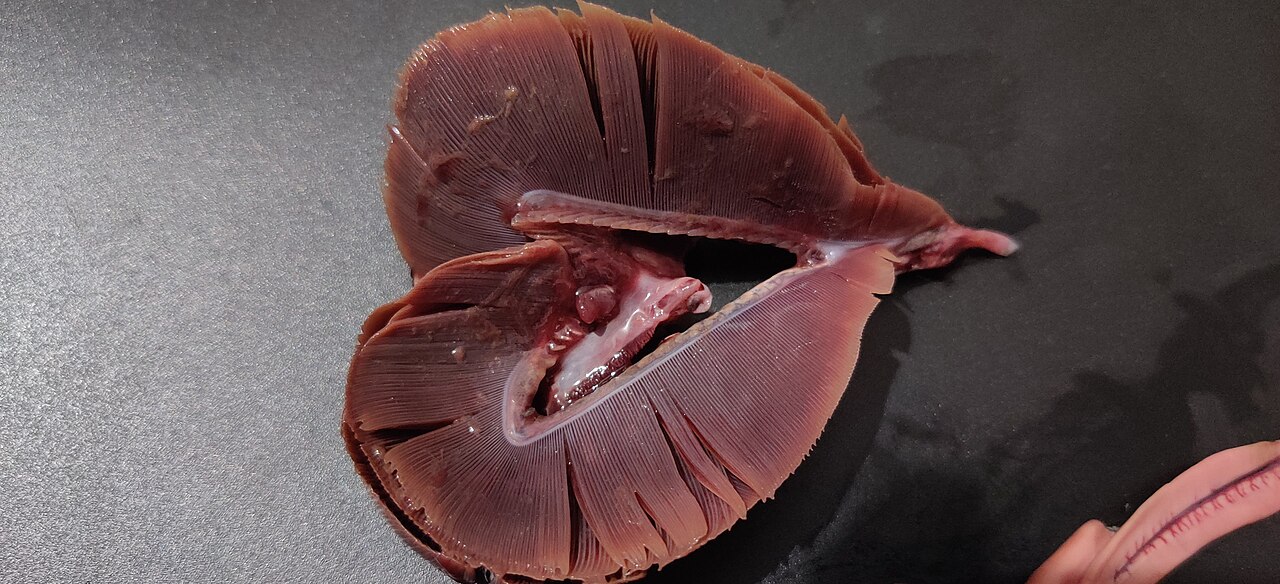
Fish gills sit on either side of the head, shielded by a bony operculum that opens and closes to control water exit. Beneath the operculum lie four to five gill arches per side, curved supports that hold the respiratory surfaces. Each arch carries rows of gill filaments, thin, feathery extensions packed with capillaries. The filaments themselves are lined with thousands of microscopic lamellae—flat, plate-like folds that multiply the exchange area dramatically.
This stacked arrangement turns a compact organ into an expansive interface. The lamellae alone can increase total surface area by orders of magnitude relative to body size, allowing efficient diffusion even when dissolved oxygen in water remains scarce.
Water Flow and Respiratory Mechanics in Fish
Most fish move water across their gills through a rhythmic pumping action. They open the mouth to draw water in, then close it while contracting muscles in the pharynx to push the water backward over the gill filaments before it exits through the opercular openings on each side of the head. This creates a steady, one-way current that keeps oxygenated water moving continuously past the exchange surfaces.
Fast swimmers such as tuna and certain sharks bypass muscular pumping entirely with ram ventilation. By swimming forward with the mouth held open, they force a stream of water directly over the gills, relying on forward motion alone to maintain the flow needed for gas exchange.
Countercurrent Exchange and Gas Transfer Efficiency
In fish gills, water is pumped over the lamellae in one direction while blood flows through the underlying capillaries in the opposite direction. This countercurrent arrangement keeps the oxygen concentration in the water slightly higher than in the blood at every point along the exchange surface, sustaining diffusion far longer than a concurrent flow would allow.
As a result, oxygen extraction reaches 80–90 percent of the dissolved oxygen present in the water. Simultaneously, carbon dioxide moves from the blood—where its partial pressure is higher—into the water, which carries it away, so both gases are exchanged efficiently across the same thin membranes without requiring separate mechanisms.
Oxygen Concentration Differences Between Air and Water
Atmospheric air holds oxygen at roughly 21 percent by volume, a dense and readily accessible supply. Water, by contrast, dissolves oxygen at only 5 to 10 parts per million by weight—equivalent to 0.0005 to 0.001 percent—making the medium thousands of times leaner in oxygen than air.
A resting human consumes about 250 milliliters of oxygen each minute. Extracting that quantity from water at typical dissolved concentrations would require processing tens of liters of water per minute across an exchange surface far larger than any fish gill relative to body size, on the order of a tennis court’s area if conventional diffusion limits were to be met.
Engineering and Physiological Barriers to Artificial Human Gills
Humans lack any equivalent to the muscular pharynx and operculum that fish use to pump water continuously over their gill filaments. Without built-in pumps, an artificial gill system would require an external mechanical pump drawing significant energy to move the massive volumes of water needed, and the human heart is engineered only for blood circulation, not for forcing liters of water across thin exchange surfaces each minute.
Osmotic and salinity challenges compound the problem. Human tissues are not adapted to direct water contact; immersion in saltwater would draw fluid from cells while freshwater would flood them, quickly disrupting electrolyte balance that kidneys alone cannot correct when exchange membranes are exposed on this scale.
CO2 flushing adds further logistics. The enormous water throughput required to extract even resting oxygen levels (roughly 250 ml per minute) would simultaneously demand rapid, continuous removal of metabolic carbon dioxide to prevent local pH drops and blood acidosis, a process far more complex than simple diffusion across fragile lamellae.
Finally, any external gill surface would remain extremely fragile. Fish protect their gill arches inside the operculum; an artificial human version would be vulnerable to mechanical damage, biofouling by debris and microorganisms, and infection, with no natural barrier to shield the delicate, high-surface-area membranes essential for gas exchange.
Oxygen Storage Upgrades Needed to Match Whales
Matching a whale's breath-hold capacity would demand major upgrades to oxygen storage systems. Myoglobin concentrations in skeletal and cardiac muscle would need to rise 10- to 30-fold above typical human levels, creating substantial reserves right where oxygen is consumed during dives.
Blood volume would have to increase relative to body size while hemoglobin density in red blood cells climbs, requiring expanded red-cell production and larger vessels and heart to manage the added load. Lung capacity would also need enlargement to take in a bigger initial air volume, coupled with flexible rib structures that permit safe lung collapse at depth so nitrogen stays out of the bloodstream and avoids decompression injury.
Metabolic and Circulatory Adaptations for Prolonged Dives
Whales rely on several tightly coordinated metabolic and circulatory changes to stretch limited oxygen stores across long dives. The dive response triggers profound bradycardia, dropping heart rate from a typical 60–90 beats per minute at the surface to as low as 4–10 beats per minute underwater. This single adjustment sharply cuts cardiac oxygen demand while the animal continues to function.
At the same time, peripheral vasoconstriction redirects blood away from skeletal muscle, skin, and digestive organs and toward the brain and heart. Non-critical tissues receive minimal flow, preserving oxygen for the organs that cannot tolerate even brief hypoxia.
- Lactate tolerance allows muscles to continue working anaerobically once local oxygen is exhausted; whales accumulate higher concentrations of lactic acid than terrestrial mammals and clear it rapidly upon surfacing.
- A modestly lowered whole-body metabolic rate further reduces oxygen consumption, achieved through reduced organ activity and behavioral quiescence during descent.
Pressure, Temperature, and Systemic Overhaul Challenges
Whales manage deep dives through flexible rib cages that permit controlled lung collapse, keeping air in the upper respiratory tract rather than letting it compress into the bloodstream where nitrogen could form bubbles on ascent. Replicating this in humans would demand major skeletal remodeling to avoid barotrauma under pressure. Thick blubber layers provide the insulation marine mammals rely on in cold water; humans would need comparable fat deposits that would reshape body composition and surface anatomy. These physical shifts alone tie into far broader changes.
Achieving whale-like breath-hold endurance would require coordinated overhaul across oxygen storage, circulation, metabolism, and neural control systems. The notes indicate this scale involves manipulating hundreds to thousands of genes and their regulatory pathways, far beyond single-trait edits, with risks of unintended effects that current genetic engineering cannot yet navigate safely.
