
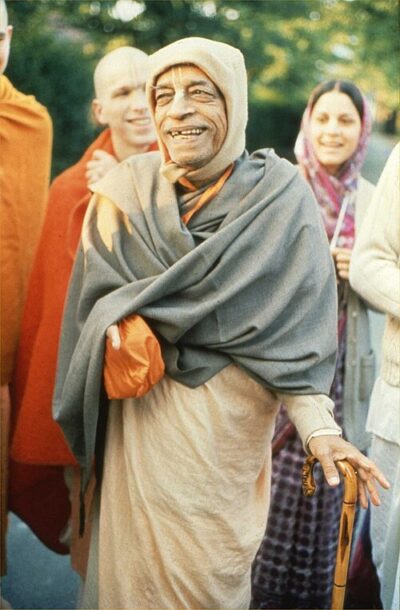
A. C. Bhaktivedanta Swami Prabhupada
A. C. Bhaktivedanta Swami Prabhupada was an Indian spiritual teacher and founder of the ISKCON. Born September 1, 1896, in Kolkata. Died November 14, 1977, in Vrindavan. Known for Bhagavad-gītā As It Is. Educated at Scottish Church College.
Facts
17 facts · 2 confirmed by two sources · 3 cited · 12 from one source
Where this comes from
Papalocal keeps its own record. It started from these sources; what each one said is kept here as it was copied, so a change on their side never changes this page by itself. Tap one to read its version.
What Wikidata says · copied November 16, 2026 · revision 2566572505
- Described as
- Indian spiritual teacher and founder of the ISKCON
- Other names
- Abhay Charan De, Abhay Charanaravinda Bhaktivedanta Swami, Srila Prabhupada
- Born
- September 1, 1896 · 2 references
- Died
- November 14, 1977 · 2 references
- Born in
- Kolkata
- Died in
- Vrindavan
- Buried in
- ISKCON Temple, Vrindavan
- Citizen of
- India (1950–); British Raj (–1947); Dominion of India (1947–1950)
- Occupation
- writer; translator; philosopher · 1 reference
- Education
- Scottish Church College
- Known for
- Bhagavad-gītā As It Is
- Field
- philosophy; culture of India · 1 reference
- Religion
- Hinduism · 1 reference
- Website
- https://www.prabhupada.net (2014–) · 1 reference
- Wikipedias with a page
- 76
Wikidata item Q234898 (wikidata.org/wiki/Q234898), public domain (CC0). Copied November 16, 2026.
What Wikipedia says · copied November 16, 2026 · revision 1385654159
Abhay Charanaravinda Bhaktivedanta Swami Prabhupada (1 September 1896 – 14 November 1977) was an Indian spiritual, philosophical, and religious teacher who spread the Hare Krishna mantra and the teachings of "Krishna consciousness" to the world. Born as Abhay Charan De and later legally named Abhay Charanaravinda Bhaktivedanta Swami, he is often referred to as "Bhaktivedanta Swami", "Srila Prabhupada", or simply "Prabhupada".
To carry out an order received in his youth from his spiritual teacher to spread "Krishna consciousness" in English, he journeyed from Kolkata to New York City in 1965 at the age of 69, on a cargo ship with little more than a few trunks of books. He knew no one in America, but he chanted Hare Krishna in a park in New York City, gave classes, and in 1966, with the help of some early students, established the International Society for Krishna Consciousness (ISKCON), which now has centers around the world.
He taught a path in which one aims at realizing oneself to be an eternal spiritual being, distinct from one's temporary material body, and seeks to revive one's dormant relationship with the supreme living being, known by the Sanskrit name Krishna. One does this through various practices, especially through hearing about Krishna from standard texts, chanting mantras consisting of names of Krishna, and adopting a life of devotional service to Krishna. As part of these practices, Prabhupada required that his initiated students strictly refrain from non-vegetarian food (such as meat, fish, or eggs), gambling, intoxicants (including coffee, tea, or cigarettes), and extramarital sex. In contrast to earlier Indian teachers who promoted the idea of an impersonal ultimate truth in the West, he taught that the Absolute is ultimately personal.
He held that the duty of a guru was to convey intact the message of Krishna as found in core spiritual texts such as the Bhagavad Gita. To this end, he wrote and published a translation and commentary called Bhagavad-Gītā As It Is. He also wrote and published translations and commentaries for texts celebrated in India but hardly known elsewhere, such as the Srimad-Bhagavatam (Bhagavata Purana) and the Chaitanya Charitamrita, thereby making these texts accessible in English for the first time. In all, he wrote more than eighty books.
In the late 1970s and the 1980s, ISKCON came to be labelled a destructive cult by critics in America and some European countries. Although scholars and courts rejected claims of cultic brainwashing and recognized ISKCON as representing an authentic branch of Hinduism, the "cult" label and image have persisted in some places. Some of Prabhupada's views or statements have been perceived as racist towards Black people, discriminatory against lower castes, or misogynistic. Decades after his death, Prabhupada's teachings and the Society he established continue to be influential, with some scholars and Indian political leaders calling him one of the most successful propagators of Hinduism abroad.
- Born, in its opening lines
- September 1, 1896
- Died, in its opening lines
- November 14, 1977
From the Wikipedia article “A. C. Bhaktivedanta Swami Prabhupada” (en.wikipedia.org/wiki/A._C._Bhaktivedanta_Swami_Prabhupada), by its contributors, under CC BY-SA 4.0 (creativecommons.org/licenses/by-sa/4.0/). Copied November 16, 2026; not changed.
Confirmed Two sources agree. Cited One source, and it names where it got it. One source One source, without a reference of its own. Sources disagree The sources disagree. We show the best-supported value and keep theirs below.
