
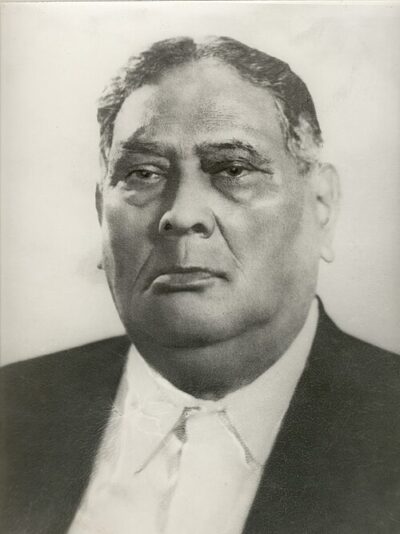
A.K. Fazlul Huq
A.K. Fazlul Huq was a Bengali-Pakistani statesman and jurist. Born October 26, 1873, in Barishal. Died April 27, 1962, in Dhaka. Positions held include Prime Minister of Bengal (1937–1943) and Federal Minister for Interior (1955–1956). Educated at University of Calcutta and Barisal Zilla School.
Facts
14 facts · 2 confirmed by two sources · 0 cited · 12 from one source
Where this comes from
Papalocal keeps its own record. It started from these sources; what each one said is kept here as it was copied, so a change on their side never changes this page by itself. Tap one to read its version.
What Wikidata says · copied November 17, 2026 · revision 2562726518
- Described as
- Bengali-Pakistani statesman and jurist (1873–1962)
- Other names
- A. K. Fazlul Huq, Abul Kasem Fazlul Huq, Fazul Haq
- Born
- October 26, 1873 · 1 reference
- Died
- April 27, 1962 · 1 reference
- Born in
- Barishal
- Died in
- Dhaka
- Buried in
- Mausoleum of Three Leaders · 1 reference
- Citizen of
- Pakistan; British Raj
- Occupation
- politician
- Positions held
- Prime Minister of Bengal (1937–1943); Federal Minister for Interior (1955–1956) · 1 reference
- Political party
- All India Muslim League
- Education
- University of Calcutta; Barisal Zilla School
- Religion
- Islam
- Wikipedias with a page
- 25
Wikidata item Q3242246 (wikidata.org/wiki/Q3242246), public domain (CC0). Copied November 17, 2026.
What Wikipedia says · copied November 17, 2026 · revision 1382736755
Abul Kasem Fazlul Huq (26 October 1873 – 27 April 1962), popularly known as Sher-e-Bangla, was a Bengali statesman, lawyer, and politician who served as the first and longest-serving prime minister of Bengal during the British Raj. He presented the Lahore Resolution in 1940, the foundational document of the Pakistan Movement, for which he is regarded as one of the Founding Fathers of Pakistan.
Born in 1873 to a Bengali Muslim family in British Bengal, Huq held important political offices in the subcontinent, including president of the All India Muslim League (1916–1921), general secretary of the Indian National Congress (1916–1918), education minister of Bengal (1924), mayor of Calcutta (1935), prime minister of Bengal (1937–1943), advocate general of East Bengal (1947–1952), chief minister of East Bengal (1954), home minister of Pakistan (1955–1956), and governor of East Pakistan (1956–1958). He was first elected to the Bengal Legislative Council from Dhaka in 1913; and served on the council for 21 years until 1934.
Huq was a key figure in the Indian independence movement and then the Pakistan movement. In 1919, he had the unique distinction of concurrently serving as president of the All India Muslim League and general secretary of the Indian National Congress. He was also a member of the Congress Party's committee enquiring into the Amritsar massacre. Fazlul Huq was a member of the Central Legislative Assembly from 1934 to 1936. Between 1937 and 1947, he was an elected member of the Bengal Legislative Assembly, where he was prime minister and leader of the house for six years. After partition, he was elected to the East Bengal Legislative Assembly, where he was chief minister for two months.
Huq boycotted titles and a knighthood granted by the British government. He was notable for his English oratory during speeches to the Bengali legislature. He courted the votes of the Bengali middle classes and rural communities. He pushed for land reform and curbing the influence of zamindars. As prime minister, Huq used legal and administrative measures to reduce the debt of millions of farmers subjected to tenancy under the Permanent Settlement. He was considered a leftist and social democrat on the political spectrum. His ministries were marked by intense factional infighting.
In 1940, Huq had one of his most notable political achievements when he presented the Lahore Resolution which called for the creation of a sovereign state in the Muslim-majority eastern and northwestern parts of British India. During the Second World War, Huq joined the Viceroy of India's Defence Council and supported the Allied war efforts. Under pressure from the governor of Bengal during the Quit India movement and after the withdrawal of the Hindu Mahasabha from his cabinet, Huq resigned from the post of premier in March 1943. In the Dominion of Pakistan, Huq worked for five years as East Bengal's attorney general and participated in the Bengali language movement. He was elected as chief minister, served as a federal minister and was a provincial governor in the late 1950s.
Fazlul Huq died in Dacca, East Pakistan (now Dhaka, Bangladesh) on 27 April 1962 at age 88. He is buried with Khwaja Nazimuddin and Huseyn Shaheed Suhrawardy in the Mausoleum of Three Leaders. Sher-e-Bangla Nagar, where the National Parliament is located, is named in his honour. His son, A. K. Faezul Huq, was a Bangladeshi politician.
- Born, in its opening lines
- October 26, 1873
- Died, in its opening lines
- April 27, 1962
From the Wikipedia article “A. K. Fazlul Huq” (en.wikipedia.org/wiki/A._K._Fazlul_Huq), by its contributors, under CC BY-SA 4.0 (creativecommons.org/licenses/by-sa/4.0/). Copied November 17, 2026; not changed.
Confirmed Two sources agree. Cited One source, and it names where it got it. One source One source, without a reference of its own. Sources disagree The sources disagree. We show the best-supported value and keep theirs below.
