
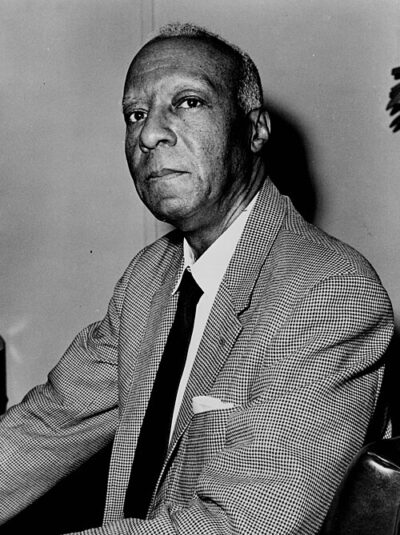
A. Philip Randolph
A. Philip Randolph was a Black American civil rights activist, labor unionist, politician. Born April 15, 1889, in Crescent City. Died May 16, 1979, in Manhattan. Educated at City College of New York. Awards include Spingarn Medal, Presidential Medal of Freedom and Humanist of the Year.
Facts
25 facts · 2 confirmed by two sources · 16 cited · 7 from one source
Where this comes from
Papalocal keeps its own record. It started from these sources; what each one said is kept here as it was copied, so a change on their side never changes this page by itself. Tap one to read its version.
What Wikidata says · copied November 15, 2026 · revision 2568779524
- Described as
- Black American civil rights activist, labor unionist, politician (1889-1979)
- Other names
- Philip Randolph, Asa Philip Randolph, Asa Phillip Randolph, A. Phillip Randolph
- Born
- April 15, 1889 · 5 references
- Died
- May 16, 1979 · 5 references
- Born in
- Crescent City · 1 reference
- Died in
- Manhattan · 1 reference
- Citizen of
- United States
- Occupation
- politician · 2 references; socialist · 2 references; civil rights advocate · 2 references; trade unionist; political activist · 1 reference; union member · 1 reference
- Education
- City College of New York
- Member of
- League for Non-Violent Civil Disobedience against Military Segregation · 1 reference
- Awards
- Spingarn Medal (1942) · 1 reference; Presidential Medal of Freedom (1964) · 1 reference; Humanist of the Year (1970); Pacem in Terris Award; Labor Hall of Honor (1989) · 1 reference; Eugene V. Debs Award (1967) · 1 reference; Phoenix Award (1972) · 1 reference
- Field
- politics · 1 reference; labor union · 1 reference; human rights · 1 reference
- Spouse
- Lucille Campbell Green Randolph
- Religion
- atheism
- Wikipedias with a page
- 24
Wikidata item Q720153 (wikidata.org/wiki/Q720153), public domain (CC0). Copied November 15, 2026.
What Wikipedia says · copied November 15, 2026 · revision 1385506558
Asa Philip Randolph (April 15, 1889 – May 16, 1979) was an American railwayman, trade unionist and civil rights activist. In 1925, he organized and led the Brotherhood of Sleeping Car Porters, the first successful African-American-led labor union. In the early Civil Rights Movement and the Labor Movement, Randolph was a prominent voice. His continuous agitation with the support of fellow labor rights activists against racist labor practices helped lead President Franklin D. Roosevelt to issue Executive Order 8802 in 1941, banning discrimination in the defense industries during World War II. The group then successfully maintained pressure, so that President Harry S. Truman proposed a new Civil Rights Act and issued Executive Orders 9980 and 9981 in 1948, promoting fair employment and anti-discrimination policies in federal government hiring, and ending racial segregation in the armed services.
Randolph was born and raised in Florida. He was educated at Cookman Institute, then moved to New York City as part of the early Great Migration, leaving behind the discriminatory Jim Crow–era south. There he became convinced that overcoming racism required collective action and he was drawn to socialism and workers' rights. He unsuccessfully ran for state office on the socialist ticket in the early 1920s, but found more success in organizing for African American workers' rights.
In 1963, Randolph was the head of the March on Washington, organized by Bayard Rustin, at which Reverend Martin Luther King Jr. delivered his "I Have a Dream" speech. Randolph inspired the "Freedom Budget", sometimes called the "Randolph Freedom budget", which aimed to deal with the economic problems facing the Black community. It was published by the Randolph Institute in January 1967 as "A Freedom Budget for All Americans".
- Born, in its opening lines
- April 15, 1889
- Died, in its opening lines
- May 16, 1979
From the Wikipedia article “A. Philip Randolph” (en.wikipedia.org/wiki/A._Philip_Randolph), by its contributors, under CC BY-SA 4.0 (creativecommons.org/licenses/by-sa/4.0/). Copied November 15, 2026; not changed.
Confirmed Two sources agree. Cited One source, and it names where it got it. One source One source, without a reference of its own. Sources disagree The sources disagree. We show the best-supported value and keep theirs below.
