
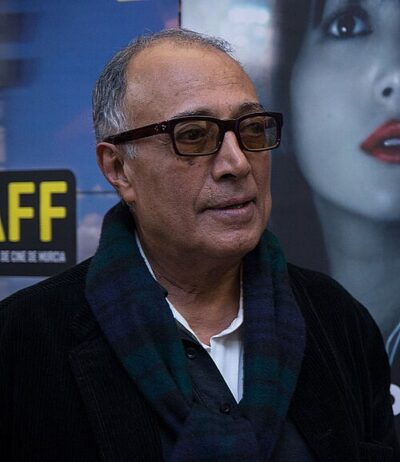
Abbas Kiarostami
Abbas Kiarostami was an Iranian film director, screenwriter, photographer and film producer. Born June 22, 1940, in Tehran. Died July 4, 2016, in 14th arrondissement of Paris. Educated at University of Tehran. Awards include Officer of the Legion of Honour, Konrad Wolf Prize and Praemium Imperiale.
Facts
35 facts · 2 confirmed by two sources · 14 cited · 18 from one source · 1 where the sources disagree
What’s different
- Cause of death: we show stomach cancer (Sources disagree). Wikidata also lists surgical complications
Where this comes from
Papalocal keeps its own record. It started from these sources; what each one said is kept here as it was copied, so a change on their side never changes this page by itself. Tap one to read its version.
What Wikidata says · copied November 16, 2026 · revision 2569143117
- Described as
- Iranian film director, screenwriter, photographer and film producer (1940-2016)
- Born
- June 22, 1940 · 9 references
- Died
- July 4, 2016 · 7 references
- Born in
- Tehran · 3 references
- Died in
- 14th arrondissement of Paris · 1 reference
- Cause of death
- stomach cancer; surgical complications
- Citizen of
- Iran · 1 reference
- Occupation
- film director; screenwriter · 1 reference; photographer · 1 reference; film producer; poet; film editor; actor · 1 reference; painter · 1 reference
- Education
- University of Tehran
- Genre
- Minimalism · 1 reference; poetry film · 1 reference
- Awards
- Officer of the Legion of Honour; Konrad Wolf Prize (2003); Praemium Imperiale (2004) · 1 reference; Austrian Decoration for Science and Art (2014); honorary doctor of Ca' Foscari University of Venice (2003); Palme d'Or · 1 reference; Grand Jury Prize of the Venice Film Festival · 1 reference; honorary doctor of the Sorbonne Nouvelle University (2010) · 2 references; honorary doctorate from ENS (2003) · 1 reference; honorary doctor of the University of Toulouse-II (2007) · 1 reference; Annual award ACFK (2012) · 1 reference
- Field
- writing; cinematography; film · 1 reference; visual arts · 1 reference; poetry · 1 reference; photography · 1 reference
- Children
- Bahman Kiarostami
- Wikipedias with a page
- 73
Wikidata item Q55210 (wikidata.org/wiki/Q55210), public domain (CC0). Copied November 16, 2026.
What Wikipedia says · copied November 16, 2026 · revision 1385266934
Abbas Kiarostami (Persian: عباس کیارستمی [ʔæbˌbɒːs kijɒːɾostæˈmi] ; 22 June 1940 – 4 July 2016) was an Iranian film director, screenwriter, poet, photographer, and film producer. An active filmmaker from 1970, Kiarostami had been involved in the production of over forty films, including multiple shorts and documentaries. Kiarostami attained critical acclaim for directing the Koker trilogy (1987–1994), Close-Up (1990), The Wind Will Carry Us (1999), and Taste of Cherry (1997), which was awarded the Palme d'Or at the Cannes Film Festival that year. His films Where Is the Friend's House? (1987), Close-Up, and The Wind Will Carry Us were ranked among the 100 best foreign films in a 2018 critics' poll by BBC Culture. Close-Up was also ranked one of the 50 greatest movies of all time in the famous decennial Sight & Sound poll conducted in 2012. He is widely regarded as one of the greatest and most influential filmmakers of all time.
Kiarostami worked extensively as a screenwriter, film editor, art director, and producer. He was also a poet, photographer, painter, illustrator, and graphic designer. He was part of a generation of filmmakers in the Iranian New Wave, a Persian cinema movement that started in the late 1960s and emphasized the use of poetic dialogue and allegorical storytelling dealing with political and philosophical issues.
Kiarostami had a reputation for using child protagonists, for documentary-style narrative films, for stories that take place in rural villages, and for conversations that unfold inside cars, using stationary mounted cameras. He is also known for his use of Persian poetry in the dialogue, titles, and themes of his films. Kiarostami's films contain a notable degree of ambiguity, an unusual mixture of simplicity and complexity, and often a mix of fictional and documentary elements. The concepts of change and continuity, in addition to the themes of life and death, play a major role in Kiarostami's works.
- Born, in its opening lines
- June 22, 1940
- Died, in its opening lines
- July 4, 2016
From the Wikipedia article “Abbas Kiarostami” (en.wikipedia.org/wiki/Abbas_Kiarostami), by its contributors, under CC BY-SA 4.0 (creativecommons.org/licenses/by-sa/4.0/). Copied November 16, 2026; not changed.
Confirmed Two sources agree. Cited One source, and it names where it got it. One source One source, without a reference of its own. Sources disagree The sources disagree. We show the best-supported value and keep theirs below.
