
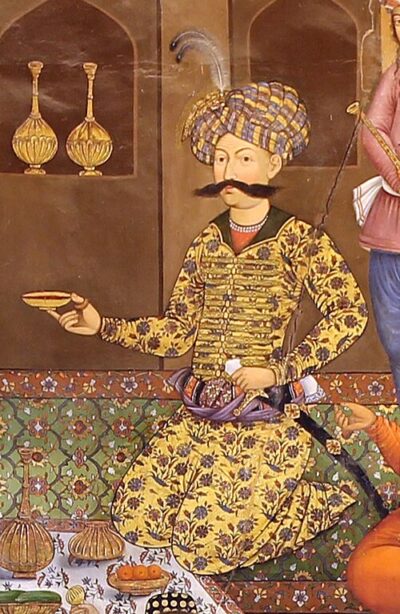
Abbas the Great
Abbas the Great was a Shah of Safavid Iran. Born January 27, 1571, in Herat. Died January 19, 1629, in Behshahr. Positions held include list of Safavid monarchs (1588–1629).
Facts
23 facts · 2 confirmed by two sources · 1 cited · 20 from one source
Where this comes from
Papalocal keeps its own record. It started from these sources; what each one said is kept here as it was copied, so a change on their side never changes this page by itself. Tap one to read its version.
What Wikidata says · copied November 16, 2026 · revision 2568353849
- Described as
- Shah of Safavid Iran (1587–1629)
- Other names
- Abbas I of Safavid
- Born
- January 27, 1571 · 1 reference
- Died
- January 19, 1629 · 2 references
- Born in
- Herat · 1 reference
- Died in
- Behshahr
- Buried in
- Imamzadeh Habib ibn Musa
- Citizen of
- Safavid Iran
- Occupation
- politician; monarch; governor; military leader; head of state
- Positions held
- list of Safavid monarchs (1588–1629)
- Spouse
- Yakhan Begum (1602); Princess Marta of Kakheti (1604–1614)
- Children
- Mohammad Baqer Mirza; Soltan Mohammad Mirza; Zubaidah Begum; Imam Qoli Mirza
- Father
- Mohammad Khodabanda
- Mother
- Khayr al-Nisa Begum
- Siblings
- Hamza Mirza; Abu Talib Mirza
- Religion
- Shia Islam
- Wikipedias with a page
- 84
Wikidata item Q171349 (wikidata.org/wiki/Q171349), public domain (CC0). Copied November 16, 2026.
What Wikipedia says · copied November 16, 2026 · revision 1384923824
Abbas I (Persian: عباس یکم, romanized: Abbâs-e Yekom; 27 January 1571 – 19 January 1629), commonly known as Abbas the Great (Persian: عباس بزرگ, romanized: Abbâs-e Bozorg), was the fifth Safavid shah of Iran from 1588 to 1629. The third son of Shah Mohammad Khodabanda, he is generally considered one of the most important rulers in Iranian history and the greatest ruler of the Safavid dynasty.
Although Abbas would reign over Safavid Iran at its military, political and economic height, he came to the throne during a period of instability in the empire. Under the ineffective rule of his father, the country was riven with discord between the different factions of the Qizilbash army, who killed Abbas' mother and elder brother. Meanwhile, Iran's main enemies, its archrival, the Ottoman Empire, and the Uzbeks, exploited this political chaos to seize territory for themselves. In 1588, one of the Qizilbash leaders, Murshid Quli Khan, overthrew Shah Mohammed in a coup and placed the 16-year-old Abbas on the throne. However, Abbas soon seized power for himself.
Under his leadership, Iran developed the gholam system where thousands of Circassian, Georgian, and Armenian slave-soldiers joined the civil administration and the military, thus creating a new strata in Iranian society, this was initiated by his predecessors but significantly expanded during his rule. This allowed Abbas to eclipse the power of the Qizilbash in the civil administration, the royal house, and the military. These actions, as well as his reforms of the Iranian army, enabled him to fight the Ottomans and Uzbeks and reconquer Iran's lost provinces, including Kakheti, whose people he subjected to widescale massacres and deportations. By the end of the 1603–1618 Ottoman War, Abbas had regained possession over South Caucasus and Dagestan, as well as swaths of Western Armenia and Mesopotamia. He also took back land from the Portuguese and the Mughals and expanded Iranian rule and influence in the North Caucasus, beyond the traditional territories of Dagestan.
Abbas was a great builder and moved the empire's capital from Qazvin to Isfahan, and transformed the city into a masterpiece of Safavid architecture. In his later years, following a court intrigue involving several leading Circassians, Abbas became suspicious of his own sons and had them killed or blinded.
Shah Abbas changed the empire, which was mainly held together by the strong beliefs of several militant tribes (Qizilbash), into a unified and stable monarchy. He strengthened the state by securing its borders, improving its economy, setting up a centralised administration, and creating a regular army (Shahsavan) that reported directly to him instead of tribal leaders. His keen economic and commercial understanding brought wealth and prosperity to the nation. Internal stability and consistent regulations encouraged agricultural growth. Infrastructure projects which included roads and public buildings, were carried out on an unprecedented scale, and enabled the flourishing of crafts and industries. As a skilled diplomat with a broad outlook, Shah Abbas sought political and economic ties with Western countries, and foreign ambassadors were warmly welcomed at his court.
- Born, in its opening lines
- January 27, 1571
- Died, in its opening lines
- January 19, 1629
From the Wikipedia article “Abbas the Great” (en.wikipedia.org/wiki/Abbas_the_Great), by its contributors, under CC BY-SA 4.0 (creativecommons.org/licenses/by-sa/4.0/). Copied November 16, 2026; not changed.
Confirmed Two sources agree. Cited One source, and it names where it got it. One source One source, without a reference of its own. Sources disagree The sources disagree. We show the best-supported value and keep theirs below.
