
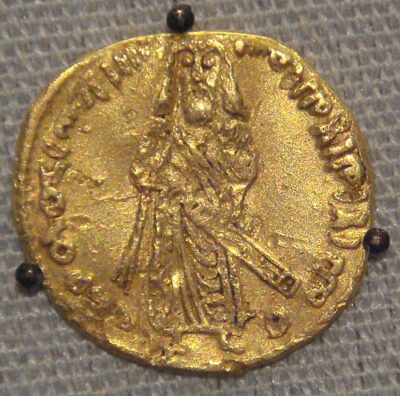
Abd al-Malik ibn Marwan
Abd al-Malik ibn Marwan was an Umayyad caliph from 685 to 705. Born 646, in Medina. Died October 9, 705, in Damascus. Positions held include Umayyad Caliph (685–705).
Facts
32 facts · 0 confirmed by two sources · 2 cited · 28 from one source · 2 where the sources disagree
What’s different
- Born: we show 646 (Sources disagree). Wikipedia says August 644
- Died: we show October 9, 705 (Sources disagree). Wikipedia says July 647
Where this comes from
Papalocal keeps its own record. It started from these sources; what each one said is kept here as it was copied, so a change on their side never changes this page by itself. Tap one to read its version.
What Wikidata says · copied November 16, 2026 · revision 2555476423
- Described as
- Umayyad caliph from 685 to 705
- Other names
- Abdel-Malik Ibn Marwan
- Born
- 646 · 3 references
- Died
- October 9, 705
- Born in
- Medina
- Died in
- Damascus
- Buried in
- Bab al-Saghir Cemetery
- Occupation
- politician; governor; caliph · 1 reference; Islamic jurist · 1 reference
- Positions held
- Umayyad Caliph (685–705)
- Spouse
- Atikah bint Yazid; Wallada bint al-Abbas ibn al-Jaz; A'isha bint Musa ibn Talha
- Children
- Al-Walid I; Hisham ibn Abd al-Malik; Yazid II; Sulayman ibn Abd al-Malik; Maslamah ibn Abd al-Malik; Marwan ibn Abd al-Malik; Fatima bint Abd al-Malik; Muhammad ibn Abd al-Malik ibn Marwan; Sa'id ibn Abd al-Malik; Abdallah ibn Abd al-Malik · 1 reference; Bakkar ibn Abd al-Malik
- Father
- Marwan I
- Mother
- A'isha bint Mu'awiya ibn al-Mughira
- Siblings
- Abd al-Aziz ibn Marwan; Muhammad ibn Marwan; Bishr ibn Marwan; Aban ibn Marwan; Ubayd Allah ibn Marwan
- Religion
- Islam
- Wikipedias with a page
- 73
Wikidata item Q36788 (wikidata.org/wiki/Q36788), public domain (CC0). Copied November 16, 2026.
What Wikipedia says · copied November 16, 2026 · revision 1380407331
Abd al-Malik ibn Marwan ibn al-Hakam (July/August 644 or June/July 647 – 9 October 705), was the fifth Umayyad caliph, ruling from April 685 until his death in October 705. A member of the first generation of born Muslims, his early life in Medina was occupied with religious pursuits. He held administrative and military posts under Caliph Mu'awiya I (r. 661–680), founder of the Umayyad Caliphate, and his own father, Caliph Marwan I (r. 684–685). By the time of Abd al-Malik's accession, Umayyad authority had collapsed across the Caliphate as a result of the Second Fitna and had been reconstituted in Syria and Egypt during his father's reign.
Following a failed invasion of Iraq in 686, Abd al-Malik focused on securing Syria before making further attempts to conquer the greater part of the Caliphate from his principal rival, the Mecca-based caliph Abd Allah ibn al-Zubayr. To that end, he concluded an unfavorable truce with the reinvigorated Byzantine Empire in 689, quelled a coup attempt in Damascus by his kinsman, al-Ashdaq, the following year, and reincorporated into the army the rebellious Qaysi tribes of the Jazira (Upper Mesopotamia) in 691. He then conquered Zubayrid Iraq and dispatched his general, al-Hajjaj ibn Yusuf, to Mecca where he killed Ibn al-Zubayr in late 692, thereby reuniting the Caliphate under Abd al-Malik's rule. The war with Byzantium resumed, resulting in Umayyad advances into Anatolia and Armenia, the destruction of Carthage and the recapture of Kairouan, the launchpad for the later conquests of western North Africa and the Iberian Peninsula, in 698. In the east, al-Hajjaj had become Abd al-Malik's viceroy and firmly established the caliph's authority in Iraq and Khurasan, stamping out opposition by the Kharijites and the Arab tribal nobility by 702. Abd al-Malik's final years were marked by a domestically peaceful and prosperous consolidation of power.
Abd al-Malik's most consequential reforms were the introduction of a single Islamic currency in place of Byzantine and Sasanian coinage and the establishment of Arabic as the language of the bureaucracy in place of Greek and Persian in Syria and Iraq, respectively. His Muslim upbringing, the conflicts with external and local Christian forces and rival claimants to Islamic leadership all influenced Abd al-Malik's efforts to prescribe a distinctly Islamic character to the Umayyad state. This also manifested with his founding of the Dome of the Rock in Jerusalem, the earliest archaeologically-attested religious monument built by a Muslim ruler and the possessor of the earliest inscriptions proclaiming Islam and the prophet Muhammad. In a significant departure from his predecessors, rule over the Caliphate's provinces was centralized under Abd al-Malik. He used loyalist Arab troops from Syria to control the provinces, reducing the reliance on local Arab garrisons. Tax surpluses from the provinces were forwarded to Damascus and the traditional stipends to veterans of the early Muslim conquests and their descendants were abolished, salaries being restricted to those in active service. The foundations established by Abd al-Malik enabled his son and successor, al-Walid I (r. 705–715), who largely maintained his father's policies, to oversee the Umayyad Caliphate's territorial and economic zenith. Abd al-Malik's centralized government became the prototype for the administrations of later medieval Muslim states.
- Born, in its opening lines
- August 644
- Died, in its opening lines
- July 647
From the Wikipedia article “Abd al-Malik ibn Marwan” (en.wikipedia.org/wiki/Abd_al-Malik_ibn_Marwan), by its contributors, under CC BY-SA 4.0 (creativecommons.org/licenses/by-sa/4.0/). Copied November 16, 2026; not changed.
Confirmed Two sources agree. Cited One source, and it names where it got it. One source One source, without a reference of its own. Sources disagree The sources disagree. We show the best-supported value and keep theirs below.
