
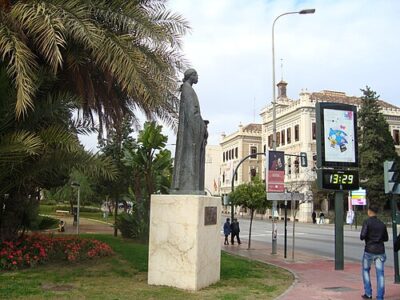
Abd ar-Rahman II
Abd ar-Rahman II was an Emir of Cordoba from 822 to 852. Born November 792, in Toledo. Died September 22, 852, in Córdoba. Positions held include emir of Cordoba (822–852).
Facts
9 facts · 2 confirmed by two sources · 1 cited · 6 from one source
What’s different
- Born: we show November 792 (Confirmed). Wikidata also lists December 792
Where this comes from
Papalocal keeps its own record. It started from these sources; what each one said is kept here as it was copied, so a change on their side never changes this page by itself. Tap one to read its version.
What Wikidata says · copied November 16, 2026 · revision 2564810025
- Described as
- Emir of Cordoba from 822 to 852
- Other names
- 'Abd ar-Rahman II, Abd-ar-rahman II, Abd Er-Rahman II, Abd-ar-Rahman II, Abd-er-Rahman II, Abd ar Rahman II, Abd al-Rahman II, Abd Al-Rahman II of Cordoba
- Born
- November 792 · 1 reference; December 792 · 1 reference
- Died
- September 22, 852 · 1 reference
- Born in
- Toledo
- Died in
- Córdoba · 1 reference
- Occupation
- monarch
- Positions held
- emir of Cordoba (822–852)
- Children
- Muhammad I of Córdoba
- Father
- Al-Hakam I
- Siblings
- al-Walid bin al-Hakam
- Wikipedias with a page
- 50
Wikidata item Q307412 (wikidata.org/wiki/Q307412), public domain (CC0). Copied November 16, 2026.
What Wikipedia says · copied November 16, 2026 · revision 1383321063
Abd al-Rahman II (Arabic: عبد الرحمن الأوسط; 792–852) was the fourth Umayyad Emir of Córdoba in al-Andalus from 822 until his death in 852. A vigorous and effective frontier warrior, he was also well known as a patron of the arts.
Abd al-Rahman was born in Toledo in 792. He was the son of Emir al-Hakam I. In his youth he took part in the so-called "massacre of the ditch", when 72 nobles and hundreds of their attendants were massacred at a banquet by order of al-Hakam.
He succeeded his father as Emir of Córdoba in 822 and for 20 years engaged in nearly continuous warfare against Alfonso II of Asturias, whose southward advance he halted. In 825, he had a new city, Murcia, built, and proceeded to settle it with Arab loyalists to ensure stability. In 835, he confronted rebellious citizens of Mérida by having a large internal fortress built. In 837, he suppressed a revolt of Christians and Jews in Toledo with similar measures. He issued a decree by which the Christians were forbidden to seek martyrdom, and he had a Christian synod held to forbid martyrdom.
In 839 or 840, he sent an embassy under al-Ghazal to Constantinople to sign a pact with the Byzantine Empire against the Abbasids. Another embassy was sent which may have either gone to Ireland or Denmark, likely encouraging trade in fur and slaves.
In 844, Abd al-Rahman repulsed an assault by Vikings who had disembarked in Cádiz, conquered Seville (with the exception of its citadel) and attacked Córdoba itself. Thereafter he constructed a fleet and naval arsenal at Seville to repel future raids.
He responded to William of Septimania's requests of assistance in his struggle against Charles the Bald who had claimed lands William considered to be his.Abd al-Rahman was famous for his public building program in Córdoba. He made additions to the Mosque–Cathedral of Córdoba. A vigorous and effective frontier warrior, he was also well known as a patron of the arts. He was also involved in the execution of the "Martyrs of Córdoba", and was a patron of the great composer Ziryab. He died in 852 in Córdoba.
- Born, in its opening lines
- 792
- Died, in its opening lines
- 852
From the Wikipedia article “Abd al-Rahman II” (en.wikipedia.org/wiki/Abd_al-Rahman_II), by its contributors, under CC BY-SA 4.0 (creativecommons.org/licenses/by-sa/4.0/). Copied November 16, 2026; not changed.
Confirmed Two sources agree. Cited One source, and it names where it got it. One source One source, without a reference of its own. Sources disagree The sources disagree. We show the best-supported value and keep theirs below.
