
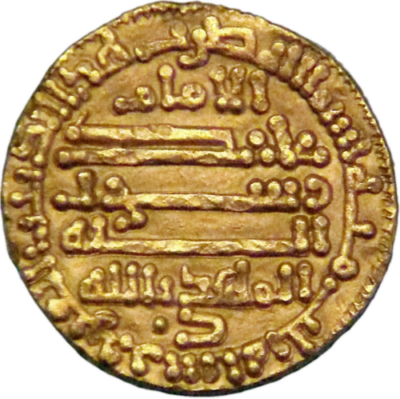
Abdullah al-Mahdi Billah
Abdullah al-Mahdi Billah was an Isma'ili Imam and Fatimid Caliph from 909 to 934. Born 873, in ʻAskar Makram. Died 934, in Mahdia. Positions held include Fatimid Caliph (909–934) and Ismaili imam (881–934).
Facts
12 facts · 1 confirmed by two sources · 0 cited · 10 from one source · 1 where the sources disagree
What’s different
- Born: we show 873 (Sources disagree). Wikipedia says July 31, 874
Where this comes from
Papalocal keeps its own record. It started from these sources; what each one said is kept here as it was copied, so a change on their side never changes this page by itself. Tap one to read its version.
What Wikidata says · copied November 16, 2026 · revision 2542921233
- Described as
- Isma'ili Imam and Fatimid Caliph from 909 to 934
- Other names
- Said ibn Husayn, Sa'id ibn Husayn, Saeed ibn husayn, Ubayd allah al mahdi billah, Said bin husayn, Ubaidallah, Ubayd Allah al-Mahdi, Abdallah al-Mahdi, Ubaydalla Said, Al-Mahdi Billah, Abdullah al Mahdi, Al Mahdi
- Born
- 873
- Died
- 934 · 1 reference
- Born in
- ʻAskar Makram
- Died in
- Mahdia
- Occupation
- politician; imam; caliph
- Positions held
- Fatimid Caliph (909–934); Ismaili imam (881–934)
- Children
- Al-Qa'im Bi-Amrillah
- Father
- Abd Allah al-Radi
- Religion
- Islam
- Wikipedias with a page
- 36
Wikidata item Q307629 (wikidata.org/wiki/Q307629), public domain (CC0). Copied November 16, 2026.
What Wikipedia says · copied November 16, 2026 · revision 1385797905
Abū Muḥammad ʿAbd Allāh ibn al-Ḥusayn (Arabic: أبو محمد عبد الله بن الحسين; 31 July 874 – 4 March 934), better known by his regnal name al-Mahdī biʾllāh (Arabic: المهدي بالله, "The Rightly Guided by God"), was the founder of the Isma'ili Fatimid Caliphate, the only major Shi'a caliphate in Islamic history, and the eleventh Imam of the Isma'ili branch of Shi'ism.
He was born as Saʿīd ibn al-Ḥusayn (سعيد بن الحسين) in Askar Mukram to a family that led the secret Isma'ili missionary network (da'wa), propagating on behalf of the hidden imam, Muhammad ibn Isma'il, who would return as the prophesied Islamic messiah (mahdi). Orphaned at a young age, he moved to Salamiya, the family's base of operations, where he was adopted by his uncle. In the mid-890s Sa'id succeeded to the leadership of the expanding da'wa, which had expanded and gained adherents across the then Muslim world. However, his claims of not merely being a trustee of the hidden imam, but of him and his ancestors holding the imamate itself, led in 899 to a schism in the Isma'ili movement: those who did not recognise his claims split off to become the Qarmatians. The schism was followed by uprisings of pro-Isma'ili Bedouin in Syria in 902–903, launched without his consent by over-eager supporters, who aimed to force him to come forward as the mahdi. The Bedouin uprising was suppressed by the Abbasids, but drew the attention of the Abbasid Caliphate's authorities to him, forcing him to abandon Salamiya, and flee first to Ramla, then Fustat in Egypt, and finally Sijilmasa in what is now Morocco. There he remained, living as a merchant, until one of his missionaries, Abu Abdallah al-Shi'i, at the head of the Kutama Berbers overthrew the Aghlabid dynasty of Ifriqiya in 909.
Proclaimed caliph and assuming power in Ifriqiya in January 910, he proclaimed his right to conquer the world in the name of God, but soon fell out with Abu Abdallah and other leading missionaries, who were disappointed that he was not the semi-divine mahdi they had been propagating for. Al-Mahdi was able to purge these dissidents, but had to overcome a series of revolts against his authority, either due to opposition to the exactions of the Kutama, the backbone of his power, or due to disillusionment of his followers with his failure to realise the Isma'ili millennialist promises. The state that al-Mahdi built, although underpinned by a messianic ideology, was otherwise conventionally organised, and relied heavily on the personnel of the previous Aghlabid regime and the swords of the Kutama. His expansionist aims achieved only moderate success: two invasions of Egypt were beaten back by the Abbasids, leaving only the Cyrenaica in his hands, while the war with the Byzantine Empire in southern Italy was characterised by raids for plunder and slaves, and did not result in any lasting successes. In the west, his repeated attempts to impose Fatimid rule over the unruly Berbers were challenged not only by Berber rivalries, but also by the Umayyads of al-Andalus, and only secured temporary success. In 921 he moved his court to the newly built fortified palace city of Mahdiya on the Tunisian coast, and spent the rest of his life there. After his death in 934, he was succeeded by his only son, al-Qa'im.
- Born, in its opening lines
- July 31, 874
- Died, in its opening lines
- March 4, 934
From the Wikipedia article “Abd Allah al-Mahdi Billah” (en.wikipedia.org/wiki/Abd_Allah_al-Mahdi_Billah), by its contributors, under CC BY-SA 4.0 (creativecommons.org/licenses/by-sa/4.0/). Copied November 16, 2026; not changed.
Confirmed Two sources agree. Cited One source, and it names where it got it. One source One source, without a reference of its own. Sources disagree The sources disagree. We show the best-supported value and keep theirs below.
