
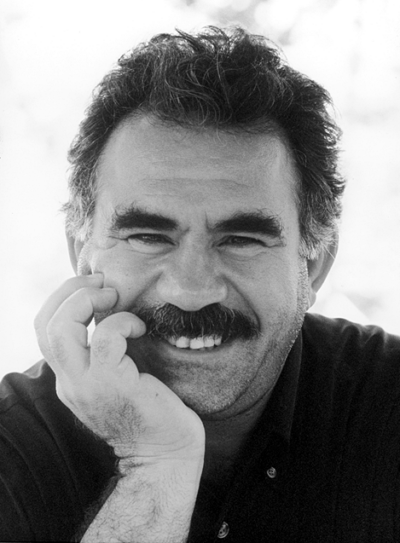
Abdullah Öcalan
Abdullah Öcalan is a founder of the Kurdistan Workers' Party (PKK). Born April 4, 1948, in Ömerli. Educated at Ankara University Faculty of Political Science and Ankara University.
Facts
16 facts · 1 confirmed by two sources · 2 cited · 13 from one source
What’s different
- Born: we show April 4, 1948 (Confirmed). Wikidata also lists April 4, 1949
Where this comes from
Papalocal keeps its own record. It started from these sources; what each one said is kept here as it was copied, so a change on their side never changes this page by itself. Tap one to read its version.
What Wikidata says · copied November 16, 2026 · revision 2567439243
- Described as
- founder of the Kurdistan Workers' Party (PKK)
- Other names
- Abdullah Ocalan, Apo, Öcalan
- Born
- April 4, 1948 · 1 reference; April 4, 1949 · 1 reference
- Born in
- Ömerli
- Citizen of
- Turkey
- Occupation
- politician; writer; activist; political scientist · 2 references
- Political party
- Kurdistan Workers' Party · 1 reference
- Education
- Ankara University Faculty of Political Science; Ankara University
- Spouse
- Kesire Yıldırım (1978–) · 1 reference
- Siblings
- Mehmet Öcalan; Fatma Öcalan; Osman Öcalan
- Lived in
- İmralı
- Website
- https://abdullahocalan.net
- Wikipedias with a page
- 68
Wikidata item Q191530 (wikidata.org/wiki/Q191530), public domain (CC0). Copied November 16, 2026.
What Wikipedia says · copied November 16, 2026 · revision 1384312003
Abdullah Öcalan ( OH-jə-lahn; Turkish: [œdʒaɫan]; born 4 April 1948 or 1949), also known as Apo (short for Abdullah in Turkish; Kurdish for "uncle"), is a founding member of the militant Kurdistan Workers' Party (PKK).
Öcalan was based in Syria from 1979 to 1998. He helped found the PKK in 1978, and led it into the Kurdish–Turkish conflict in 1984. For most of his leadership, he was based in Syria, which provided sanctuary to the PKK until the late 1990s.
After being forced to leave Syria, Öcalan was abducted by the Turkish National Intelligence Organization (MIT) in Nairobi, Kenya in February 1999 and imprisoned on İmralı island in Turkey, where after a trial he was sentenced to death under Article 125 of the Turkish Penal Code, which concerns the formation of armed organizations. The sentence was commuted to aggravated life imprisonment when Turkey abolished the death penalty. From 1999 until 2009, he was the sole prisoner in İmralı prison in the Sea of Marmara, where he is still held.
Öcalan has advocated for a political solution to the conflict since the 1993 Kurdistan Workers' Party ceasefire. Öcalan's prison regime has oscillated between long periods of isolation during which he is allowed no contact with the outside world, and periods when he is permitted visits. He was also involved in negotiations with the Turkish government that led to a temporary Kurdish–Turkish peace process in 2013. In February 2025, he issued a statement from prison calling on the PKK to disarm and disband itself, after which the group's leadership declared a unilateral ceasefire.
From prison, Öcalan has published several books. Jineology, also known as the science of women, is a form of feminism advocated by Öcalan and subsequently a fundamental tenet of the Kurdistan Communities Union (KCK). Öcalan's philosophy of democratic confederalism was applied in the Democratic Autonomous Administration of North and East Syria (DAANES), an autonomous polity formed in Syria in 2012.
- Born, in its opening lines
- April 4, 1948
From the Wikipedia article “Abdullah Öcalan” (en.wikipedia.org/wiki/Abdullah_Öcalan), by its contributors, under CC BY-SA 4.0 (creativecommons.org/licenses/by-sa/4.0/). Copied November 16, 2026; not changed.
Confirmed Two sources agree. Cited One source, and it names where it got it. One source One source, without a reference of its own. Sources disagree The sources disagree. We show the best-supported value and keep theirs below.
