
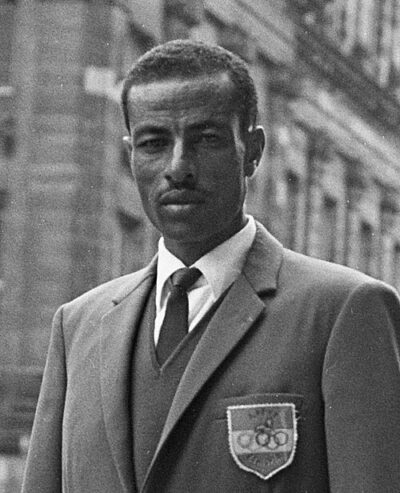
Abebe Bikila
Abebe Bikila was an Ethiopian double Olympic marathon champion. Born August 7, 1932, in Shewa. Died October 25, 1973, in Addis Ababa. Awards include BBC World Sport Star of the Year and Silver Olympic Order.
Facts
16 facts · 2 confirmed by two sources · 4 cited · 10 from one source
Where this comes from
Papalocal keeps its own record. It started from these sources; what each one said is kept here as it was copied, so a change on their side never changes this page by itself. Tap one to read its version.
What Wikidata says · copied November 16, 2026 · revision 2568976890
- Described as
- Ethiopian double Olympic marathon champion
- Born
- August 7, 1932 · 4 references
- Died
- October 25, 1973 · 6 references
- Born in
- Shewa
- Died in
- Addis Ababa · 2 references
- Buried in
- Ethiopia
- Cause of death
- cerebral hemorrhage
- Citizen of
- Ethiopia
- Occupation
- marathon runner; long-distance runner; athletics competitor; athlete · 1 reference; Olympic champion · 1 reference
- Sport
- athletics
- Awards
- BBC World Sport Star of the Year (1964); Silver Olympic Order (1984)
- Height
- 1.77 m (5 ft 10 in) · 2 references
- Wikipedias with a page
- 64
Wikidata item Q52596 (wikidata.org/wiki/Q52596), public domain (CC0). Copied November 16, 2026.
What Wikipedia says · copied November 16, 2026 · revision 1384645256
Shambel Abebe Bikila (Amharic: ሻምበል አበበ ቢቂላ; August 7, 1932 – October 25, 1973) was an Ethiopian marathon runner who was a back-to-back Olympic marathon champion. He was the first Ethiopian Olympic gold medalist, winning his first gold medal at the 1960 Summer Olympics in Rome while running barefoot. At the 1964 Tokyo Olympics, he won his second gold medal, making him the first athlete to successfully defend an Olympic marathon title. In both victories, he ran in world record time.
Born in Shewa, Abebe moved to Addis Ababa around 1952 and joined the 5th Infantry Regiment of the Ethiopian Imperial Guard, an elite infantry division that safeguarded the emperor of Ethiopia. Abebe served in the Kagnew Battalion during the Korean War.
Enlisting as a soldier before his athletic career, he rose to the rank of shambel (captain). Abebe participated in a total of sixteen marathons. He placed second on his first marathon in Addis Ababa, won twelve other races, and finished fifth in the 1963 Boston Marathon. In July 1967, he sustained the first of several sports-related leg injuries that prevented him from finishing his last two marathons. Abebe was a pioneer in long-distance running. Mamo Wolde, Juma Ikangaa, Tegla Loroupe, Paul Tergat, and Haile Gebrselassie—all recipients of the New York Road Runners' Abebe Bikila Award—are a few of the athletes who have followed in his footsteps to establish East Africa as a force in long-distance running.
On March 22, 1969, Abebe was paralysed due to a car accident. He regained some upper-body mobility, but he never walked again. While he was receiving medical treatment in England, Abebe competed in archery and table tennis at the 1970 Stoke Mandeville Games in London. Those games were an early predecessor of the Paralympic Games. He competed in both sports at a 1971 competition for disabled people in Norway and won its cross-country sleigh-riding event. Abebe died at age 41 in 1973 of a cerebral haemorrhage related to his accident four years earlier. He received a state funeral, and Emperor Haile Selassie declared a national day of mourning. Many schools, venues, and events, including Abebe Bikila Stadium in Addis Ababa, are named after him. He is the subject of biographies and films documenting his athletic career, and he is often featured in publications about the marathon and the Olympics.
- Born, in its opening lines
- August 7, 1932
- Died, in its opening lines
- October 25, 1973
From the Wikipedia article “Abebe Bikila” (en.wikipedia.org/wiki/Abebe_Bikila), by its contributors, under CC BY-SA 4.0 (creativecommons.org/licenses/by-sa/4.0/). Copied November 16, 2026; not changed.
Confirmed Two sources agree. Cited One source, and it names where it got it. One source One source, without a reference of its own. Sources disagree The sources disagree. We show the best-supported value and keep theirs below.
