
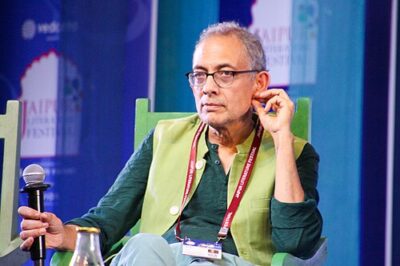
Abhijit Banerjee
Abhijit Banerjee is an Indian American economist. Born February 21, 1961, in Mumbai. Educated at Harvard University and University of Calcutta. Awards include Guggenheim Fellowship, Michael Wallerstein Award and Infosys Prize.
Facts
31 facts · 1 confirmed by two sources · 22 cited · 8 from one source
Where this comes from
Papalocal keeps its own record. It started from these sources; what each one said is kept here as it was copied, so a change on their side never changes this page by itself. Tap one to read its version.
What Wikidata says · copied November 13, 2026 · revision 2567063331
- Described as
- Indian American economist
- Other names
- Abhijit Vinayak Banerjee, Abhijit V. Banerjee, Abhijit Binayak Banerjee, Abhijit B. Banerjee, A. V. Banerjee, A. B. Banerjee, A. Banerjee
- Born
- February 21, 1961 · 3 references
- Born in
- Mumbai · 1 reference
- Citizen of
- United States (2017–) · 1 reference; India (1961–2017)
- Occupation
- economist · 1 reference; university teacher · 1 reference
- Worked for
- Massachusetts Institute of Technology (1993–) · 1 reference; Princeton University (1988–1992) · 1 reference; Harvard University (1992–1993) · 1 reference
- Education
- Harvard University (–1988) · 1 reference; University of Calcutta (–1981) · 1 reference; Presidency University; Jawaharlal Nehru University (–1983) · 1 reference; South Point School
- Member of
- American Academy of Arts and Sciences (2004–) · 1 reference; Econometric Society (1995–) · 3 references; National Academy of Sciences (2020–)
- Awards
- Guggenheim Fellowship (2000) · 1 reference; Michael Wallerstein Award (2006) · 2 references; Infosys Prize (2009) · 1 reference; Fellow of the Econometric Society (1995) · 2 references; Fellow of the American Academy of Arts and Sciences (2004) · 1 reference; Prize in Economic Sciences in Memory of Alfred Nobel (2019) · 1 reference; honorary doctor of the Katholieke Universiteit Leuven (2014); BBVA Foundation Frontiers of Knowledge Award (2008) · 1 reference; Albert O. Hirschman Prize (2014) · 1 reference; honorary doctorate at École Normale Supérieure de Lyon (2022) · 1 reference; Bernhard Harms Medal (2014)
- Field
- development economics · 1 reference
- Spouse
- Esther Duflo (2015–) · 1 reference
- Website
- http://economics.mit.edu/faculty/banerjee/
- Wikipedias with a page
- 61
Wikidata item Q320578 (wikidata.org/wiki/Q320578), public domain (CC0). Copied November 13, 2026.
What Wikipedia says · copied November 13, 2026 · revision 1383620518
Abhijit Vinayak Banerjee (Bengali pronunciation: [obʱid͡ʒit̪ binae̯ɔk bɔnd̪opad̪ʱːae̯]; born 21 February 1961) is an Indian American economist who is currently the Lemann Foundation Professor in Economics at the University of Zurich (UZH). He is co-founder and co-director of the Abdul Latif Jameel Poverty Action Lab (J-PAL), an MIT based global research center promoting the use of scientific evidence to inform poverty alleviation strategies. In 2019, Banerjee shared the Nobel Memorial Prize in Economic Sciences with Esther Duflo and Michael Kremer, "for their experimental approach to alleviating global poverty." He and Esther Duflo are married, and became the sixth married couple to jointly win a Nobel or Nobel Memorial Prize on economic sciences.
Banerjee's academic appointments include being a fellow of the Econometric Society, a member of the National Academy of Sciences, and a fellow of the American Academy of Arts and Sciences. In 1994, he received a Sloan Research Fellowship, awarded annually to early career researchers with the "potential to revolutionize their fields." According to Research Papers in Economics, Banerjee is among the most productive development economists in the world, ranking in the top 75 researchers by total research output.
- Born, in its opening lines
- February 21, 1961
From the Wikipedia article “Abhijit Banerjee” (en.wikipedia.org/wiki/Abhijit_Banerjee), by its contributors, under CC BY-SA 4.0 (creativecommons.org/licenses/by-sa/4.0/). Copied November 13, 2026; not changed.
Confirmed Two sources agree. Cited One source, and it names where it got it. One source One source, without a reference of its own. Sources disagree The sources disagree. We show the best-supported value and keep theirs below.
