
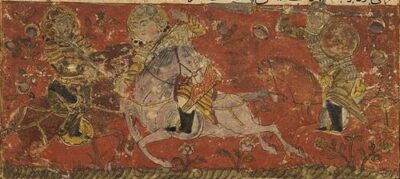
Abraha
Abraha was an Aksumite General. Born 6th century, in Axum. Died 570. Positions held include list of rulers of Saba and Himyar (535–570).
Facts
5 facts · 0 confirmed by two sources · 0 cited · 5 from one source
Where this comes from
Papalocal keeps its own record. It started from these sources; what each one said is kept here as it was copied, so a change on their side never changes this page by itself. Tap one to read its version.
What Wikidata says · copied November 16, 2026 · revision 2561487699
- Described as
- Aksumite General
- Other names
- Abraham
- Born
- 6th century
- Died
- 570
- Born in
- Axum
- Occupation
- military personnel · 1 reference
- Positions held
- list of rulers of Saba and Himyar (535–570)
- Wikipedias with a page
- 34
Wikidata item Q323363 (wikidata.org/wiki/Q323363), public domain (CC0). Copied November 16, 2026.
What Wikipedia says · copied November 16, 2026 · revision 1384373247
Abraha (Ge’ez: አብርሃ) (also spelled Abreha, died after 570 CE), also known as Abraha al-Ashram or Abraha al-Habashi was an Aksumite viceroy of Himyar (modern-day Yemen) in the 6th century. He participated in the Aksumite invasion of Himyar between 525 CE and 530 CE, then seized the Himyarite throne by overthrowing King Sumyafa Ashwa, crowning himself ruler of the Kingdom of Himyar' and its dependencies. He titled himself with the very long royal titles carried by Himyarite kings since the 5th century CE—namely, the title "King of Saba', Dhu Raydan, Hadhramaut, Yamnat, and their Arabs on the coast and the highlands." However, Abraha distinguished himself from previous Himyarite rulers by also styling himself "The Agazian King" (Malikan Ag'azin).
It appears that Abraha faced widespread opposition to his rule in southern Arabia, particularly from the major tribe "Saba'," which was supported by the tribes of Marib, Dhu Yazan, Kinda, and the Bedouin, but he successfully suppressed all of those tribes. After Abraha reasserted his authority in southern Arabia around 548 CE, he repaired much of the infrastructure in Marib, normalized relations with major powers, and engaged important tribes of the time. During the 550s CE, Abraha set out to establish a Himyaritic empire that, during his reign, expanded to include most of the Arabian Peninsula; ultimately, his empire did not last long. Abraha’s two sons, who succeeded him on the throne, lacked their father's ambitious qualities, and no inscriptions for either ruler have been discovered yet.
He is famous for the tradition of his failed siege of Mecca, an event that is referred to as the Year of the Elephant in Islamic tradition, using an army that included war elephants. This event is interpreted by some to be the historical context behind Surah Al-Fil, the 105th surah of the Quran. A newly discovered Himyarite inscription may mention elephants, offering potential support for this battle having taken place. Abraha's campaign of the Elephant became a watershed event used by the people of Mecca as a starting point for dating years and recording events. This incident also contributed to exalting the status of the Holy Kaaba in Mecca, enhancing its religious and symbolic position across the Arabian Peninsula, and elevating the standing of Quraysh among other tribes as the guardians of the House.
From the Wikipedia article “Abraha” (en.wikipedia.org/wiki/Abraha), by its contributors, under CC BY-SA 4.0 (creativecommons.org/licenses/by-sa/4.0/). Copied November 16, 2026; not changed.
Confirmed Two sources agree. Cited One source, and it names where it got it. One source One source, without a reference of its own. Sources disagree The sources disagree. We show the best-supported value and keep theirs below.
