
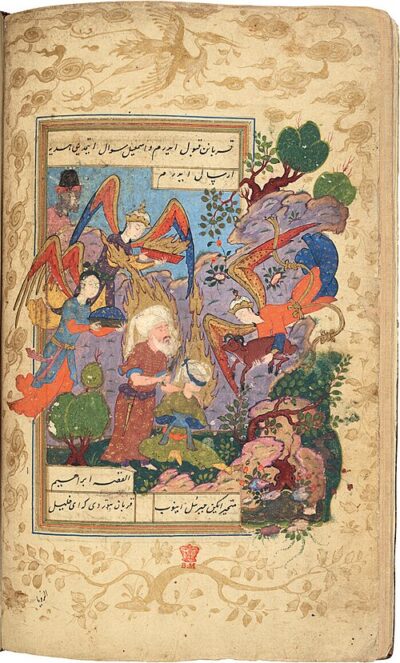
Abraham in Islām
Abraham in Islām was a forefather of the Abrahamic religions from the Islamic perspective. Born 1810s BC, in Ur. Positions held include prophet of Islam. Known for Binding of Ishmael and Scrolls of Abraham.
Facts
13 facts · 0 confirmed by two sources · 0 cited · 12 from one source · 1 where the sources disagree
What’s different
- Born in: we show Ur (Sources disagree). Wikidata also lists Babylonia
Where this comes from
Papalocal keeps its own record. It started from these sources; what each one said is kept here as it was copied, so a change on their side never changes this page by itself. Tap one to read its version.
What Wikidata says · copied November 16, 2026 · revision 2565844277
- Described as
- forefather of the Abrahamic religions from the Islamic perspective
- Other names
- Islamic views on Abraham, Ibrāhīm, Ibrahim
- Born
- 1810s BC
- Born in
- Ur; Babylonia
- Died in
- Hebron
- Occupation
- preacher; prophet
- Positions held
- prophet of Islam
- Known for
- Binding of Ishmael; Scrolls of Abraham
- Spouse
- Sarah · 1 reference; Hagar · 1 reference
- Children
- Ismail · 1 reference; Isaac in Islam · 1 reference
- Father
- Azar
- Wikipedias with a page
- 56
Wikidata item Q1768161 (wikidata.org/wiki/Q1768161), public domain (CC0). Copied November 16, 2026.
What Wikipedia says · copied November 16, 2026 · revision 1378811759
Abraham in Islam, known as Ibrahim, is a prophet and messenger of God and is the ancestor to the Ishmaelite Arabs and Israelite Hebrews. Abraham plays a prominent role as an example of faith in Judaism, Christianity, and Islam. In Islam, Abraham fulfilled all the commandments and trials wherein God nurtured him throughout his lifetime. As a result of his unwavering faith in God, Abraham was promised by God to be a leader to all the nations of the world. The Quran extols Abraham as a model, an exemplar, obedient and not an idolater. In this sense, Abraham has been described as representing "primordial man in universal surrender to the Divine Reality before its fragmentation into religions separated from each other by differences in form". Muslims believe that the Kaaba in Mecca was built by Abraham and his son Ishmael as the first house of worship on earth. The Islamic holy day 'Eid ul-Adha is celebrated in commemoration of Abraham's willingness to sacrifice his son on God's command, as well as the end of the Hajj pilgrimage to the Kaaba.
Muslims believe that Abraham became the leader of the righteous in his time and that it was through him that Ishmaelites and Israelites came. Abraham, in the belief of Islam, was instrumental in cleansing the world of idolatry at the time. Paganism was cleared out by Abraham in both the Arabian Peninsula and Canaan. He spiritually purified both places as well as physically sanctifying the houses of worship. Abraham and Isma'il (Ishmael) further established the rites of pilgrimage (Ḥajj), which are followed by Muslims today. Muslims maintain that Abraham further asked God to bless both the lines of his progeny, of Isma'il and Isḥaq (Isaac), and to keep all of his descendants in the protection of God.
From the Wikipedia article “Abraham in Islam” (en.wikipedia.org/wiki/Abraham_in_Islam), by its contributors, under CC BY-SA 4.0 (creativecommons.org/licenses/by-sa/4.0/). Copied November 16, 2026; not changed.
Confirmed Two sources agree. Cited One source, and it names where it got it. One source One source, without a reference of its own. Sources disagree The sources disagree. We show the best-supported value and keep theirs below.
