
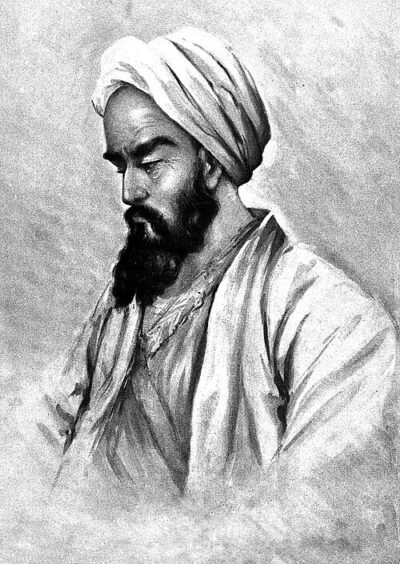
Abu Bakr al-Razi
Abu Bakr al-Razi was a Persian polymath, physician, chemist and philosopher. Born 866, in Ray. Died 925, in Ray. Known for Ṭibb al-rūḥānī, The comprehensive book on medicine and Doubts About Galen.
Facts
15 facts · 1 confirmed by two sources · 5 cited · 8 from one source · 1 where the sources disagree
What’s different
- Born: we show 866 (Sources disagree). Wikipedia says 865
Where this comes from
Papalocal keeps its own record. It started from these sources; what each one said is kept here as it was copied, so a change on their side never changes this page by itself. Tap one to read its version.
What Wikidata says · copied November 16, 2026 · revision 2567368226
- Described as
- Persian polymath, physician, chemist and philosopher (854-925)
- Other names
- al-Razi, Razi, Rhazes, Rasis, Abū Bakr Muḥammad ibn Zakarīyā Rāzī
- Born
- 866 · 2 references
- Died
- 925 · 1 reference
- Born in
- Ray · 2 references
- Died in
- Ray · 2 references
- Occupation
- mathematician; chemist; philosopher · 1 reference; inventor; physician · 1 reference; writer · 1 reference
- Known for
- Ṭibb al-rūḥānī; The comprehensive book on medicine; Doubts About Galen
- Field
- medicine
- Religion
- Islam
- Wikipedias with a page
- 98
Wikidata item Q169234 (wikidata.org/wiki/Q169234), public domain (CC0). Copied November 16, 2026.
What Wikipedia says · copied November 16, 2026 · revision 1384886953
Abū Bakr al-Rāzī, also known as Rhazes (full name: أبو بکر محمد بن زکریاء الرازي, Abū Bakr Muḥammad ibn Zakariyyāʾ al-Rāzī, 864 or 865 – 925 or 935 CE), was a Persian Muslim physician, philosopher, alchemist, and pre-eminent medical writer of the Islamic Golden Age, widely regarded as one of the most important figures in the history of medicine. In addition to medicine and philosophy, he wrote on logic, astronomy, and grammar.
Al-Rāzī studied medicine in Baghdad, where he spent much of his career, and became a successful physician who served as chief physician of hospitals in Baghdad and Ray. He was an early proponent of experimental medicine and made numerous medical advances through observation and discovery. As a teacher he attracted students of differing backgrounds and interests and was reputed to be compassionate and devoted to patients irrespective of whether they were rich or poor. Together with Thābit ibn Qurra (836–901), he was among the first physicians to distinguish clinically between smallpox and measles. He recognized the complexity of the causes of disease and the importance of the patient's own disposition or will in recovery, observing that this influence could be sufficiently strong for even charlatans sometimes to bring about apparent cures, while also acknowledging the limitations of physicians themselves.
A prolific author, al-Rāzī is credited with more than 200 works or manuscripts. Among his major medical writings were Kitāb al-Manṣūrī, translated into Latin as Liber Almansoris, Kitāb al-Mulūkī (Liber Regius), and the extensive medical encyclopaedia Ḥāwī (Continens), which was completed by his pupils after his death. The latter was first translated into Latin in 1279 and subsequently became one of the early printed medical books, being printed five times between 1488 and 1542. Through Latin translation, his writings exerted a profound influence on medieval European medicine and medical education. Portions of Al-Manṣūrī, including sections on surgery and general therapeutics, entered the curricula of Western universities. Edward Granville Browne regarded him as "probably the greatest and most original of all the Muslim physicians, and one of the most prolific as an author". He has additionally been described as the father of pediatrics and as a pioneer in obstetrics and ophthalmology.
In philosophy, al-Rāzī accorded a particularly high status to reason, regarding it as a divine gift through which human beings could attain the benefits available to them in this life and the next. He was also critical of religion, particularly the concepts of prophethood and revelation, and a now lost work on prophecy reportedly maintained that reason occupied a higher rank than prophecy. His religio-philosophical doctrines, including a belief in five "eternal principles", survive only fragmentarily and are known largely through reports by writers who were often hostile to him. Toward the end of his life he became blind and declined treatment, explaining that after so long a life he had already seen enough of the world.
- Born, in its opening lines
- 865
- Died, in its opening lines
- 925
From the Wikipedia article “Abu Bakr al-Razi” (en.wikipedia.org/wiki/Abu_Bakr_al-Razi), by its contributors, under CC BY-SA 4.0 (creativecommons.org/licenses/by-sa/4.0/). Copied November 16, 2026; not changed.
Confirmed Two sources agree. Cited One source, and it names where it got it. One source One source, without a reference of its own. Sources disagree The sources disagree. We show the best-supported value and keep theirs below.
