
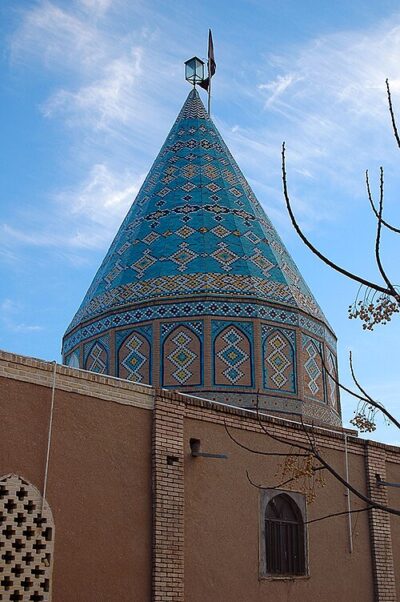
abu lulu majousi
abu lulu majousi was a Persian sasanian soldier, murder of caliph Omar. Died November 3, 644, in Medina.
Facts
12 facts · 1 confirmed by two sources · 1 cited · 8 from one source · 2 where the sources disagree
What’s different
- Born in: we show Nahavand (Sources disagree). Wikidata also lists Kashan
- Died in: we show Medina (Sources disagree). Wikidata also lists Kashan
Where this comes from
Papalocal keeps its own record. It started from these sources; what each one said is kept here as it was copied, so a change on their side never changes this page by itself. Tap one to read its version.
What Wikidata says · copied November 16, 2026 · revision 2563006988
- Described as
- Persian sasanian soldier, murder of caliph Omar
- Other names
- Piruz Nahavandi, Pirouz Nahavandi, Pirooz Nahavandi, Firuz Nahavandi, Firouz Nahavandi, Firooz Nahavandi, Baba Shuja' al-din, Baba Shuja aldin, Abu Luʼluʼah, Abu Luluah, Abu Lu'lu', Abu Lulu
- Died
- November 3, 644
- Born in
- Nahavand; Kashan
- Died in
- Medina; Kashan
- Buried in
- Piruz Nahavandi Mausoleum · 1 reference
- Cause of death
- exsanguination
- Occupation
- soldier; artisan; blacksmith; joiner; murderer
- Worked for
- Mughira ibn Shu'ba
- Religion
- Zoroastrianism
- Wikipedias with a page
- 35
Wikidata item Q3771961 (wikidata.org/wiki/Q3771961), public domain (CC0). Copied November 16, 2026.
What Wikipedia says · copied November 16, 2026 · revision 1380719908
Abū Luʾluʾa Fīrūz (Arabic: أبو لؤلؤة فیروز, from Middle Persian: Pērōz), also known in modern Persian-language sources as Abū Luʾluʾ (ابولؤلؤ) or Fīrūz Nahāvandī (فیروز نهاوندی), was a Sasanian Persian slave who assassinated Umar ibn al-Khattab (r. 634–644), the second Islamic caliph, in November 644.
After having been captured in battle during the Arab-Muslim conquest of Persia, Abu Lu'lu'a was brought to Medina, the then-capital of the Rashidun Caliphate, which was normally off-limits to non-Arab captives. However, as a highly skilled craftsman, Abu Lu'lu'a was exceptionally allowed entrance into the city in order to work for the caliph. His motive for killing the caliph is not entirely clear, but medieval sources generally attribute it to a tax dispute. At one point, Abu Lu'lu'a is said to have asked the caliph to lift a tax imposed upon him by his Arab master, al-Mughira ibn Shu'ba. When Umar refused to lift the tax, Abu Lu'lu'a attacked him while he was leading the congregational prayer in the mosque, stabbing him with a double-bladed dagger and leaving him mortally wounded.
According to historical accounts, Abu Lu'lu'a was either captured and executed in Medina, or committed suicide there. In retaliation, Ubayd Allah ibn Umar (one of Umar's sons) killed Abu Lu'lu'a's daughter, as well as Hurmuzān (a former officer in the Sasanian army) and a Christian man from al-Hira (Iraq). However, according to later legends that were first recorded in the Safavid era, the prophet Muhammad's cousin and son-in-law Ali (later revered as the first Shi'ite Imam) saved Abu Lu'lu'a from his pursuers and miraculously transported him to the city of Kashan (Iran), where Abu Lu'lu'a married and lived out the rest of his life.
At some point a shrine was erected for Abu Lu'lu'a in Kashan. From the 16th century onward this shrine became the focus of a yearly anti-Sunni festival celebrating Abu Lu'lu'a's assassination of Umar, whose reign Shi'ites consider to have been oppressive and unjust. In the context of this festival, which is called Omar Koshan (lit. 'the killing of Umar'), Abu Lu'lu'a received the nickname Bābā Shujāʿ al-Dīn (بابا شجاع الدين, 'Father Courageous of the Faith').
- Born, in its opening lines
- 634
- Died, in its opening lines
- 644
From the Wikipedia article “Abu Lu'lu'a” (en.wikipedia.org/wiki/Abu_Lu'lu'a), by its contributors, under CC BY-SA 4.0 (creativecommons.org/licenses/by-sa/4.0/). Copied November 16, 2026; not changed.
Confirmed Two sources agree. Cited One source, and it names where it got it. One source One source, without a reference of its own. Sources disagree The sources disagree. We show the best-supported value and keep theirs below.
