
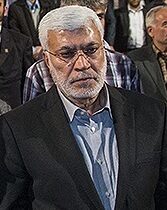
Abu Mahdi al-Muhandis
Abu Mahdi al-Muhandis was an Iraqi politician and Army commander. Born July 1, 1954, in Abu Al-Khaseeb District. Died January 3, 2020, in Baghdad Airport Road. Positions held include Member of the Council of Representatives of Iraq (2006–2007) and Secretary General of Kataib Hezbollah (2003–2020). Educated at University of Technology, Iraq.
Facts
22 facts · 1 confirmed by two sources · 3 cited · 17 from one source · 1 where the sources disagree
What’s different
- Born: we show July 1, 1954 (Sources disagree). Wikipedia says November 16, 1954
Where this comes from
Papalocal keeps its own record. It started from these sources; what each one said is kept here as it was copied, so a change on their side never changes this page by itself. Tap one to read its version.
What Wikidata says · copied November 16, 2026 · revision 2570485410
- Described as
- Iraqi politician and Army commander (1954-2020)
- Other names
- Jamal Jafaar Mohammed Ali Ebrahimi
- Born
- July 1, 1954 · 1 reference
- Died
- January 3, 2020 · 2 references
- Born in
- Abu Al-Khaseeb District
- Died in
- Baghdad Airport Road · 1 reference
- Buried in
- Wadi-us-Salaam
- Cause of death
- drone warfare · 1 reference
- Name at birth
- جمال جعفر محمد علي آل إبراهيم
- Citizen of
- Kingdom of Iraq (1954–1958); First Republic of Iraq (1958–1968); Ba'athist Iraq (1968–1980); Iraq (2003–2020)
- Occupation
- politician · 2 references; civil engineer · 1 reference; military leader
- Positions held
- Member of the Council of Representatives of Iraq (2006–2007); Secretary General of Kataib Hezbollah (2003–2020)
- Political party
- Islamic Dawa Party (1977–2020); Islamic Supreme Council of Iraq (1985–2020)
- Education
- University of Technology, Iraq (–1977)
- Member of
- Kata'ib Hezbollah
- Religion
- Islam
- Military branch
- Popular Mobilization Forces
- Wikipedias with a page
- 39
Wikidata item Q19609480 (wikidata.org/wiki/Q19609480), public domain (CC0). Copied November 16, 2026.
What Wikipedia says · copied November 16, 2026 · revision 1375603956
Jamal Ja'far Muhammad Ali Al Ibrahim (Arabic: جمال جعفر محمد علي آل إبراهيم Jamāl Jaʿfar Muḥammad ʿAlīy ʾĀl ʾIbrāhīm, 16 November 1954 – 3 January 2020), better known by his kunya Abu Mahdi al-Muhandis (Arabic: أبو مهدي المهندس, lit. 'Father of Mahdi, the Engineer'), was an Iraqi paramilitary leader and former chief of staff of the Popular Mobilization Forces (PMF). At the time of his death, he was deputy chairman of the PMC.
From 1977, he was an opponent of Saddam Hussein. He became the commander of volunteer militias that grew from the need to combat ISIS, including the Kata'ib Hezbollah paramilitary group, which is designated a terrorist group by the governments of Japan, the United States and the United Arab Emirates; and prior to that worked with the Iranian Revolutionary Guards (IRGC) against Saddam's regime. Muhandis was on the United States list of designated terrorists since 2009.
Allegations of terrorism have been levelled against him over his activities in Kuwait in the 1980s. He was sentenced to death in absentia in 2007 by a court in Kuwait for his involvement in the 1983 Kuwait bombings. The organisations he oversaw, such as the Popular Mobilization Forces, have been reported to have close links to the IRGC's Quds Force. Al-Muhandis was held responsible for planning the attack on the American embassy in Baghdad in late December 2019.
On 3 January 2020, Al-Muhandis was traveling with the head of Iran's expeditionary Quds Force Qasem Soleimani near Baghdad International Airport. Soleimani was the primary target of a targeted U.S. drone strike which killed Al-Muhandis as well.
- Born, in its opening lines
- November 16, 1954
- Died, in its opening lines
- January 3, 2020
From the Wikipedia article “Abu Mahdi al-Muhandis” (en.wikipedia.org/wiki/Abu_Mahdi_al-Muhandis), by its contributors, under CC BY-SA 4.0 (creativecommons.org/licenses/by-sa/4.0/). Copied November 16, 2026; not changed.
Confirmed Two sources agree. Cited One source, and it names where it got it. One source One source, without a reference of its own. Sources disagree The sources disagree. We show the best-supported value and keep theirs below.
