
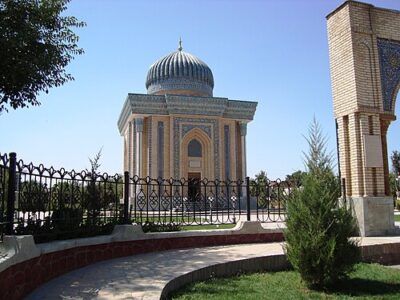
Abu Mansur al-Maturidi
Abu Mansur al-Maturidi was a Persian Muslim theologian. Born 852, in Maturid. Died 944, in Samarkand. Known for Kitab al-Tawhid and Tafsir al-Maturidi.
Facts
20 facts · 1 confirmed by two sources · 2 cited · 16 from one source · 1 where the sources disagree
What’s different
- Born: we show 852 (Sources disagree). Wikipedia says 853
Where this comes from
Papalocal keeps its own record. It started from these sources; what each one said is kept here as it was copied, so a change on their side never changes this page by itself. Tap one to read its version.
What Wikidata says · copied November 16, 2026 · revision 2567382480
- Described as
- Persian Muslim theologian (853–944)
- Other names
- Maturidi, Abū Mansūr al-Māturīdī
- Born
- 852 · 1 reference
- Died
- 944 · 5 references
- Born in
- Maturid · 1 reference
- Died in
- Samarkand · 1 reference
- Buried in
- Mausoleum of Abu Mansur al-Maturidi
- Citizen of
- Abbasid Caliphate
- Occupation
- Islamic jurist; mutakallim; Qur'anic exegete; philosopher; mystic; theologian · 1 reference
- Known for
- Kitab al-Tawhid; Tafsir al-Maturidi
- Field
- Islamic theology; Ilm al-Kalam; tafsir; Usul al-fiqh
- Religion
- Islam; Sunni Islam
- Wikipedias with a page
- 35
Wikidata item Q12827721 (wikidata.org/wiki/Q12827721), public domain (CC0). Copied November 16, 2026.
What Wikipedia says · copied November 16, 2026 · revision 1377814508
Imam Abu Mansur al-Maturidi (Arabic: أبو منصور الماتريدي, romanized: Abū Manṣūr al-Māturīdī; 853–944; AH 333) was a Hanafi jurist and theologian, and the eponymous founder of the Maturidi school of kalam in Sunni Islam. A contemporary of al-Ashʿarī, he established an important school of orthodox, conservative theology that accorded a significant, though not paramount, role to human reason. His nisba derives from Māturīd, a district of Samarkand. His works include Tafsir al-Maturidi, a classical exegesis of the Qur'an, and Kitāb al-Tawḥīd. The theological school associated with him remains one of the three principal Sunni schools of theology alongside Ash'arism and Atharism.
Al-Maturidi opposed the Muʿtazilites, employing forms of rational argument similar to their own in order to contest their doctrines. The differences between the Ashʿarite and Maturidite schools were traditionally reckoned at thirteen, the most substantial concerning divine and human agency: Ashʿarism emphasized the absolute power of the will of Allah, whereas Maturidism emphasized human freedom and responsibility. In this connection, the Ashʿarites were characterized as saying, "I am a believer if God wills" (in shāʾ Allāh), while the Muʿtazilites could say, "I know with truth [ḥaqqan] that I am a believer". Al-Ashʿarī nevertheless accepted a somewhat different doctrine of acquisition (kasb).
Al-Maturidi affirmed the divine attributes described in the Qur'an, while maintaining that their mode cannot be comprehended by human beings. Thus, in relation to descriptions such as God sitting upon his throne, he accepted the principle of bilā kayf, "without knowing how".
- Born, in its opening lines
- 853
- Died, in its opening lines
- 944
From the Wikipedia article “Abu Mansur al-Maturidi” (en.wikipedia.org/wiki/Abu_Mansur_al-Maturidi), by its contributors, under CC BY-SA 4.0 (creativecommons.org/licenses/by-sa/4.0/). Copied November 16, 2026; not changed.
Confirmed Two sources agree. Cited One source, and it names where it got it. One source One source, without a reference of its own. Sources disagree The sources disagree. We show the best-supported value and keep theirs below.
