
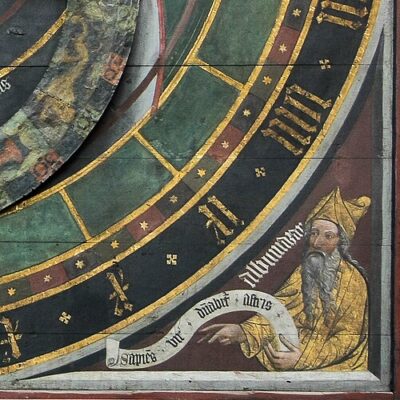
Abu Ma'shar al-Balkhi
Abu Ma'shar al-Balkhi was a Persian astrologer and philosopher. Born August 10, 787, in Balkh. Died 886, in Wasit Governorate.
Facts
13 facts · 2 confirmed by two sources · 5 cited · 6 from one source
Where this comes from
Papalocal keeps its own record. It started from these sources; what each one said is kept here as it was copied, so a change on their side never changes this page by itself. Tap one to read its version.
What Wikidata says · copied November 16, 2026 · revision 2567386220
- Described as
- Persian astrologer and philosopher (787–886)
- Other names
- Apomasar
- Born
- August 10, 787
- Died
- 886 · 1 reference
- Born in
- Balkh · 1 reference
- Died in
- Wasit Governorate
- Citizen of
- Abbasid Caliphate
- Occupation
- astronomer; mathematician · 1 reference; philosopher; astrologer · 2 references
- Field
- mathematics; astrology · 1 reference; astronomy · 1 reference
- Religion
- Islam
- Wikipedias with a page
- 38
Wikidata item Q11373 (wikidata.org/wiki/Q11373), public domain (CC0). Copied November 16, 2026.
What Wikipedia says · copied November 16, 2026 · revision 1382833254
Abu Ma‘shar al-Balkhi, Latinized as Albumasar (also Albusar, Albuxar, Albumazar; full name Abū Maʿshar Jaʿfar ibn Muḥammad ibn ʿUmar al-Balkhī ابومَعْشَر جعفر بن محمد بن عمر بلخی;
10 August 787 – 9 March 886, AH 171–272), was an early Persian Muslim astrologer, thought to be the greatest astrologer of the Abbasid court in Baghdad. While he was not a major innovator, his practical manuals for training astrologers profoundly influenced Muslim intellectual history and, through translations, that of western Europe and Byzantium.
- Born, in its opening lines
- August 10, 787
- Died, in its opening lines
- March 9, 886
From the Wikipedia article “Abu Ma'shar al-Balkhi” (en.wikipedia.org/wiki/Abu_Ma'shar_al-Balkhi), by its contributors, under CC BY-SA 4.0 (creativecommons.org/licenses/by-sa/4.0/). Copied November 16, 2026; not changed.
Confirmed Two sources agree. Cited One source, and it names where it got it. One source One source, without a reference of its own. Sources disagree The sources disagree. We show the best-supported value and keep theirs below.
