
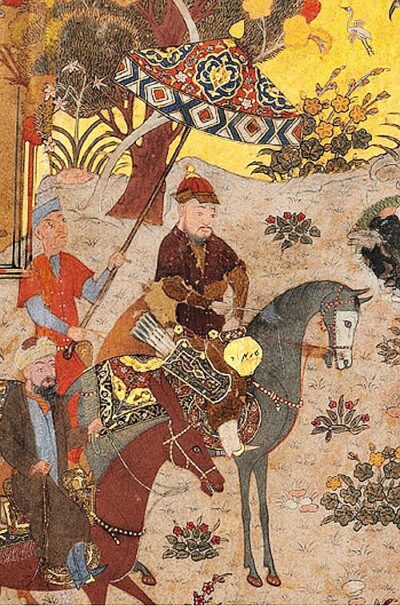
Abu Sa'id Mirza was a Timurid Empire ruler. Born 1424, in Samarkand. Died February 5, 1469, in Herat. Positions held include Timurid sultan (1451–1469).
Facts
12 facts · 2 confirmed by two sources · 0 cited · 10 from one source
Where this comes from
Papalocal keeps its own record. It started from these sources; what each one said is kept here as it was copied, so a change on their side never changes this page by itself. Tap one to read its version.
What Wikidata says · copied November 16, 2026 · revision 2554507862
- Described as
- Timurid Empire ruler (1424-1469)
- Born
- 1424
- Died
- February 5, 1469 · 1 reference
- Born in
- Samarkand
- Died in
- Herat
- Occupation
- politician
- Positions held
- Timurid sultan (1451–1469)
- Children
- Umar Shaikh Mirza II; Sultan Ahmed Mirza; Ulugh Beg Mirza; Sultan Mahmud Mirza
- Father
- Sultan Muhammad
- Religion
- Islam
- Wikipedias with a page
- 29
Wikidata item Q1192519 (wikidata.org/wiki/Q1192519), public domain (CC0). Copied November 16, 2026.
What Wikipedia says · copied November 16, 2026 · revision 1374719396
Abu Sa'id Mirza (Chagatay/Persian: ابو سعید میرزا; 1424 – 5 February 1469) was the ruler of the Timurid Empire during the mid-fifteenth century.
Born a minor prince of the Timurid dynasty, Abu Sa'id quickly established himself as the most prominent among his warring relations. Over the course of two decades, he reunified much of the Timurid Empire, which had become fractured in the aftermath of the death of his great-uncle Shah Rukh. However, Abu Sa'id's hopes of restoring the empire to its former extent at the time of Timur ultimately failed after he was killed during an invasion of what is now western Iran.
He was the paternal grandfather of Babur, who later founded the Mughal Empire of India.
- Born, in its opening lines
- 1424
- Died, in its opening lines
- February 5, 1469
From the Wikipedia article “Abu Sa'id Mirza” (en.wikipedia.org/wiki/Abu_Sa'id_Mirza), by its contributors, under CC BY-SA 4.0 (creativecommons.org/licenses/by-sa/4.0/). Copied November 16, 2026; not changed.
Confirmed Two sources agree. Cited One source, and it names where it got it. One source One source, without a reference of its own. Sources disagree The sources disagree. We show the best-supported value and keep theirs below.
