
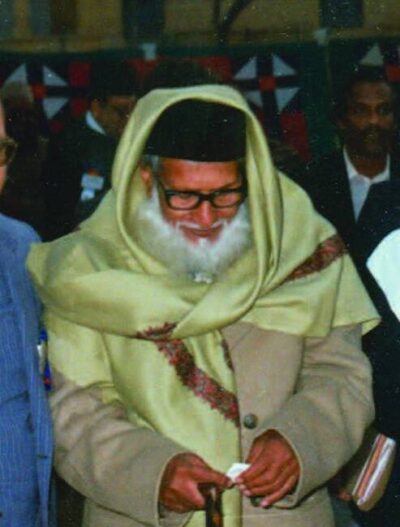
Abul Hasan Ali Hasani Nadwi
Abul Hasan Ali Hasani Nadwi was an Indian Islamic scholar, thinker, author, orator and critic of Arab Nationalist. Born December 5, 1913, in Raebareli. Died December 31, 1999, in Raebareli. Awards include King Faisal Prize in Service to Islam.
Facts
15 facts · 2 confirmed by two sources · 2 cited · 11 from one source
Where this comes from
Papalocal keeps its own record. It started from these sources; what each one said is kept here as it was copied, so a change on their side never changes this page by itself. Tap one to read its version.
What Wikidata says · copied November 18, 2026 · revision 2564406780
- Described as
- Indian Islamic scholar, thinker, author, orator and critic of Arab Nationalist (1913–1999)
- Other names
- Abdulḥsan ʻAlī Nadvī, Ali Mian, Maulana Nadwi, Syed Abul Hasan Ali Hasani Nadwi
- Born
- December 5, 1913 · 1 reference
- Died
- December 31, 1999 · 2 references
- Born in
- Raebareli
- Died in
- Raebareli · 1 reference
- Citizen of
- India (1950–); British Raj (–1947); Dominion of India (1947–1950)
- Occupation
- philosopher; academic · 1 reference; Islamicist · 1 reference
- Member of
- Arab Academy of Damascus
- Awards
- King Faisal Prize in Service to Islam (1980)
- Religion
- Islam
- Lived in
- Raebareli; Lucknow
- Wikipedias with a page
- 20
Wikidata item Q3348646 (wikidata.org/wiki/Q3348646), public domain (CC0). Copied November 18, 2026.
What Wikipedia says · copied November 18, 2026 · revision 1382859995
Syed Abul Hasan Ali Hasani Nadwi (also known as Ali Miyan; 5 December 1913 – 31 December 1999) was a leading Indian Islamic scholar, thinker, writer, preacher, reformer and a Muslim public intellectual of 20th century India and the author of numerous books on history, biography, contemporary Islam, and the Muslim community in India, one of the most prominent figure of Deoband School. His teachings covered the entire spectrum of the collective existence of the Muslim Indians as a living community in the national and international context. Due to his command over Arabic, in writings and speeches, he had a wide area of influence extending far beyond the Sub-continent, particularly in the Arab World. During 1950s and 1960s he stringently attacked Arab nationalism and pan-Arabism as a new Jahiliyyah and promoted pan-Islamism. He began his academic career in 1934 as a teacher in Nadwatul Ulama, later in 1961; he became Chancellor of Nadwa and in 1985, he was appointed as Chairman of Oxford Centre for Islamic Studies.
He had a lifelong association with Tablighi Jamaat. For decades, he enjoyed universal respect, was accepted by the non-Muslims, at the highest level, as the legitimate spokesman for the concerns and aspirations of the entire Muslim community. Islam and the World is the much acclaimed book of Nadwi for which he received accolades throughout, especially Arab world where it was first published in 1951. His books are part of syllabic studies in various Arab Universities. In 1951, during his second Hajj, the key-bearer of the Kaaba, opened its door for two days and allowed him to take anyone he chose inside. He was the first Alim from India who was given the key to Kaaba by the Royal Family of Saudi Arabia to allow him to enter whenever he chose during his pilgrimage. He was the chairman of Executive Committee of Darul Uloom Deoband and president of All India Muslim Personal Law Board. He was the founder of Payam-e-Insaniyaat Movement and co-founder of All India Muslim Majlis-e-Mushawarat and Academy of Islamic Research & Publications. Internationally recognised, he was one of the Founding Members of the Muslim World League and served on the Higher Council of the Islamic University of Madinah, the executive committee of the League of Islamic Universities. The lectures he delivered at Indian, Arab and western Universities have been appreciated as original contribution to the study of Islam and on Islam's relevance to the modern age. As a theorist of a revivalist movement, in particular he believed Islamic civilisation could be revived via a synthesis of western ideas and Islam. In 1980, he received the King Faisal International Prize, followed by the Sultan of Brunei International Prize and the UAE Award in 1999.
- Born, in its opening lines
- December 5, 1913
- Died, in its opening lines
- December 31, 1999
From the Wikipedia article “Abul Hasan Ali Hasani Nadwi” (en.wikipedia.org/wiki/Abul_Hasan_Ali_Hasani_Nadwi), by its contributors, under CC BY-SA 4.0 (creativecommons.org/licenses/by-sa/4.0/). Copied November 18, 2026; not changed.
Confirmed Two sources agree. Cited One source, and it names where it got it. One source One source, without a reference of its own. Sources disagree The sources disagree. We show the best-supported value and keep theirs below.
