
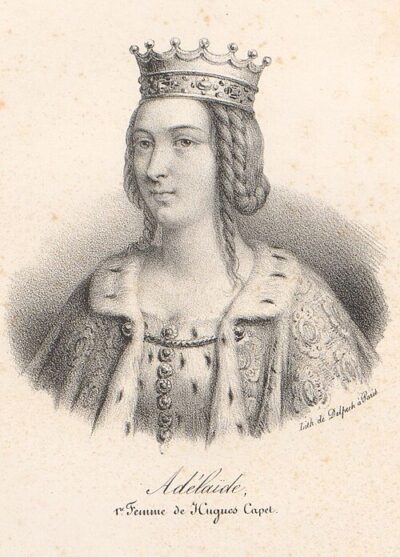
Adelaide of Aquitaine
Adelaide of Aquitaine was a French noble woman and queens consort. Born 950. Died June 15, 1004.
Facts
10 facts · 1 confirmed by two sources · 5 cited · 3 from one source · 1 where the sources disagree
What’s different
- Born: we show 950 (Sources disagree). Wikipedia says 952
Where this comes from
Papalocal keeps its own record. It started from these sources; what each one said is kept here as it was copied, so a change on their side never changes this page by itself. Tap one to read its version.
What Wikidata says · copied November 16, 2026 · revision 2551976292
- Described as
- French noble woman and queens consort
- Other names
- Adelais de Poitou reine des Francs
- Born
- 950
- Died
- June 15, 1004
- Occupation
- embroiderer · 1 reference
- Spouse
- Hugh Capet of France (969–) · 3 references
- Children
- Hedwig of France, Countess of Mons; Robert II of France · 1 reference; Gisèle de France
- Father
- William III, Duke of Aquitaine · 2 references
- Mother
- Gerloc · 1 reference
- Siblings
- William IV, Duke of Aquitaine
- Wikipedias with a page
- 39
Wikidata item Q232425 (wikidata.org/wiki/Q232425), public domain (CC0). Copied November 16, 2026.
What Wikipedia says · copied November 16, 2026 · revision 1368059256
Adbelahide, Adele, Adela or Adelaide of Aquitaine (also known as Adelaide of Poitiers; c. 945 or 952 – 1004), was the queen of France by marriage to King Hugh Capet (c. 939 – 14 October 996). Adelaide and Hugh were the founders of the Capetian dynasty of France, which ruled France until the 18th and 19th centuries. As queen, Adelaide had some extent of influence over her husband's governance of France. Adelaide is typically only briefly mentioned in connection to her husband, Hugh, and her son Robert II.
- Born, in its opening lines
- 952
- Died, in its opening lines
- 1004
From the Wikipedia article “Adelaide of Aquitaine” (en.wikipedia.org/wiki/Adelaide_of_Aquitaine), by its contributors, under CC BY-SA 4.0 (creativecommons.org/licenses/by-sa/4.0/). Copied November 16, 2026; not changed.
Confirmed Two sources agree. Cited One source, and it names where it got it. One source One source, without a reference of its own. Sources disagree The sources disagree. We show the best-supported value and keep theirs below.
