
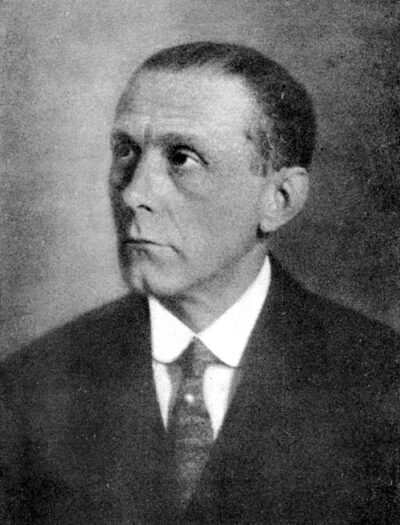
Adolf Loos
Adolf Loos was an Austrian and Czech architect and art collector. Born December 10, 1870, in Brno. Died August 23, 1933, in Vienna. Known for Looshaus and Villa Müller. Educated at University of Applied Arts Vienna and TU Dresden.
Facts
28 facts · 2 confirmed by two sources · 12 cited · 14 from one source
Where this comes from
Papalocal keeps its own record. It started from these sources; what each one said is kept here as it was copied, so a change on their side never changes this page by itself. Tap one to read its version.
What Wikidata says · copied November 16, 2026 · revision 2568987613
- Described as
- Austrian and Czech architect and art collector (1870-1933)
- Other names
- Adolph Loos, Adolf Franz Karl Viktor Maria Loos
- Born
- December 10, 1870 · 8 references
- Died
- August 23, 1933 · 7 references
- Born in
- Brno · 4 references
- Died in
- Vienna · 2 references
- Buried in
- Vienna Central Cemetery
- Citizen of
- Austria · 2 references; Czechoslovakia; Cisleithania
- Occupation
- architect · 7 references; writer · 1 reference; architecture critic · 1 reference; designer · 4 references; photographer · 1 reference; teacher · 1 reference; art theorist · 1 reference; essayist · 1 reference
- Education
- University of Applied Arts Vienna; TU Dresden; Stiftsgymnasium Melk
- Known for
- Looshaus · 1 reference; Villa Müller
- Field
- architecture; modern architecture · 1 reference
- Spouse
- Lina Loos; Elsie Altmann-Loos; Claire Beck Loos (1929–)
- Father
- Adolf Loos
- Siblings
- Helene Dülberg
- Wikipedias with a page
- 61
Wikidata item Q44323 (wikidata.org/wiki/Q44323), public domain (CC0). Copied November 16, 2026.
What Wikipedia says · copied November 16, 2026 · revision 1383865890
Adolf Franz Karl Viktor Maria Loos (German: [ˈaːdɔlf ˈloːs]; 10 December 1870 – 23 August 1933) was an Austrian and Czechoslovak architect, influential European theorist, and polemicist of modern architecture. He was inspired by modernism and a widely-known critic of the Art Nouveau movement. His controversial views and literary contributions sparked the establishment of the Vienna Secession movement and postmodernism.
Loos was born in Brno to a family of sculptors and stonemasons. His father, a stonemason who was almost deaf, died when he was 9 and played a role in Loos' interest in arts and crafts. Loos later inherited his father's hearing impairment and other health-related issues. His lack of hearing contributed to his solitary personality. Loos had three tumultuous marriages that all ended in divorce, and was convicted as a pedophile in 1928.
Loos attended multiple colleges also due to his poor academics and changing interests, which provided him a diverse skillset for architecture. After leaving his last university, Loos visited America and was strongly impacted by the Chicago School of Architecture, inspired by "form follows function" philosophy of architect Louis Sullivan.
Loos then went on to write many literary pieces including the satirical piece The Story of a Poor Rich Man and his most popular manifesto, Ornament and Crime, which advocated for a lack of ornamentation, exemplified in his design of Looshaus, Vienna, in contrast to both the lavish decorations of the fin de siècle and the more modern aesthetic principles of the Vienna Secession.
Loos became a pioneer of modern architecture and contributed a body of theory and criticism of Modernism in architecture and design and developed the "Raumplan" (literally spatial plan) method of arranging interior spaces, exemplified in Villa Müller in Prague. He died aged 62 in 1933 in Kalksburg near Vienna.
- Born, in its opening lines
- December 10, 1870
- Died, in its opening lines
- August 23, 1933
From the Wikipedia article “Adolf Loos” (en.wikipedia.org/wiki/Adolf_Loos), by its contributors, under CC BY-SA 4.0 (creativecommons.org/licenses/by-sa/4.0/). Copied November 16, 2026; not changed.
Confirmed Two sources agree. Cited One source, and it names where it got it. One source One source, without a reference of its own. Sources disagree The sources disagree. We show the best-supported value and keep theirs below.
