
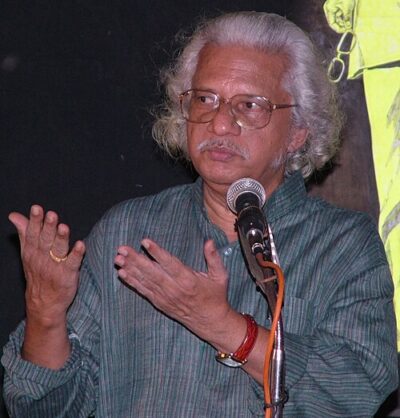
Adoor Gopalakrishnan
Adoor Gopalakrishnan is an Indian film director. Born July 3, 1941, in Adoor. Educated at Film and Television Institute of India and Gandhigram Rural Institute. Awards include Knight of the Legion of Honour, National Film Award for Best Feature Film (2 times) and National Film Award for Best Direction (5 times).
Facts
27 facts · 1 confirmed by two sources · 9 cited · 17 from one source
Where this comes from
Papalocal keeps its own record. It started from these sources; what each one said is kept here as it was copied, so a change on their side never changes this page by itself. Tap one to read its version.
What Wikidata says · copied November 17, 2026 · revision 2535773294
- Described as
- Indian film director (born 1941)
- Other names
- Adoor
- Born
- July 3, 1941 · 1 reference
- Born in
- Adoor
- Citizen of
- India
- Occupation
- film director; screenwriter · 3 references; film producer · 4 references; camera operator
- Education
- Film and Television Institute of India · 1 reference; Gandhigram Rural Institute · 1 reference
- Genre
- Parallel Cinema · 1 reference
- Awards
- Knight of the Legion of Honour (1984) · 1 reference; National Film Award for Best Feature Film (2 times) (1972, 1995); National Film Award for Best Direction (5 times) (1972, 1984, 1987, 1989, 2007) · 1 reference; Kerala State Film Award for Best Story (1977); National Film Award for Best Feature Film in Malayalam (6 times) (1977, 1981, 1984, 1989, 1993, 2002); Kerala State Film Award for Best Film (5 times) (1977, 1981, 1984, 1993, 2008); Kerala State Film Award for Best Director (6 times) (1977, 1984, 1987, 1993, 1995, 2008); National Film Award – Special Jury Award / Special Mention (1980); Sutherland Trophy (1982) · 1 reference; Kerala State Film Award for Best Documentary (2 times) (1982, 1999); National Film Award for Best Book on Cinema (1983); National Film Award for Best Screenplay (2 times) (1984, 1987); Kerala State Film Award for Best Screenplay (2 times) (1993, 2008); Dadasaheb Phalke Award (2004) · 1 reference; Kerala State Film Award for Best Short Film (2005)
- Religion
- Hinduism
- Website
- http://www.adoorgopalakrishnan.com/profile.htm
- Wikipedias with a page
- 27
Wikidata item Q366242 (wikidata.org/wiki/Q366242), public domain (CC0). Copied November 17, 2026.
What Wikipedia says · copied November 17, 2026 · revision 1383881325
Mouttathu Unnithan Gopalakrishnan (born 3 July 1941), known professionally as Adoor Gopalakrishnan, is an Indian film director, screenwriter, and producer who works in Malayalam cinema. With the release of his first feature film Swayamvaram (1972), Gopalakrishnan pioneered the "new wave" in Malayalam cinema during the 1970s. In a career spanning over five decades, Gopalakrishnan has made 12 feature films. His films often depict the society and culture of Kerala. Nearly all of his films premiered at Venice, Cannes and Toronto film festivals. Along with Satyajit Ray and Mrinal Sen, Gopalakrishnan is one of the most recognized Indian film directors in the world cinema.
For his films, Gopalakrishnan has won 16 National Film Awards, next only to Ray and Sen. He also won 17 Kerala State Film Awards. He was awarded the Padma Shri in 1984 and the Padma Vibhushan in 2006. He received the Dadasaheb Phalke Award in 2004 for his valuable contributions to Indian cinema. In 2016, he was awarded the J. C. Daniel Award, Kerala government's highest honour for contributions to Malayalam cinema. The University of Wisconsin-Milwaukee have established an archive and research center, the Adoor Gopalakrishnan Film Archive and Research Center, at their Peck School of Arts where research students will have access to 35 mm prints of the 11 feature films and several documentaries made by Gopalakrishnan.
- Born, in its opening lines
- July 3, 1941
From the Wikipedia article “Adoor Gopalakrishnan” (en.wikipedia.org/wiki/Adoor_Gopalakrishnan), by its contributors, under CC BY-SA 4.0 (creativecommons.org/licenses/by-sa/4.0/). Copied November 17, 2026; not changed.
Confirmed Two sources agree. Cited One source, and it names where it got it. One source One source, without a reference of its own. Sources disagree The sources disagree. We show the best-supported value and keep theirs below.
