
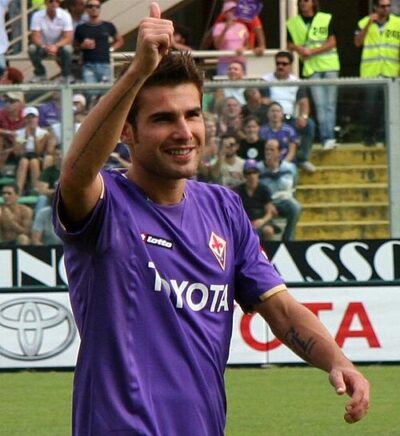
Adrian Mutu
Adrian Mutu is a Romanian footballer. Born January 8, 1979, in Călinești. Teams include Juventus FC (2005–2006), ACF Fiorentina (2006–2011) and Parma Calcio 1913 (2002–2003). Educated at University of Bucharest. Awards include The "Sport Merit" Medal.
Facts
25 facts · 1 confirmed by two sources · 0 cited · 24 from one source
Where this comes from
Papalocal keeps its own record. It started from these sources; what each one said is kept here as it was copied, so a change on their side never changes this page by itself. Tap one to read its version.
What Wikidata says · copied November 16, 2026 · revision 2546534615
- Described as
- Romanian footballer (born 1979)
- Born
- January 8, 1979 · 2 references
- Born in
- Călinești
- Citizen of
- Romania
- Occupation
- association football player (–2016); association football coach
- Education
- University of Bucharest
- Teams
- Juventus FC (2005–2006); ACF Fiorentina (2006–2011); Parma Calcio 1913 (2002–2003); Hellas Verona FC (2000–2002); A.C. Ajaccio (2012–2014); AC Cesena (2011–2012); Chelsea F.C. (2003–2004); Inter Milan (1999–2000); FC Argeș (1996–1998); FC Dinamo Bucharest (1998–1999); US Livorno 1915 (2005); FC Petrolul Ploiești (2014); FC Pune City (2015); ASA 2013 Târgu Mureș (2016); Romania men's national association football team (2000–2013)
- Sport
- association football
- Awards
- The "Sport Merit" Medal
- Height
- 1.80 m (5 ft 11 in)
- Website
- http://www.adrianmutu.com
- Wikipedias with a page
- 53
Wikidata item Q202645 (wikidata.org/wiki/Q202645), public domain (CC0). Copied November 16, 2026.
What Wikipedia says · copied November 16, 2026 · revision 1383965599
Adrian Mutu (Romanian pronunciation: [adriˈan ˈmutu] ; born 8 January 1979) is a Romanian professional football manager and former player. During his playing career, he was deployed as a forward or an attacking midfielder.
Mutu started his career playing two years for Argeș Pitești and one year for Dinamo București, before joining Inter Milan in Italy midway through the 1999–2000 Serie A season. After only ten games with the Nerazzurri, he left for Hellas Verona and then Parma, for which he scored 39 goals in the next three years. His excellent form brought him a €22.5 million transfer to Chelsea and a nomination for the Ballon d'Or in 2003. Following a failed drug test, he was released and returned to Serie A to join Juventus. After the 2006 Italian football scandal and the relegation of Juventus to Serie B, Mutu decided to join Fiorentina, where he played consistently for the next five years. He then had a season at Cesena and French club Ajaccio, before returning to his native country with Petrolul Ploiești in 2014. After two more brief spells with Pune City and ASA Târgu Mureș, Mutu retired from professional football in 2016.
A controversial figure off the field, Mutu received widespread attention following a positive test for cocaine while playing for Chelsea in 2005, which resulted in his immediate release from the club, a subsequent seven-month ban from the Football Association, and an order to pay £15.2 million in damages to his former employers, the largest financial penalty in FIFA history. He has unsuccessfully tried to appeal the fine numerous times, and was banned for a second time in 2010 following a positive test for sibutramine while at Fiorentina.
From his international debut in 2000, Mutu played 77 matches for the Romania national team and scored 35 goals, making him the joint all-time top-scorer alongside Gheorghe Hagi. He was included in the country's squads at the UEFA European Championship in 2000 and 2008. Mutu earned the Romanian Footballer of the Year award four times, a total surpassed only by Gheorghe Popescu and Gheorghe Hagi, who have won six and seven times, respectively.
- Born, in its opening lines
- January 8, 1979
From the Wikipedia article “Adrian Mutu” (en.wikipedia.org/wiki/Adrian_Mutu), by its contributors, under CC BY-SA 4.0 (creativecommons.org/licenses/by-sa/4.0/). Copied November 16, 2026; not changed.
Confirmed Two sources agree. Cited One source, and it names where it got it. One source One source, without a reference of its own. Sources disagree The sources disagree. We show the best-supported value and keep theirs below.
