
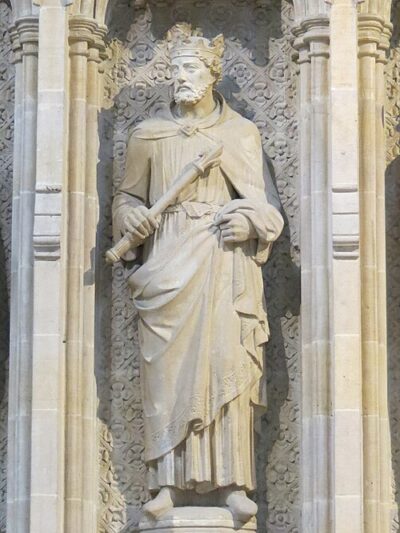
Æthelberht
Æthelberht was a King of Kent from 589. Born 552. Died February 24, 612. Positions held include king of Kent (–612).
Facts
11 facts · 0 confirmed by two sources · 1 cited · 8 from one source · 2 where the sources disagree
What’s different
- Born: we show 552 (Sources disagree). Wikipedia says c. 550
- Died: we show February 24, 612 (Sources disagree). Wikipedia says February 24, 616
Where this comes from
Papalocal keeps its own record. It started from these sources; what each one said is kept here as it was copied, so a change on their side never changes this page by itself. Tap one to read its version.
What Wikidata says · copied November 16, 2026 · revision 2553915608
- Described as
- King of Kent from 589
- Other names
- AEthelbert of Kent, Aethelbert I, Aethelberht of Kent, Aethelberht I, St. Ethelbert, St Ethelbert, Ethelbert of Kent, AEthelberht of Kent, Æthelbert of Kent, Ethelbertus Anglorum, Aethelbert of Kent, Ethelbert I of Kent
- Born
- 552
- Died
- February 24, 612
- Citizen of
- Kingdom of Kent
- Occupation
- monarch
- Positions held
- king of Kent (–612)
- Spouse
- Bertha of Kent · 2 references; unnamed queen of Kent · 1 reference
- Children
- Eadbald of Kent; Æthelburh of Kent; Æðelwald
- Father
- Eormenric of Kent
- Wikipedias with a page
- 45
Wikidata item Q272173 (wikidata.org/wiki/Q272173), public domain (CC0). Copied November 16, 2026.
What Wikipedia says · copied November 16, 2026 · revision 1376007165
Æthelberht (; Old English: Æðelberht [ˈæðelberˠxt]; c. 550 – 24 February 616) was King of Kent from about 589 until his death. The eighth-century monk Bede, in his Ecclesiastical History of the English People, lists him as the third king to hold imperium over other Anglo-Saxon kingdoms. In the late-ninth-century Anglo-Saxon Chronicle, he is referred to as a bretwalda, or "Britain-ruler". He was the first Anglo-Saxon king to convert to Christianity.
Æthelberht was the son of Eormenric, succeeding him as king, according to the Chronicle. He married Bertha, the Christian daughter of Charibert I, king of the Franks, thus building an alliance with the most powerful state in contemporary Western Europe; the marriage probably took place before he came to the throne. Bertha's influence may have led to Pope Gregory I's decision to send Augustine as a missionary from Rome. Augustine landed on the Isle of Thanet in east Kent in 597. Shortly thereafter, Æthelberht converted to Christianity, churches were established, and wider-scale conversion to Christianity began in the kingdom. He provided the new church with land in Canterbury, thus helping to establish one of the foundation stones of English Christianity.
Æthelberht's law for Kent, the earliest written code in any Germanic language, instituted a complex system of fines; the law code is preserved in the Textus Roffensis. Kent was rich, with strong trade ties to the Continent, and Æthelberht may have instituted royal control over trade. Coinage probably began circulating in Kent during his reign for the first time since the Anglo-Saxon settlement.
He is regarded as a saint for his leading role in establishing Christianity among the Anglo-Saxons. His feast day was originally 24 February but was changed to 25 February in some Churches. In the Catholic Church, his feast day is currently celebrated on 24 February.
- Born, in its opening lines
- c. 550
- Died, in its opening lines
- February 24, 616
From the Wikipedia article “Æthelberht of Kent” (en.wikipedia.org/wiki/Æthelberht_of_Kent), by its contributors, under CC BY-SA 4.0 (creativecommons.org/licenses/by-sa/4.0/). Copied November 16, 2026; not changed.
Confirmed Two sources agree. Cited One source, and it names where it got it. One source One source, without a reference of its own. Sources disagree The sources disagree. We show the best-supported value and keep theirs below.
