
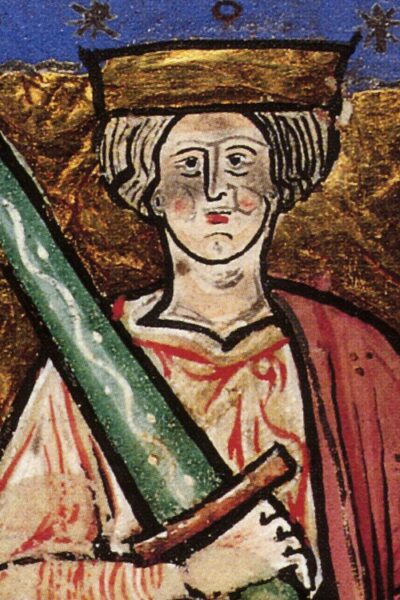
Æthelred the Unready
Æthelred the Unready was a King of England. Born 968, in Kingdom of Wessex. Died April 23, 1016, in London. Positions held include Monarch of England (978–1016).
Facts
27 facts · 2 confirmed by two sources · 16 cited · 9 from one source
What’s different
- Born: we show 968 (Confirmed). Wikidata also lists 967
Where this comes from
Papalocal keeps its own record. It started from these sources; what each one said is kept here as it was copied, so a change on their side never changes this page by itself. Tap one to read its version.
What Wikidata says · copied November 16, 2026 · revision 2560033856
- Described as
- King of England
- Other names
- Æthelred the Unready, king of England, Æthelræd the Unready, king of England, King Æthelræd, Aethelred II of England, Athelred, king of the English, Æthelred, King Æthelred II, Æthelræd, king of England, Æthelræd, king of the English, Athelred, King Ethelred II, Æthelred II of England
- Born
- 967; 968 · 1 reference
- Died
- April 23, 1016 · 5 references
- Born in
- Kingdom of Wessex · 1 reference
- Died in
- London
- Buried in
- Old St Paul's Cathedral
- Citizen of
- Kingdom of England
- Occupation
- monarch
- Positions held
- Monarch of England (978–1016)
- Spouse
- Ælfgifu of York · 2 references; Emma of Normandy (1002–) · 2 references
- Children
- Æthelstan Ætheling · 2 references; Edmund II of England · 1 reference; Eadred Ætheling · 1 reference; Eadwig Ætheling · 1 reference; Edward the Confessor · 2 references; Alfred Aetheling · 2 references; Goda of England · 2 references; Edgar · 1 reference; Edward · 1 reference; Ecgberht (?) · 1 reference; Eadgyth · 2 references; Ælfgifu · 1 reference
- Father
- Edgar of England · 1 reference
- Mother
- Ælfthryth · 1 reference
- Siblings
- Edward the Martyr; Edith of Wilton
- Religion
- Chalcedonian Christianity
- Wikipedias with a page
- 60
Wikidata item Q183499 (wikidata.org/wiki/Q183499), public domain (CC0). Copied November 16, 2026.
What Wikipedia says · copied November 16, 2026 · revision 1385724677
Æthelred II (c. 968 – 23 April 1016), known as Æthelred the Unready, was King of the English from March 978 to December 1013 and again from February 1014 until his death. The epithet "Unready" or "Unræd" is a pun on his name in Old English, Æðel (noble) and ræd (counsel). He was the son of King Edgar (r. 959–975) and Queen Ælfthryth.
Æthelred was born between 966 and 969, and very little is known of his early life. He came to the throne after the assassination by unknown perpetrators of his older half-brother, King Edward the Martyr (r. 975–978). The crime deeply shocked people, but Æthelred was too young to be suspected of involvement. Shortly after his accession, Viking attacks resumed after a generation of peace. Minor raids in the 980s escalated to large attacks from the 990s. As the English were rarely victorious in battle, the king and his advisers resorted to giving the Vikings tribute to leave England. In 1002, Æthelred ordered the St Brice's Day massacre of Danes, which is seen by historians as a sign of his increasing paranoia, and this culminated by 1009 in the rise of Eadric Streona to become the most powerful of Æthelred's advisers. Increasingly destructive raids by Viking armies wore down English resistance, and in December 1013 King Swein Forkbeard of Denmark conquered England. Æthelred fled to Normandy, but when Swein died in February 1014 he returned to the throne and drove out Swein's son Cnut. In early 1015, civil war broke out when Eadric Streona murdered close allies of Æthelred's oldest surviving son, Edmund Ironside. Cnut returned soon afterwards and Edmund and Æthelred tried to unite against him, but suspicion between father and son hampered them, as did Eadric's treachery and Æthelred's poor health. Æthelred died in April 1016 and Edmund carried on the war until he died in December and Cnut became the king of all England.
Æthelred was only nine to twelve years old when he became king, and during his minority the country was governed by his father's leading advisers, including his mother. When he came of age in the mid-980s, he rejected these advisers and adopted new ones, who persuaded him to grant them property at the expense of the church. By the early 990s he had come to regret the course he had followed and to see the Viking raids as God's punishment for his persecution of the church. The 990s and early 1000s formed the most successful period of his reign, when his advisers were of high calibre and there were major cultural achievements in Latin and Old English literature. Historians writing after the Norman Conquest saw him as a bad king until the late twentieth century, when a new generation reassessed his record and argued that although his reign ended catastrophically, there were significant achievements in the 990s and early 1000s.
- Born, in its opening lines
- c. 968
- Died, in its opening lines
- April 23, 1016
From the Wikipedia article “Æthelred the Unready” (en.wikipedia.org/wiki/Æthelred_the_Unready), by its contributors, under CC BY-SA 4.0 (creativecommons.org/licenses/by-sa/4.0/). Copied November 16, 2026; not changed.
Confirmed Two sources agree. Cited One source, and it names where it got it. One source One source, without a reference of its own. Sources disagree The sources disagree. We show the best-supported value and keep theirs below.
