
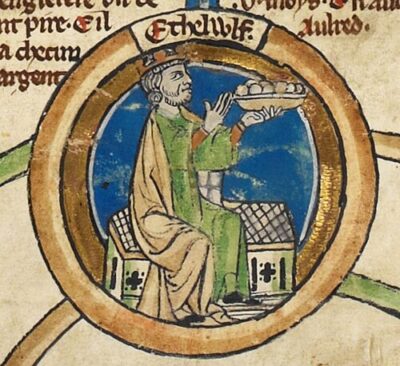
Æthelwulf
Æthelwulf was a King of Wessex. Died January 13, 858, in Kingdom of Wessex. Positions held include King of Wessex (839–858).
Facts
20 facts · 1 confirmed by two sources · 11 cited · 8 from one source
Where this comes from
Papalocal keeps its own record. It started from these sources; what each one said is kept here as it was copied, so a change on their side never changes this page by itself. Tap one to read its version.
What Wikidata says · copied November 16, 2026 · revision 2557874949
- Described as
- King of Wessex
- Other names
- Aethelwulf of Wessex, Ethelwulf of Wessex, AEthelwulf of Wessex, King Æthelwulf, Athelwulf of Wessex, Ethelwulf
- Died
- January 13, 858
- Born in
- Aachen · 1 reference
- Died in
- Kingdom of Wessex
- Buried in
- Winchester Cathedral
- Citizen of
- Kingdom of Wessex
- Occupation
- monarch
- Positions held
- King of Wessex (839–858)
- Spouse
- Judith of Flanders (856–) · 3 references; Osburh (830–) · 2 references
- Children
- Alfred the Great · 2 references; Æthelstan of Kent · 1 reference; Æthelswith · 2 references; Æthelbald · 1 reference; Æthelberht · 2 references; Æthelred I · 3 references; Egila of Wessex · 1 reference; Æthelbald of Mercia · 1 reference
- Father
- Ecgberht · 1 reference
- Mother
- unnamed wife of King Egbert of Wessex · 1 reference
- Religion
- Christianity
- Wikipedias with a page
- 48
Wikidata item Q272326 (wikidata.org/wiki/Q272326), public domain (CC0). Copied November 16, 2026.
What Wikipedia says · copied November 16, 2026 · revision 1385446634
Æthelwulf (Old English: [ˈæðelwuɫf]; Old English for 'Noble Wolf'; died 13 January 858) was King of Wessex from 839 to 858. In 825, his father, King Ecgberht, defeated King Beornwulf of Mercia, ending a long Mercian dominance over Anglo-Saxon England south of the Humber. Ecgberht sent Æthelwulf with an army to Kent, where he expelled the Mercian sub-king and was himself appointed sub-king. After 830, Ecgberht maintained good relations with Mercia, and this was continued by Æthelwulf when he became king in 839, the first son to succeed his father as West Saxon king since 641.
The Vikings were not a major threat to Wessex during Æthelwulf's reign. In 843, he was defeated in a battle against the Vikings at Carhampton in Somerset, but he achieved a major victory at the Battle of Aclea in 851. In 853, he joined a successful Mercian expedition to Wales to restore the traditional Mercian hegemony, and in the same year, his daughter Æthelswith married King Burgred of Mercia. In 855, Æthelwulf went on a pilgrimage to Rome. In preparation he gave a "decimation", donating a tenth of his personal property to his subjects; he appointed his eldest surviving son Æthelbald to act as King of Wessex in his absence, and his next son Æthelberht to rule Kent and the south-east. Æthelwulf spent a year in Rome, and on his way back he married Judith, the daughter of the West Frankish king Charles the Bald.
When Æthelwulf returned to England, Æthelbald refused to surrender the West Saxon throne, and Æthelwulf agreed to divide the kingdom, taking the east and leaving the west in Æthelbald's hands. On Æthelwulf's death in 858, he left Wessex to Æthelbald and Kent to Æthelberht, but Æthelbald's death only two years later led to the reunification of the kingdom. In the 20th century, Æthelwulf's reputation among historians was poor: he was seen as excessively pious and impractical, and his pilgrimage was viewed as a desertion of his duties. Historians in the 21st century see him very differently, as a king who consolidated and extended the power of his dynasty, commanded respect on the continent, and dealt more effectively than most of his contemporaries with Viking attacks. He is regarded as one of the most successful West Saxon kings, who laid the foundations for the success of his youngest son, Alfred the Great.
- Died, in its opening lines
- January 13, 858
From the Wikipedia article “Æthelwulf, King of Wessex” (en.wikipedia.org/wiki/Æthelwulf,_King_of_Wessex), by its contributors, under CC BY-SA 4.0 (creativecommons.org/licenses/by-sa/4.0/). Copied November 16, 2026; not changed.
Confirmed Two sources agree. Cited One source, and it names where it got it. One source One source, without a reference of its own. Sources disagree The sources disagree. We show the best-supported value and keep theirs below.
