
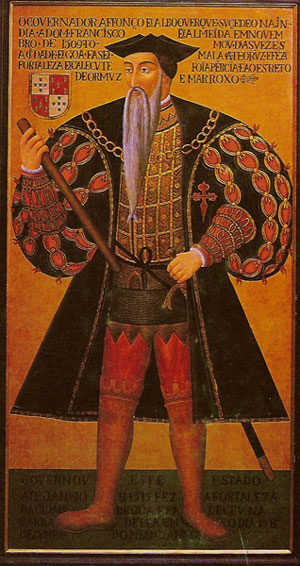
Afonso de Albuquerque
Afonso de Albuquerque was a Portuguese general, admiral, and statesman. Born 1453, in Freguesia de Alhandra. Died December 16, 1515, in Old Goa. Positions held include Governor of Portuguese India (1509–1515).
Facts
16 facts · 2 confirmed by two sources · 10 cited · 4 from one source
Where this comes from
Papalocal keeps its own record. It started from these sources; what each one said is kept here as it was copied, so a change on their side never changes this page by itself. Tap one to read its version.
What Wikidata says · copied November 16, 2026 · revision 2565537576
- Described as
- Portuguese general, admiral, and statesman (1453–1515)
- Other names
- Alfonso de Alburquerque, Alfonso d'Alburquerque
- Born
- 1453 · 11 references
- Died
- December 16, 1515 · 6 references
- Born in
- Freguesia de Alhandra · 2 references
- Died in
- Old Goa · 1 reference
- Buried in
- Lisbon
- Citizen of
- Kingdom of Portugal
- Occupation
- explorer · 1 reference; soldier · 1 reference; statesperson · 1 reference; seafarer · 1 reference; politician · 1 reference
- Positions held
- Governor of Portuguese India (1509–1515)
- Children
- Brás de Albuquerque · 1 reference
- Father
- Gonçalo de Albuquerque, seigneur de Vilaverde dos Francos · 1 reference
- Mother
- Dona Leonor de Menezes · 1 reference
- Military rank
- admiral
- Wikipedias with a page
- 69
Wikidata item Q204397 (wikidata.org/wiki/Q204397), public domain (CC0). Copied November 16, 2026.
What Wikipedia says · copied November 16, 2026 · revision 1382936719
Afonso de Albuquerque, 1st Duke of Goa (c. 1453 – 16 December 1515), was a Portuguese general, admiral, statesman, and conquistador. He served as viceroy of Portuguese India from 1509 to 1515, during which he expanded Portuguese influence across the Indian Ocean and built a reputation as a fierce and skilled military commander.
Albuquerque advanced the three-fold Portuguese grand scheme of combating Islam, spreading Christianity, and securing the trade of spices by establishing a Portuguese Asian empire. Among his achievements, Albuquerque managed to conquer Goa and was the first European of the Renaissance to raid the Persian Gulf, and he led the first voyage by a European fleet into the Red Sea. He is generally considered a highly effective military commander, and "probably the greatest naval commander of the age", given his successful strategy of attempting to close all the Indian Ocean naval passages to the Atlantic, Red Sea, Persian Gulf, and to the Pacific, transforming it into a Portuguese mare clausum. He was appointed head of the "fleet of the Arabian and Persian sea" in 1506.
Many of the conflicts in which he was directly involved took place in the Indian Ocean, in the Persian Gulf regions for control of the trade routes, and on the coasts of India. His military brilliance in these initial campaigns enabled Portugal to become the first global empire in history. He led the Portuguese forces in numerous battles, including the conquest of Goa in 1510 and the capture of Malacca in 1511.
During the last five years of his life, he turned to administration, where his actions as the second governor of Portuguese India were crucial to the longevity of the Portuguese Empire. He oversaw expeditions that resulted in establishing diplomatic contacts with the Ayutthaya Kingdom through his envoy Duarte Fernandes, with Pegu in Myanmar, and Timor and the Moluccas through a voyage headed by António de Abreu and Francisco Serrão. He laid the path for European trade with Ming China through Rafael Perestrello. He also aided in establishing diplomatic relations with Ethiopia, and established diplomatic ties with Persia during the Safavid dynasty.
Throughout his career, he received epithets such as "the Terrible", "the Great", "the Lion of the Seas", "the Portuguese Mars", and "the Caesar of the East".
- Born, in its opening lines
- c. 1453
- Died, in its opening lines
- December 16, 1515
From the Wikipedia article “Afonso de Albuquerque” (en.wikipedia.org/wiki/Afonso_de_Albuquerque), by its contributors, under CC BY-SA 4.0 (creativecommons.org/licenses/by-sa/4.0/). Copied November 16, 2026; not changed.
Confirmed Two sources agree. Cited One source, and it names where it got it. One source One source, without a reference of its own. Sources disagree The sources disagree. We show the best-supported value and keep theirs below.
