
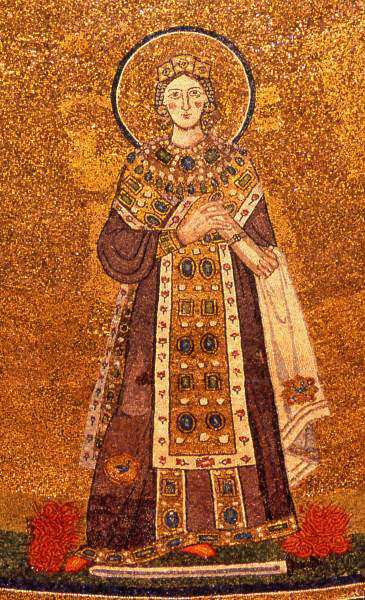
Agnes of Rome was a Christian martyr. Born 291, in Rome. Died January 21, 304, in Rome.
Facts
8 facts · 2 confirmed by two sources · 3 cited · 3 from one source
Where this comes from
Papalocal keeps its own record. It started from these sources; what each one said is kept here as it was copied, so a change on their side never changes this page by itself. Tap one to read its version.
What Wikidata says · copied November 16, 2026 · revision 2567599863
- Described as
- Christian martyr
- Other names
- Saint Agnes, Santa Inez, Saint, Martyr Agnes, Agnes, St. Agnes
- Born
- 291
- Died
- January 21, 304
- Born in
- Rome · 1 reference
- Died in
- Rome · 1 reference
- Buried in
- Sant'Agnese fuori le mura
- Cause of death
- decapitation
- Field
- Christianity · 1 reference
- Religion
- Christianity
- Wikipedias with a page
- 64
Wikidata item Q210096 (wikidata.org/wiki/Q210096), public domain (CC0). Copied November 16, 2026.
What Wikipedia says · copied November 16, 2026 · revision 1384653143
Agnes of Rome (c. 291 – 21 January 304) was a Roman Christian adolescent who was executed for her faith in the 4th century. She is venerated as a virgin martyr and as a saint in the Catholic Church, Oriental Orthodox Church and the Eastern Orthodox Church, as well as the Anglican Communion and Lutheran Churches. She is one of several virgin martyrs commemorated by name in the Canon of the Mass, and one of many Christians martyred during the reign of the Roman emperor Diocletian.
Agnes was born in 291 into Roman nobility, and raised as a Christian. She suffered martyrdom on 21 January 304, aged 12 or 13. Her high-ranking suitors, slighted by her resolute devotion to religious purity, sought to persecute her for her beliefs. Her father urged her to deny God, but she refused, and she was dragged naked through the streets to a brothel, then tried and sentenced to death. She was eventually beheaded, after attempts for her to be burnt at the stake failed. A few days after her death, her foster-sister Emerentiana was found praying by her tomb, and was stoned to death.
An early account of Agnes, stressing her young age, steadfastness and virginity was written by the 4th-century theologian, St Ambrose. Since the Middle Ages, she has traditionally been depicted as a young girl with her long hair with a lamb (the symbol of her virginal innocence and her name), a sword, and a palm branch (an attribute of her martyrdom). Her bones are beneath the high altar of the church built over her tomb in Rome. Her skull is preserved in the church of Sant'Agnese in Agone, Rome.
- Born, in its opening lines
- c. 291
- Died, in its opening lines
- January 21, 304
From the Wikipedia article “Agnes of Rome” (en.wikipedia.org/wiki/Agnes_of_Rome), by its contributors, under CC BY-SA 4.0 (creativecommons.org/licenses/by-sa/4.0/). Copied November 16, 2026; not changed.
Confirmed Two sources agree. Cited One source, and it names where it got it. One source One source, without a reference of its own. Sources disagree The sources disagree. We show the best-supported value and keep theirs below.
