
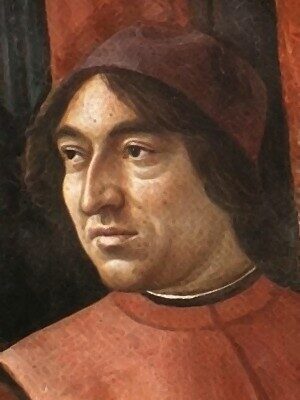
Agnolo Poliziano
Agnolo Poliziano was an Italian classical scholar and poet. Born July 14, 1454, in Montepulciano. Died September 29, 1494, in Florence. Known for Letters, Manto and Stanze cominciate per la giostra del Magnifico Giuliano de’ Medici. Educated at University of Florence.
Facts
24 facts · 1 confirmed by two sources · 8 cited · 14 from one source · 1 where the sources disagree
What’s different
- Died: we show September 29, 1494 (Sources disagree). Wikipedia says September 24, 1494
Where this comes from
Papalocal keeps its own record. It started from these sources; what each one said is kept here as it was copied, so a change on their side never changes this page by itself. Tap one to read its version.
What Wikidata says · copied November 16, 2026 · revision 2567590001
- Described as
- Italian classical scholar and poet (1454-1494)
- Other names
- Angelo Poliziano, Angelo Politian, Politian, Poliziano, Angelo Ambrogini
- Born
- July 14, 1454 · 2 references
- Died
- September 29, 1494 · 2 references
- Born in
- Montepulciano · 2 references
- Died in
- Florence · 2 references
- Buried in
- Florence
- Cause of death
- poison
- Name at birth
- Angelo Ambrogini
- Citizen of
- Republic of Siena; Republic of Florence
- Occupation
- poet · 3 references; playwright; university teacher · 1 reference; philologist · 1 reference; writer · 2 references; humanist · 1 reference
- Education
- University of Florence · 1 reference
- Known for
- Letters; Manto; Stanze cominciate per la giostra del Magnifico Giuliano de’ Medici; Fabula di Orfeo; Rime; Lamia; Nutricia
- Lived in
- Florence · 1 reference
- Wikipedias with a page
- 47
Wikidata item Q250414 (wikidata.org/wiki/Q250414), public domain (CC0). Copied November 16, 2026.
What Wikipedia says · copied November 16, 2026 · revision 1385563979
Agnolo (or Angelo) Ambrogini (Italian pronunciation: [ˈaɲɲolo ambroˈdʒiːni]; 14 July 1454 – 24 September 1494), commonly known as Angelo Poliziano (Italian: [ˈandʒelo politˈtsjaːno]) or simply Poliziano, anglicized as Politian, was an Italian classical scholar and poet of the Florentine Renaissance. His scholarship was instrumental in the divergence of Renaissance (or Humanist) Latin from medieval norms and for developments in philology. His nickname Poliziano, by which he is chiefly identified to the present day, was derived from the Latin name of his birthplace, Montepulciano (Mons Politianus).
Poliziano's works include translations of passages from Homer's Iliad, an edition of the poetry of Catullus and commentaries on classical authors and literature. It was his classical scholarship that brought him the attention of the wealthy and powerful Medici family that ruled Florence. He served the Medici as a tutor to their children, and later as a close friend and political confidant. His later poetry, including La Giostra, glorified his patrons.
He used his didactic poem Manto, written in the 1480s, as an introduction to his lectures on Virgil.
- Born, in its opening lines
- July 14, 1454
- Died, in its opening lines
- September 24, 1494
From the Wikipedia article “Poliziano” (en.wikipedia.org/wiki/Poliziano), by its contributors, under CC BY-SA 4.0 (creativecommons.org/licenses/by-sa/4.0/). Copied November 16, 2026; not changed.
Confirmed Two sources agree. Cited One source, and it names where it got it. One source One source, without a reference of its own. Sources disagree The sources disagree. We show the best-supported value and keep theirs below.
