
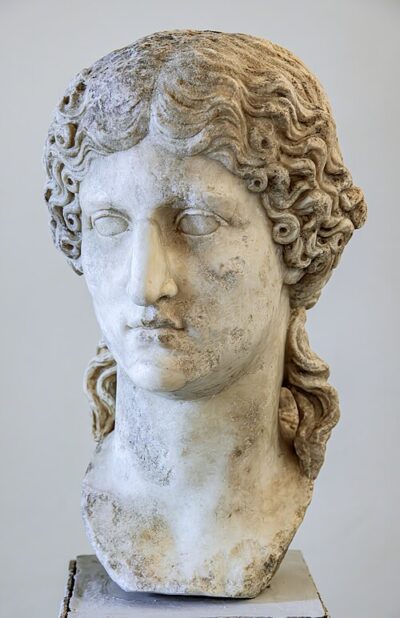
Agrippina the Elder
Agrippina the Elder was a Member of Julio-Claudian dynasty (c. 14 BC–AD 33). Born 14 BC, in Athens. Died October 18, 33, in Ventotene.
Facts
29 facts · 0 confirmed by two sources · 8 cited · 21 from one source
Where this comes from
Papalocal keeps its own record. It started from these sources; what each one said is kept here as it was copied, so a change on their side never changes this page by itself. Tap one to read its version.
What Wikidata says · copied November 16, 2026 · revision 2565527880
- Described as
- Member of Julio-Claudian dynasty (c. 14 BC–AD 33)
- Other names
- Vipsania Agrippina, Agrippina Major, Vipsania Julia Agrippina, Agrippina Maior, Agrippina
- Born
- 14 BC · 1 reference
- Died
- October 18, 33
- Born in
- Athens
- Died in
- Ventotene
- Buried in
- Mausoleum of Augustus
- Cause of death
- starvation
- Citizen of
- Ancient Rome
- Occupation
- politician
- Spouse
- Germanicus · 2 references
- Children
- Caligula · 1 reference; Agrippina the Younger · 2 references; Drusus Caesar · 1 reference; Julia Livilla; Julia Drusilla; Nero Caesar · 1 reference; Gaius Julius Caesar Germanicus Major; Tiberius Caesar; Ignotus Julius Caesar Germanicus
- Father
- Marcus Vipsanius Agrippa · 3 references
- Mother
- Julia the Elder · 3 references
- Siblings
- Gaius Caesar; Lucius Caesar; Agrippa Postumus; Julia the Younger; Tiberillus; Vipsania Agrippina; Vipsania Attica; Vipsania Marcella Major; Vipsania Marcella Minor
- Wikipedias with a page
- 44
Wikidata item Q229413 (wikidata.org/wiki/Q229413), public domain (CC0). Copied November 16, 2026.
What Wikipedia says · copied November 16, 2026 · revision 1382402497
Vipsania Agrippina the Elder (also, in Latin, Agrippina Germanici, "Germanicus's Agrippina"; c. 14 BC – AD 33) was a prominent member of the Julio-Claudian dynasty. She was the daughter of Marcus Vipsanius Agrippa (a close supporter of the first Roman emperor, Augustus) and Augustus' daughter, Julia the Elder. Her brothers Lucius and Gaius Caesar were the adoptive sons of Augustus, and were his heirs until their deaths in AD 2 and 4, respectively. Following their deaths, her second cousin Germanicus was made the adoptive son of Tiberius, Augustus' stepson, as part of the succession scheme in the adoptions of AD 4 (in which Tiberius was adopted by Augustus). As a result of the adoption, Agrippina was wed to Germanicus in order to bring him closer to the Julian family.
Agrippina the Elder is known to have traveled with Germanicus throughout his career, taking her children wherever they went. In AD 14, Germanicus was deployed in Gaul as a governor and general, and, while there, the late Augustus sent her son Gaius to stay with her. Agrippina liked to dress him in a little soldiers' outfit for which Gaius earned the nickname "Caligula" ("little soldier's boots"). After three years in Gaul, they returned to Rome, and her husband was awarded a triumph on 26 May AD 17 to commemorate his victories. The following year, Germanicus was sent to govern over the eastern provinces. While Germanicus was active in his administration, the governor of Syria Gnaeus Calpurnius Piso began feuding with him. During the feud, her husband died of illness on 10 October AD 19.
Germanicus was cremated in Antioch, and she transported his ashes to Rome where they were interred at the Mausoleum of Augustus. Agrippina was vocal in claims of her husband being murdered in order to promote Tiberius' son, Drusus Julius Caesar ("Drusus the Younger"), as heir. Following the model of her stepgrandmother Livia, she spent the time following Germanicus' death supporting the cause of her sons Nero and Drusus Caesar. This put her and her sons at odds with the powerful Praetorian prefect Lucius Aelius Sejanus, who began eliminating their supporters with accusations of treason and sexual misconduct in AD 26. Her family's rivalry with Sejanus would culminate with her and Nero's exile in AD 29. Nero was exiled to Pontia and she was exiled to the island of Pandateria, where she would remain until her death by starvation in AD 33.
From the Wikipedia article “Agrippina the Elder” (en.wikipedia.org/wiki/Agrippina_the_Elder), by its contributors, under CC BY-SA 4.0 (creativecommons.org/licenses/by-sa/4.0/). Copied November 16, 2026; not changed.
Confirmed Two sources agree. Cited One source, and it names where it got it. One source One source, without a reference of its own. Sources disagree The sources disagree. We show the best-supported value and keep theirs below.
