
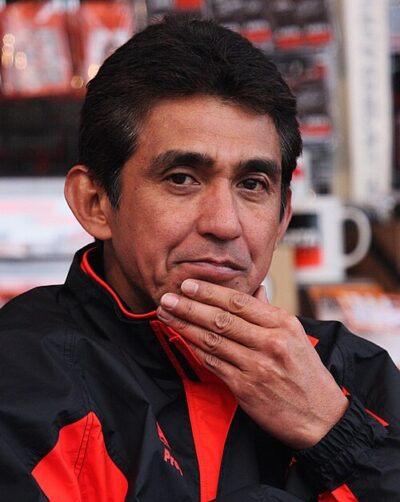
Aguri Suzuki is a racecar driver. Born September 8, 1960, in Tokyo. Educated at Josai University.
Facts
8 facts · 1 confirmed by two sources · 1 cited · 6 from one source
Where this comes from
Papalocal keeps its own record. It started from these sources; what each one said is kept here as it was copied, so a change on their side never changes this page by itself. Tap one to read its version.
What Wikidata says · copied November 17, 2026 · revision 2552686604
- Described as
- racecar driver
- Born
- September 8, 1960
- Born in
- Tokyo
- Citizen of
- Japan
- Occupation
- racing automobile driver · 1 reference; Formula One driver
- Education
- Josai University
- Sport
- auto racing
- Website
- http://www.super-aguri.co.jp/
- Wikipedias with a page
- 27
Wikidata item Q173197 (wikidata.org/wiki/Q173197), public domain (CC0). Copied November 17, 2026.
What Wikipedia says · copied November 17, 2026 · revision 1385779086
Aguri Suzuki (Japanese: 鈴木 亜久里, Hepburn: Suzuki Aguri; born 8 September 1960) is a Japanese former racing driver and motorsport executive who competed in Formula One from 1988 to 1995.
Suzuki entered 88 Formula One Grands Prix, achieving a best result of third at the 1990 Japanese Grand Prix, becoming the first Asian driver to score a podium finish. He also won the Japanese Formula 3000 Championship in 1988, and later finished third overall at the 24 Hours of Le Mans in 1998. He was also a race-winner in the All-Japan GT Championship.
Suzuki became involved in team ownership after his Formula One career, first forming Autobacs Racing Team Aguri (ARTA) in 1997 in partnership with Autobacs. ARTA has competed mostly in Super GT, where they have won titles in both the GT500 and GT300 classes. He was the owner of the Super Aguri F1 team, which participated in Formula One from 2006 to 2008. He also formed Team Aguri, which raced in Formula E from 2014 to 2016.
- Born, in its opening lines
- September 8, 1960
From the Wikipedia article “Aguri Suzuki” (en.wikipedia.org/wiki/Aguri_Suzuki), by its contributors, under CC BY-SA 4.0 (creativecommons.org/licenses/by-sa/4.0/). Copied November 17, 2026; not changed.
Confirmed Two sources agree. Cited One source, and it names where it got it. One source One source, without a reference of its own. Sources disagree The sources disagree. We show the best-supported value and keep theirs below.
