
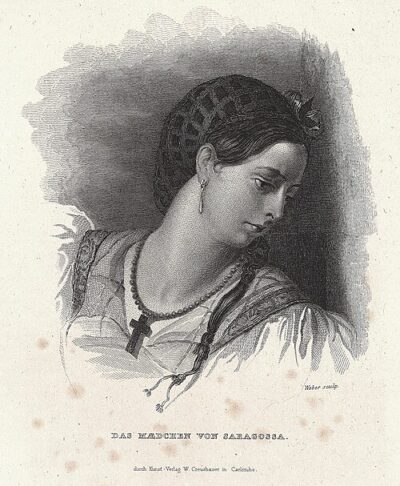
Agustina de Aragón
Agustina de Aragón was a Spanish heroine. Born March 4, 1786, in Barcelona. Died May 29, 1857, in Ceuta.
Facts
10 facts · 2 confirmed by two sources · 4 cited · 4 from one source
Where this comes from
Papalocal keeps its own record. It started from these sources; what each one said is kept here as it was copied, so a change on their side never changes this page by itself. Tap one to read its version.
What Wikidata says · copied November 17, 2026 · revision 2567811994
- Described as
- Spanish heroine (1786-1857)
- Other names
- Agustina de Aragon, Agostina, the Maid of Zaragoza, Agustina Raimunda Maria Saragossa i Domènech
- Born
- March 4, 1786 · 2 references
- Died
- May 29, 1857 · 1 reference
- Born in
- Barcelona · 3 references
- Died in
- Ceuta · 1 reference
- Buried in
- Parish Church of Our Lady of Portillo (1908–)
- Name at birth
- Agustina Raimunda Maria Saragossa i Domènech · 1 reference
- Citizen of
- Spain
- Occupation
- partisan; freedom fighter · 1 reference
- Military rank
- sub-lieutenant · 1 reference
- Wikipedias with a page
- 25
Wikidata item Q718272 (wikidata.org/wiki/Q718272), public domain (CC0). Copied November 17, 2026.
What Wikipedia says · copied November 17, 2026 · revision 1384417339
Agustina Raimunda María Saragossa i Domènech (March 4, 1786 – May 29, 1857), better known as Agustina of Aragón, was a Spanish woman who defended Spain during the Peninsular War, first as a civilian and later as a professional officer in the Spanish Army. Known as "the Spanish Joan of Arc," she has been the subject of much folklore, mythology, and artwork, including sketches by Francisco Goya and the poetry of Lord Byron.
- Born, in its opening lines
- March 4, 1786
- Died, in its opening lines
- May 29, 1857
From the Wikipedia article “Agustina de Aragón” (en.wikipedia.org/wiki/Agustina_de_Aragón), by its contributors, under CC BY-SA 4.0 (creativecommons.org/licenses/by-sa/4.0/). Copied November 17, 2026; not changed.
Confirmed Two sources agree. Cited One source, and it names where it got it. One source One source, without a reference of its own. Sources disagree The sources disagree. We show the best-supported value and keep theirs below.
