
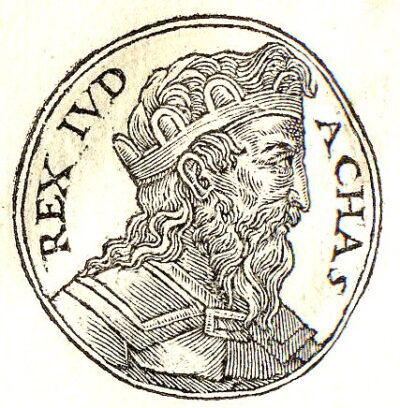
Ahaz
Ahaz was a king of Judah. Born 763 BC. Died 727 BC. Positions held include King of Judah (-735–-715).
Facts
9 facts · 0 confirmed by two sources · 3 cited · 6 from one source
Where this comes from
Papalocal keeps its own record. It started from these sources; what each one said is kept here as it was copied, so a change on their side never changes this page by itself. Tap one to read its version.
What Wikidata says · copied November 16, 2026 · revision 2568881393
- Described as
- king of Judah
- Born
- 763 BC
- Died
- 727 BC
- Citizen of
- Kingdom of Judah · 1 reference
- Occupation
- monarch
- Positions held
- King of Judah (-735–-715) · 1 reference
- Spouse
- Abijah
- Children
- Hezekiah
- Father
- Jotham · 1 reference
- Religion
- Yahwism · 1 reference
- Wikipedias with a page
- 52
Wikidata item Q30914 (wikidata.org/wiki/Q30914), public domain (CC0). Copied November 16, 2026.
What Wikipedia says · copied November 16, 2026 · revision 1383272463
Ahaz (Hebrew: אָחָז, romanized: ʼĀḥāz, lit. '"has held"'; Greek: Ἄχαζ, Ἀχάζ Akhaz; Latin: Achaz) an abbreviation of Jehoahaz II (of Judah), "Yahweh has held" (Hebrew: יְהוֹאָחָז, Modern: Yəhō’aḥaz, Tiberian: Yŏhō’āḥāz; Akkadian: 𒅀𒌑𒄩𒍣 Ya'úḫazi [ia-ú-ḫa-zi]) was the twelfth king of Judah, and the son and successor of Jotham. Ahaz was 20 when he became king of Judah and reigned for 16 years.
Ahaz is portrayed as an evil king in the Second Book of Kings (2 Kings 16:2).
In Edwin R. Thiele's opinion, Ahaz was co-regent with Jotham from 736/735 BC, and his sole reign began in 732/731 and ended in 716/715 BC. However, William F. Albright has dated his reign to 744–728 BC.
The Gospel of Matthew lists Ahaz of Judah in the genealogy of Jesus. He is also mentioned in Isaiah 7 and Isaiah 14:28.
From the Wikipedia article “Ahaz” (en.wikipedia.org/wiki/Ahaz), by its contributors, under CC BY-SA 4.0 (creativecommons.org/licenses/by-sa/4.0/). Copied November 16, 2026; not changed.
Confirmed Two sources agree. Cited One source, and it names where it got it. One source One source, without a reference of its own. Sources disagree The sources disagree. We show the best-supported value and keep theirs below.
