
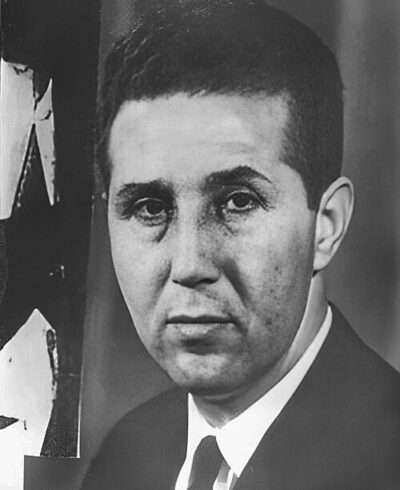
Ahmad ibn Billah
Ahmad ibn Billah was a President of Algeria from 1963 to 1965. Born December 25, 1916, in Maghnia. Died April 11, 2012, in Algiers. Positions held include President of Algeria (1963–1965) and Minister of Foreign Affairs of Algeria (1963). Awards include Croix de guerre 1939–1945, Hero of the Soviet Union and Order of Lenin.
Facts
24 facts · 2 confirmed by two sources · 5 cited · 17 from one source
Where this comes from
Papalocal keeps its own record. It started from these sources; what each one said is kept here as it was copied, so a change on their side never changes this page by itself. Tap one to read its version.
What Wikidata says · copied November 16, 2026 · revision 2568181983
- Described as
- President of Algeria from 1963 to 1965
- Other names
- Muhammad Ahmad ibn Billah
- Born
- December 25, 1916 · 6 references
- Died
- April 11, 2012 · 5 references
- Born in
- Maghnia · 2 references
- Died in
- Algiers · 2 references
- Citizen of
- Algeria
- Occupation
- politician; association football player
- Positions held
- President of Algeria (1963–1965); Minister of Foreign Affairs of Algeria (1963) · 1 reference
- Political party
- National Liberation Front (1954–1965); Algerian People's Party; Movement for Democracy in Algeria (1982–1997)
- Sport
- association football
- Awards
- Croix de guerre 1939–1945; Hero of the Soviet Union; Order of Lenin; Al-Gaddafi International Prize for Human Rights; Médaille militaire; Lenin Peace Prize; Order of the Companions of O. R. Tambo; Algerian National Order of Merit, Grand Master rank · 1 reference
- Spouse
- Zohra Michelle Sellami · 1 reference
- Children
- Noria · 1 reference
- Religion
- Sunni Islam
- Wikipedias with a page
- 85
Wikidata item Q179908 (wikidata.org/wiki/Q179908), public domain (CC0). Copied November 16, 2026.
What Wikipedia says · copied November 16, 2026 · revision 1383920448
Ahmed Ben Bella (Arabic: أحمد بن بلّة, romanized: Aḥmad bin Billah; 1916 – 11 April 2012) was an Algerian politician, soldier and revolutionary who served as the head of government of Algeria from 27 September 1962 to 15 September 1963 and then the first president of Algeria from 15 September 1963 until his overthrow on 19 June 1965.
Ben Bella played an important role during the Algerian war of independence against France, leading the National Liberation Front (FLN), organizing the shipment of foreign weapons and coordinating political strategy from Cairo. Despite not being present in Algeria, the French regime attempted to murder him multiple times. Once Algeria gained independence in 1962, Ben Bella's Oujda Group seized power from Benyoucef Benkhedda's provisional government, and Ben Bella became prime minister of Algeria with Ferhat Abbas as acting president. Ben Bella succeeded Ferhat Abbas on 15 September 1963 after rapidly sidelining him, and was elected president after winning an election with 99.6 percent of the votes.
Ben Bella pursued Arab socialist and pan-Arabist policies and came to describe himself as a Nasserist. He nationalized several industries and established good relations with other anti-Zionist Arab states and left-wing states such as Gamal Abdel Nasser's Egypt and Fidel Castro's Cuba. He encountered political conflict during his presidency, and was faced with border clashes in the Sand War with Morocco in 1963 and a failed rebellion by the Socialist Forces Front against his regime in 1963–1964. He was ousted from power and put under house arrest following a coup d'état by his Minister of Defense Houari Boumédiéne in 1965. He was freed from house arrest on 17 January 1980 and died in 2012.
- Born, in its opening lines
- 1916
- Died, in its opening lines
- April 11, 2012
From the Wikipedia article “Ahmed Ben Bella” (en.wikipedia.org/wiki/Ahmed_Ben_Bella), by its contributors, under CC BY-SA 4.0 (creativecommons.org/licenses/by-sa/4.0/). Copied November 16, 2026; not changed.
Confirmed Two sources agree. Cited One source, and it names where it got it. One source One source, without a reference of its own. Sources disagree The sources disagree. We show the best-supported value and keep theirs below.
