
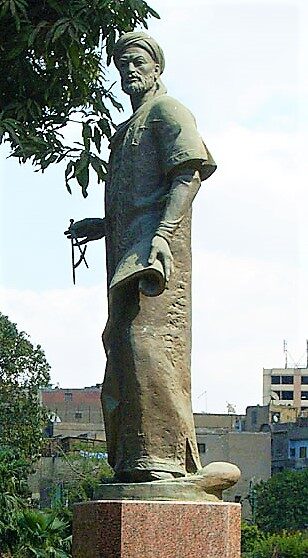
Ahmad ibn Muhammad ibn Kathīr al-Farghānī
Ahmad ibn Muhammad ibn Kathīr al-Farghānī was an Abbasid astronomer (c. 800 – 870). Died 861, in Cairo.
Facts
11 facts · 0 confirmed by two sources · 1 cited · 9 from one source · 1 where the sources disagree
What’s different
- Died: we show 861 (Sources disagree). Wikipedia says 870
Where this comes from
Papalocal keeps its own record. It started from these sources; what each one said is kept here as it was copied, so a change on their side never changes this page by itself. Tap one to read its version.
What Wikidata says · copied November 16, 2026 · revision 2544755420
- Described as
- Abbasid astronomer (c. 800 – 870)
- Other names
- Alfraganus, Al-Farghani, Abū al-ʿAbbās Aḥmad ibn Muḥammad ibn Kathīr al-Farghānī, Fergani
- Died
- 861 · 2 references
- Born in
- Ferghana Valley
- Died in
- Cairo · 1 reference
- Citizen of
- Abbasid Caliphate
- Occupation
- astronomer · 1 reference; mathematician; astrologer
- Worked for
- House of Wisdom
- Field
- mathematics; astronomy
- Religion
- Islam
- Wikipedias with a page
- 40
Wikidata item Q336550 (wikidata.org/wiki/Q336550), public domain (CC0). Copied November 16, 2026.
What Wikipedia says · copied November 16, 2026 · revision 1379592978
Abū al-ʿAbbās Aḥmad ibn Muḥammad ibn Kathīr al-Farghānī (Arabic: أبو العبّاس أحمد بن محمد بن كثير الفرغاني) also known as Alfraganus in the West (c. 800 – 870), was an astronomer in the Abbasid court in Baghdad, and one of the most famous astronomers in the 9th century. Al-Farghani composed several works on astronomy and astronomical equipment that were widely distributed in Arabic and Latin and were influential to many scientists. His best known work, Kitāb fī Jawāmiʿ ʿIlm al-Nujūmi (whose name translates to Elements of astronomy on the celestial motions), was an extensive summary of Ptolemy's Almagest containing revised and more accurate experimental data. Christopher Columbus used Al Farghani's calculations for his voyages to America (but mistakenly interpreted Arabic miles as Roman miles). In addition to making substantial contributions to astronomy, al-Farghani also worked as an engineer, supervising construction projects on rivers in Cairo, Egypt. The lunar crater Alfraganus is named after him.
- Born, in its opening lines
- 800
- Died, in its opening lines
- 870
From the Wikipedia article “Al-Farghani” (en.wikipedia.org/wiki/Al-Farghani), by its contributors, under CC BY-SA 4.0 (creativecommons.org/licenses/by-sa/4.0/). Copied November 16, 2026; not changed.
Confirmed Two sources agree. Cited One source, and it names where it got it. One source One source, without a reference of its own. Sources disagree The sources disagree. We show the best-supported value and keep theirs below.
