
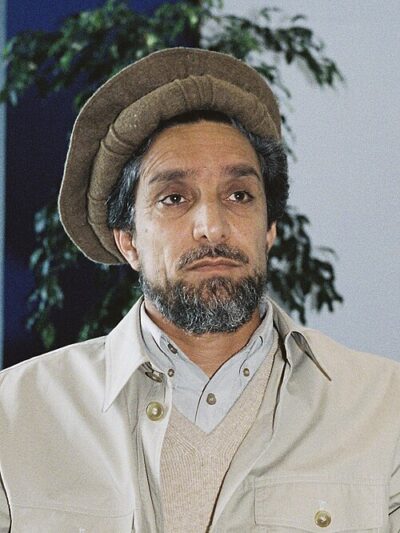
Ahmad Shah Massoud
Ahmad Shah Massoud was a Tajik military leader. Born September 2, 1953, in Bazarak. Died September 9, 2001, in Khwaja Bahauddin District. Positions held include Minister of Defence of Afghanistan (1992–2001). Educated at Lycée Esteqlal and Kabul University. Awards include Order of Ismoili Somoni.
Facts
22 facts · 2 confirmed by two sources · 4 cited · 16 from one source
Where this comes from
Papalocal keeps its own record. It started from these sources; what each one said is kept here as it was copied, so a change on their side never changes this page by itself. Tap one to read its version.
What Wikidata says · copied November 16, 2026 · revision 2563020423
- Described as
- Tajik military leader (1953–2001)
- Other names
- Ahmed Shah Masood, Ahmed Shah Masoud, Afghanistan national hero, Ahmad Shah Masoud, Ahmad Shah Masood, The Goat, Ahmed Shah Massoud
- Born
- September 2, 1953 · 1 reference
- Died
- September 9, 2001 · 2 references
- Born in
- Bazarak
- Died in
- Khwaja Bahauddin District
- Cause of death
- bomb attack
- Citizen of
- Islamic State of Afghanistan
- Occupation
- politician; military leader
- Positions held
- Minister of Defence of Afghanistan (1992–2001) · 1 reference
- Political party
- Jamiat-e Islami · 1 reference
- Education
- Lycée Esteqlal; Kabul University
- Awards
- Order of Ismoili Somoni (2021)
- Field
- politics · 1 reference; military affairs · 1 reference; Islam · 1 reference
- Children
- Ahmad Massoud
- Siblings
- Ahmad Zia Massoud; Ahmad Wali Massoud
- Religion
- Islam · 1 reference
- Military rank
- commander-in-chief · 1 reference
- Nickname
- Lion of Panjshir
- Wikipedias with a page
- 79
Wikidata item Q200029 (wikidata.org/wiki/Q200029), public domain (CC0). Copied November 16, 2026.
What Wikipedia says · copied November 16, 2026 · revision 1384850310
Ahmad Shah Massoud (c. 1953 – 9 September 2001) was an Afghan military leader and politician. Known as the "Lion of Panjshir", he was the foremost commander of the Afghan mujahideen against Soviet occupation during the Soviet–Afghan War from 1979 to 1989. Later, in the 1990s, he led the government's military wing against rival militias, and actively fought against the Taliban and their allies, from the time the regime rose to power in 1996, and until his assassination in 2001.
Massoud came from a Tajik Sunni Muslim background in the Panjshir Valley in northern Afghanistan. He began studying engineering at Polytechnical University of Kabul in the 1970s, where he developed Islamist and anti-communist views. He joined the Jamiat-i Islami of Burhanuddin Rabbani and, in 1975, participated in a failed uprising against President Daoud Khan's government. During the Soviet–Afghan War, he successfully resisted the Soviets from taking the Panjshir Valley. In 1992, he signed the Peshawar Accord, a peace and power-sharing agreement, in the post-communist Islamic State of Afghanistan. He was appointed the Minister of Defense as well as the government's main military commander. The accord was opposed by Gulbuddin Hekmatyar and other warlords, who attacked Kabul and initiated the Second Afghan Civil War (1992–1996).
Following the rise of the Taliban in 1996, Massoud, who rejected the group's extremist interpretation of Islam, returned to armed opposition. He became the military leader of the Northern Alliance, which by 2000 controlled only 5–10% of the country. In 2001, he visited Europe and urged European Parliament leaders for humanitarian aid to combat the Afghan people's conditions under the Taliban. On September 9, 2001, Massoud was killed in a suicide bombing by two al-Qaeda assassins. Two days later, al-Qaeda operatives carried out the September 11 attacks in the United States. Within weeks, American and NATO forces invaded Afghanistan, allying with the Northern Alliance and toppling the Taliban from power. By December 2001, the coalition had secured control over the country.
Regarded as one of the most influential guerrilla leaders in modern history, Massoud became an icon of several anti-imperialist movements and gained the status of a cult of personality. He was posthumously named the national hero of Afghanistan by the order of President Hamid Karzai after the Taliban were ousted from power in 2001. The date of Massoud's death, 9 September, was observed as "Martyrs' Day" under the Islamic Republic of Afghanistan. His son Ahmad Massoud is leading the National Resistance Front (NRF) against the Taliban.
- Born, in its opening lines
- c. 1953
- Died, in its opening lines
- September 9, 2001
From the Wikipedia article “Ahmad Shah Massoud” (en.wikipedia.org/wiki/Ahmad_Shah_Massoud), by its contributors, under CC BY-SA 4.0 (creativecommons.org/licenses/by-sa/4.0/). Copied November 16, 2026; not changed.
Confirmed Two sources agree. Cited One source, and it names where it got it. One source One source, without a reference of its own. Sources disagree The sources disagree. We show the best-supported value and keep theirs below.
