
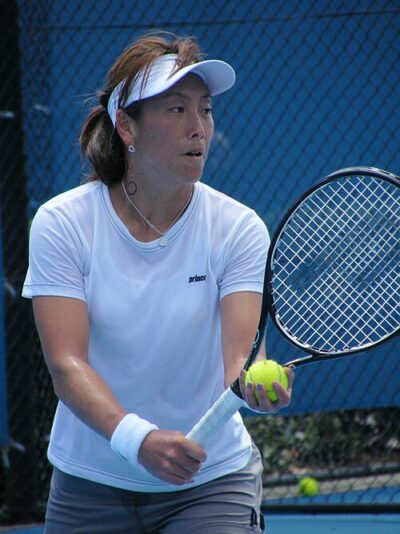
Ai Sugiyama
Ai Sugiyama is a Japanese tennis player. Born July 5, 1975, in Yokohama. Teams include Japan Billie Jean King Cup team (1995–). Educated at Shonan Institute of Technology High School.
Facts
9 facts · 1 confirmed by two sources · 4 cited · 4 from one source
Where this comes from
Papalocal keeps its own record. It started from these sources; what each one said is kept here as it was copied, so a change on their side never changes this page by itself. Tap one to read its version.
What Wikidata says · copied November 16, 2026 · revision 2538311470
- Described as
- Japanese tennis player
- Born
- July 5, 1975 · 3 references
- Born in
- Yokohama · 2 references
- Citizen of
- Japan · 1 reference
- Occupation
- tennis player (1992–2009) · 1 reference
- Education
- Shonan Institute of Technology High School
- Teams
- Japan Billie Jean King Cup team (1995–) · 1 reference
- Sport
- tennis · 1 reference
- Height
- 1.63 m (5 ft 4 in)
- Website
- http://www.ai-sugiyama.com
- Wikipedias with a page
- 34
Wikidata item Q229100 (wikidata.org/wiki/Q229100), public domain (CC0). Copied November 16, 2026.
What Wikipedia says · copied November 16, 2026 · revision 1374469131
Ai Sugiyama (杉山愛, Sugiyama Ai; born July 5, 1975) is a Japanese former tennis player. She reached the world No. 1 ranking in women's doubles on the WTA Tour and had a career-high singles ranking of world No. 8, achieved on February 9, 2004. In her career, she won six singles and 38 doubles titles, including three major titles (one with Julie Halard-Decugis and two partnering Kim Clijsters), and one mixed doubles title (partnering Mahesh Bhupathi). Sugiyama held the all-time record, for both male and female players, for her 62 consecutive Grand Slam tournament main-draw appearances, until she was surpassed by Roger Federer at the 2015 Wimbledon Championships.
- Born, in its opening lines
- July 5, 1975
From the Wikipedia article “Ai Sugiyama” (en.wikipedia.org/wiki/Ai_Sugiyama), by its contributors, under CC BY-SA 4.0 (creativecommons.org/licenses/by-sa/4.0/). Copied November 16, 2026; not changed.
Confirmed Two sources agree. Cited One source, and it names where it got it. One source One source, without a reference of its own. Sources disagree The sources disagree. We show the best-supported value and keep theirs below.
