
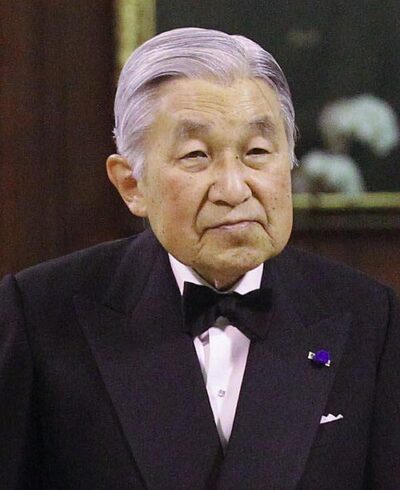
Akihito
Akihito is an Emperor of Japan from 1989 to 2019. Born December 23, 1933, in Tokyo Imperial Palace. Positions held include Emperor of Japan (1989–2019) and Emperor Emeritus (2019–). Known for A Message from His Majesty The Emperor (March 16, 2011) and Message from His Majesty the Emperor (August 8, 2016). Educated at Gakushuin University. Awards include Grand Cross of the Legion of Honour, Knight Grand Cross of the Order of Merit of the Italian Republic and Knight Grand Cross of the Royal Victorian Order.
Facts
46 facts · 1 confirmed by two sources · 11 cited · 34 from one source
Where this comes from
Papalocal keeps its own record. It started from these sources; what each one said is kept here as it was copied, so a change on their side never changes this page by itself. Tap one to read its version.
What Wikidata says · copied November 16, 2026 · revision 2568218309
- Described as
- Emperor of Japan from 1989 to 2019
- Other names
- Emperor Akihito, Prince Akihito, His Majesty the Emperor Emeritus
- Born
- December 23, 1933 · 1 reference
- Born in
- Tokyo Imperial Palace
- Name at birth
- 継宮明仁親王
- Citizen of
- Japan
- Occupation
- monarch; ichthyologist · 2 references; zoologist · 1 reference; marine biologist · 1 reference; ruler · 1 reference; Emperor of Japan · 1 reference
- Positions held
- Emperor of Japan (1989–2019) · 1 reference; Emperor Emeritus (2019–)
- Education
- Gakushuin University · 1 reference
- Member of
- Emperor Akihito and Empress Michiko
- Instrument
- cello
- Known for
- A Message from His Majesty The Emperor (March 16, 2011); Message from His Majesty the Emperor (August 8, 2016)
- Awards
- Grand Cross of the Legion of Honour; Knight Grand Cross of the Order of Merit of the Italian Republic (1982) · 1 reference; Knight Grand Cross of the Royal Victorian Order (1975) · 1 reference; Order of the White Eagle (Third Polish Republic) (2002) · 1 reference; Order of the Crown of the Realm (2012) · 1 reference; Knight Grand Cross with Collar of the Order of Saint Olav (2001) · 1 reference; Collar of the Order of the White Lion; Grand Cross of the Order of the Redeemer; Knight Grand Cross in the Order of the Netherlands Lion; Order of the Rising Sun with Paulownia Flowers, 1st class; Grand Cordon of the Order of Leopold; Grand Cross with Collar of the Order of the Three Stars (2007) · 1 reference; Grand Cross of the National Order of the Lion; Order of the Nile; Grand Cross of the Order of the Aztec Eagle
- Spouse
- Empress Michiko (1959–)
- Children
- Naruhito; Fumihito, Crown Prince of Japan; Sayako Kuroda
- Father
- Hirohito
- Mother
- Kōjun
- Siblings
- Shigeko Higashikuni; Sachiko, Princess Hisa; Kazuko Takatsukasa; Atsuko Ikeda; Masahito, Prince Hitachi; Takako Shimazu
- Religion
- Shinto
- Height
- 1.65 m (5 ft 5 in)
- Wikipedias with a page
- 130
Wikidata item Q37979 (wikidata.org/wiki/Q37979), public domain (CC0). Copied November 16, 2026.
What Wikipedia says · copied November 16, 2026 · revision 1385441941
Akihito (born 23 December 1933) is a member of the Imperial House of Japan who reigned as the 125th emperor of Japan from 7 January 1989 until his abdication on 30 April 2019. The era of his rule was named the Heisei era, Heisei being an expression of achieving peace worldwide.
Akihito was born as the fifth child and first son of Emperor Hirohito and Empress Kōjun. During the Second World War, he moved out of Tokyo with his classmates and remained in Nikkō until the surrender of Japan. In 1952, his Coming-of-Age ceremony and investiture as crown prince were held, and he began to undertake official duties in his capacity as crown prince. The next year, he made his first journey overseas and represented Japan at the coronation of Elizabeth II in London. He completed his university education in 1956. In April 1959, he married Michiko Shōda, a commoner; it was the first imperial wedding to be televised in Japan, drawing about 15 million viewers. The couple has three children: Naruhito, Fumihito, and Sayako.
Akihito succeeded to the Chrysanthemum Throne and became emperor upon his father's death in January 1989, with an enthronement ceremony in 1990. He made efforts to bring the Japanese imperial family closer to the Japanese people, and made official visits to all forty-seven prefectures of Japan and to many of the remote islands of Japan. He has a keen interest in natural life and conservation, as well as Japanese and world history. Akihito abdicated in 2019, citing his advanced age and declining health, and assumed the title Emperor Emeritus (上皇, Jōkō; lit. 'Retired Emperor'). He was succeeded by his elder son, Naruhito, whose era is named Reiwa (令和). At age 92, Akihito is the longest-lived verifiable Japanese emperor in recorded history. During his reign, 17 prime ministers served in 25 terms, beginning with Noboru Takeshita and ending with Shinzo Abe. He is the oldest living member of the Imperial House of Japan, following the death of Yuriko, Princess Mikasa, on 15 November 2024.
- Born, in its opening lines
- December 23, 1933
From the Wikipedia article “Akihito” (en.wikipedia.org/wiki/Akihito), by its contributors, under CC BY-SA 4.0 (creativecommons.org/licenses/by-sa/4.0/). Copied November 16, 2026; not changed.
Confirmed Two sources agree. Cited One source, and it names where it got it. One source One source, without a reference of its own. Sources disagree The sources disagree. We show the best-supported value and keep theirs below.
