
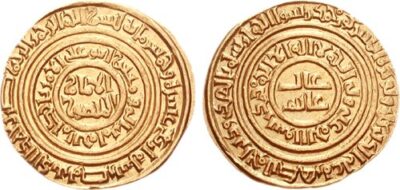
Al-Amir bi-Ahkam Allah
Al-Amir bi-Ahkam Allah was a Fatimid caliph and imam. Born December 31, 1096, in Cairo. Died October 7, 1130, in Cairo. Positions held include Fatimid Caliph (1101–1130) and Ismaili imam (1101–1130).
Facts
15 facts · 2 confirmed by two sources · 1 cited · 12 from one source
What’s different
- Born: we show December 31, 1096 (Confirmed). Wikidata also lists 1097
- Died: we show October 7, 1130 (Confirmed). Wikidata also lists 1130
Where this comes from
Papalocal keeps its own record. It started from these sources; what each one said is kept here as it was copied, so a change on their side never changes this page by itself. Tap one to read its version.
What Wikidata says · copied November 17, 2026 · revision 2568216075
- Described as
- Fatimid caliph and imam (1096–1130)
- Other names
- al-Āmīr bi'Aḥkāmi’l-Lāh, Mansur ibn Ahamad al-Fatimi
- Born
- December 31, 1096; 1097 · 1 reference
- Died
- October 7, 1130; 1130 · 1 reference
- Born in
- Cairo
- Died in
- Cairo
- Cause of death
- stab wound
- Citizen of
- Fatimid Caliphate
- Occupation
- imam; caliph; politician · 1 reference
- Positions held
- Fatimid Caliph (1101–1130); Ismaili imam (1101–1130)
- Children
- Abu'l-Qasim al-Tayyib
- Father
- Al-Musta'li
- Religion
- Islam; Shia Islam
- Wikipedias with a page
- 26
Wikidata item Q285678 (wikidata.org/wiki/Q285678), public domain (CC0). Copied November 17, 2026.
What Wikipedia says · copied November 17, 2026 · revision 1385798306
Abu Ali al-Mansur ibn al-Musta'li (Arabic: أبو علي المنصور بن المستعلي, romanized: Abū ʿAlī al-Manṣūr ibn al-Mustaʿlī; 31 December 1096 – 7 October 1130), better known by his regnal name al-Amir bi-Ahkam Allah (Arabic: الآمر بأحكام الله, romanized: al-Āmir bi-Aḥkām Allāh, lit. 'The Ruler Who Executes God's Decrees') was the tenth Fatimid caliph, ruling from 1101 to his death in 1130, and the 20th imam of the Musta'li Isma'ili branch of Shia Islam.
Al-Amir succeeded his father, al-Musta'li, at the age of five. For the first twenty years of his reign, al-Amir was a puppet of his uncle and father-in-law, the vizier al-Afdal Shahanshah, who ruled the Fatimid state and confined al-Amir, like al-Musta'li before him, to the palace. In December 1121, al-Afdal was murdered, officially by agents of the rival Nizari branch of Isma'ilism, although some medieval accounts blame al-Amir and al-Afdal's chief secretary, al-Ma'mun al-Bata'ihi, instead. Al-Amir and al-Bata'ihi moved quickly to forestall a succession by one of al-Afdal's sons, imprisoning them and moving the vast treasures al-Afdal had amassed into the caliphal palace. Al-Bata'ihi was appointed as the new vizier, but al-Amir took an increasing role in government, and was prominently featured in spectacular public ceremonies. Finally, in 1125, al-Amir dismissed and imprisoned al-Bata'ihi, ruling thenceforth without a vizier.
Despite al-Afdal's and al-Bata'ihi's repeated military efforts against the Crusaders in Palestine, al-Amir's reign saw the progressive loss of the Fatimid coastal strongholds in the Levant apart from Ascalon. Al-Amir took care to strengthen relations with the fellow Musta'li Isma'ili Sulayhid realm of Yemen, and issued a statement of Musta'li orthodoxy, the al-Hidaya al-Amiriyya, in 1122, refuting Nizari claims to legitimacy. His assassination by Nizari agents in 1130, leaving only his infant son al-Tayyib as heir, threw the Fatimid regime into a succession struggle during which it almost collapsed. Fatimid rule was restored with the succession of al-Amir's cousin al-Hafiz li-Din Allah in 1132, which led to the division of Musta'li Isma'ilism into the rival Hafizi and Tayyibi branches.
- Born, in its opening lines
- December 31, 1096
- Died, in its opening lines
- October 7, 1130
From the Wikipedia article “Al-Amir bi-Ahkam Allah” (en.wikipedia.org/wiki/Al-Amir_bi-Ahkam_Allah), by its contributors, under CC BY-SA 4.0 (creativecommons.org/licenses/by-sa/4.0/). Copied November 17, 2026; not changed.
Confirmed Two sources agree. Cited One source, and it names where it got it. One source One source, without a reference of its own. Sources disagree The sources disagree. We show the best-supported value and keep theirs below.
