
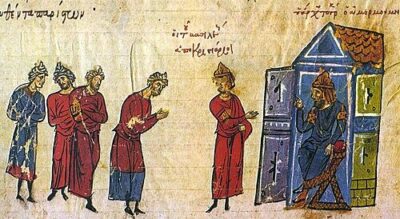
Al-Mu'tasim
Al-Mu'tasim was the 8th Abbasid Caliph. (r. 833–842). Born 796, in Khuld Palace. Died January 5, 842, in Samarra. Positions held include Abbasid caliph (833–842).
Facts
17 facts · 2 confirmed by two sources · 0 cited · 15 from one source
Where this comes from
Papalocal keeps its own record. It started from these sources; what each one said is kept here as it was copied, so a change on their side never changes this page by itself. Tap one to read its version.
What Wikidata says · copied November 16, 2026 · revision 2568061096
- Described as
- 8th Abbasid Caliph. (r. 833–842)
- Other names
- Abu Ishaq 'Abbas al-Mu'tasim ibn Harun al-Rashid
- Born
- 796 · 1 reference
- Died
- January 5, 842 · 1 reference
- Born in
- Khuld Palace
- Died in
- Samarra
- Occupation
- caliph
- Positions held
- Abbasid caliph (833–842)
- Children
- Al-Wathiq; Al-Mutawakkil; Al-Musta'in
- Father
- Harun al-Rashid
- Mother
- Maridah bint Shabib
- Siblings
- Al-Amin; al-Maʾmun; Al-Qasim ibn Harun al-Rashid; Ahmed Al-Sabti; Abu ʿIsa Muhammad ibn Harun al-Rashid
- Religion
- Islam
- Wikipedias with a page
- 49
Wikidata item Q284550 (wikidata.org/wiki/Q284550), public domain (CC0). Copied November 16, 2026.
What Wikipedia says · copied November 16, 2026 · revision 1385612875
Abū Isḥāq Muḥammad ibn Hārūn al-Rashīd (Arabic: أبو إسحاق محمد بن هارون الرشيد; October 796 – 5 January 842), better known by his regnal name al-Muʿtaṣim biʾllāh (المعتصم بالله, lit. 'He who seeks refuge in God'), was the eighth Abbasid caliph, ruling from 833 until his death in 842. When al-Ma'mun died unexpectedly on campaign in August 833, al-Mu'tasim was thus well placed to succeed him, with the support of the powerful chief qādī, Ahmad ibn Abi Duwad, he continued to implement the rationalist Islamic doctrine of Mu'tazilism and implementing miḥna policy.
A younger son of Caliph Harun al-Rashid (r. 786–809), he rose to prominence through his formation of a private army composed predominantly of Turkic mercenaries (ghilmān, sing. ghulām). This proved useful to his half-brother, Caliph al-Ma'mun, who employed al-Mu'tasim and his Turkic guard to counterbalance other powerful interest groups in the state, as well as employing them in campaigns against rebels and the Byzantine Empire.
Although not personally interested in literary pursuits, al-Mu'tasim also nurtured and supporting the scientific renaissance that begun under al-Ma'mun. In other ways, his reign marks a departure and a watershed moment in Islamic history, with the creation of a new regime centred on the military, and particularly his Turkic guard. In 836, a new capital was established at Samarra to symbolize this new regime and remove it from the restive populace of Baghdad.
The power of the caliphal government was increased by centralizing measures that reduced the power of provincial governors in favour of a small group of senior civil and military officials in Samarra, and the fiscal apparatus of the state was more and more dedicated to the maintenance of the professional army. The new dominance of the Turkic military elite was established by al-Mu'tasim to counterbalance the Arab and Iranian elites who had previously held many elite positions, as well as to build a professional army prepared for state expansion and the strengthening of state centralized command.
This strengthened the position of the Turks and their principal leaders, Ashinas, Wasif, Itakh, and Bugha. Another prominent member of al-Mu'tasim's inner circle, the prince of Ushrusana, al-Afshin, fell afoul of his enemies at court and was overthrown and killed in 840/1. The rise of the Turks would eventually result in the troubles of the 'Anarchy at Samarra' and led to the collapse of Abbasid power in the mid-10th century, this situation was caused by the fact that many subsequent caliphs, especially Al-Mutawakkil lacked the competence to organize and grant political and economic rights to the Turkic military generals. But, the ghulām-based political military system inaugurated by al-Mu'tasim would be widely adopted throughout the Muslim world.
Al-Mu'tasim's reign was marked by continuous warfare and at the same time of several significant strategic victories. The two major internal campaigns of the reign were against the long-running Khurramite uprising of Babak Khorramdin in Adharbayjan, which was suppressed by al-Afshin in 835–837, and against Mazyar, the autonomous ruler of Tabaristan, who had clashed with the Tahirid governor of Khorasan and risen up in revolt. While his Turkic generals led the fight against internal rebellions, al-Mu'tasim himself led the sole major external campaign of the period, in 838 against the Byzantine Empire. His armies defeated Emperor Theophilos and sacked the city of Amorium. The successful Amorium campaign was widely celebrated, and became a cornerstone of caliphal propaganda, cementing al-Mu'tasim's reputation as a warrior-caliph.
- Born, in its opening lines
- October 796
- Died, in its opening lines
- January 5, 842
From the Wikipedia article “Al-Mu'tasim” (en.wikipedia.org/wiki/Al-Mu'tasim), by its contributors, under CC BY-SA 4.0 (creativecommons.org/licenses/by-sa/4.0/). Copied November 16, 2026; not changed.
Confirmed Two sources agree. Cited One source, and it names where it got it. One source One source, without a reference of its own. Sources disagree The sources disagree. We show the best-supported value and keep theirs below.
