
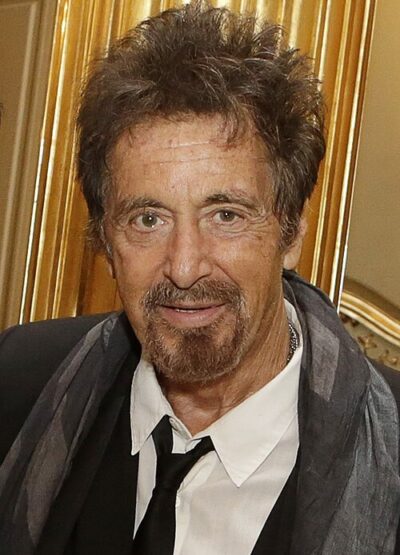
Al Pacino
Al Pacino is an American actor. Born April 25, 1940, in Manhattan. Educated at HB Studio and Actors Studio. Awards include Golden Globe Award for Best Actor – Motion Picture Drama (2 times), BAFTA Award for Best Actor in a Leading Role and National Board of Review Award for Best Supporting Actor.
Facts
39 facts · 1 confirmed by two sources · 5 cited · 33 from one source
Where this comes from
Papalocal keeps its own record. It started from these sources; what each one said is kept here as it was copied, so a change on their side never changes this page by itself. Tap one to read its version.
What Wikidata says · copied November 13, 2026 · revision 2568212407
- Described as
- American actor (born 1940)
- Other names
- Alfredo James Pacino, Alfred James Pacino, Alfred Pacino, Alfredo Pacino
- Born
- April 25, 1940 · 11 references
- Born in
- Manhattan · 1 reference
- Name at birth
- Alfredo James Pacino
- Citizen of
- United States
- Occupation
- film producer; film actor · 1 reference; stage actor; television actor; actor · 2 references; screenwriter; film director; writer
- Education
- HB Studio; Actors Studio; Lee Strasberg Theatre and Film Institute · 1 reference; Fiorello H. LaGuardia High School · 1 reference; Herman Ridder Junior High School; Wake Forest Department of Theatre and Dance
- Member of
- American Academy of Arts and Sciences; SAG-AFTRA
- Awards
- Golden Globe Award for Best Actor – Motion Picture Drama (2 times) (1974, 1993); BAFTA Award for Best Actor in a Leading Role (1976); National Board of Review Award for Best Supporting Actor (1973); Screen Actors Guild Award for Outstanding Performance by a Male Actor in a Miniseries or Television Movie; National Society of Film Critics Award for Best Actor (1973); Goldene Kamera 2013; Academy Award for Best Actor (1993); National Medal of Arts (2011); Donostia Award (1996); Directors Guild of America Award for Outstanding Directing – Documentaries (1997); National Board of Review Award for Best Actor (1974); Tony Award for Best Featured Actor in a Play (1969); Tony Award for Best Actor in a Play (1977); Golden Globe Award for Best Actor – Miniseries or Television Film (2 times) (2004, 2011); Golden Globe Cecil B. DeMille Award (2001)
- Children
- Julie Pacino
- Religion
- Latin Church · 1 reference; agnosticism · 1 reference
- Height
- 1.68 m (5 ft 6 in)
- Wikipedias with a page
- 135
Wikidata item Q41163 (wikidata.org/wiki/Q41163), public domain (CC0). Copied November 13, 2026.
What Wikipedia says · copied November 13, 2026 · revision 1384583187
Alfredo James Pacino ( pə-CHEE-noh; Italian: [paˈtʃiːno]; born April 25, 1940) is an American actor. Known for his intense performances on stage and screen, Pacino is widely regarded as one of the greatest actors of all time. His career spans more than six decades, during which he has earned many accolades, achieving the Triple Crown of Acting by winning an Academy Award, two Tony Awards, and two Emmy Awards. He was honored with the Golden Lion for Lifetime Achievement in 1994, the Golden Globe Cecil B. DeMille Award in 2001, the AFI Life Achievement Award in 2007, the National Medal of Arts in 2011, the Kennedy Center Honor in 2016, the Sam Wanamaker Award in 2026 and the SAG-AFTRA Life Achievement Award in 2027. A method actor, Pacino studied at HB Studio and the Actors Studio where he was taught by Charlie Laughton and Lee Strasberg. Films in which he has appeared have grossed over $3 billion worldwide.
Pacino started acting in theater, ranging from underground to off-Broadway and out-of-town productions to Broadway. He won two Tony Awards for Best Featured Actor in a Play for Does a Tiger Wear a Necktie? (1969) and Best Actor in a Play for The Basic Training of Pavlo Hummel (1977). He also played "Teach" in Off-Broadway, Broadway, and West End productions of David Mamet's American Buffalo (1981–1984), starred in multiple productions of Oscar Wilde's Salome (1992, 2003, 2006), and earned a third Tony Award nomination for portraying Shylock in The Merchant of Venice (2010), a role he played in the 2004 feature film adaptation.
After garnering acclaim for his first lead film role in The Panic in Needle Park (1971), Pacino was cast as Michael Corleone in The Godfather (1972), reprising the role in its two sequels (1974, 1990). He was nominated for Academy Awards for the first two films. Pacino would go on to win an Academy Award for Best Actor for his role in Scent of a Woman (1992). His other Oscar-nominated roles were in Serpico (1973), Dog Day Afternoon (1975), ...And Justice for All (1979), Dick Tracy (1990), Glengarry Glen Ross (1992), and The Irishman (2019). Pacino has also starred in Scarecrow (1973), Scarface (1983), Sea of Love (1989), Carlito's Way (1993), Heat (1995), Donnie Brasco, The Devil's Advocate (both 1997), The Insider, Any Given Sunday (both 1999), Insomnia (2002), Ocean's Thirteen (2007), Once Upon a Time in Hollywood (2019), and House of Gucci (2021), among others. On television, Pacino has acted in multiple productions for HBO, including the miniseries Angels in America (2003) and the Jack Kevorkian made-for-television biopic You Don't Know Jack (2010), winning a Primetime Emmy Award for Outstanding Lead Actor in a Miniseries or a Movie for each. Pacino starred in the Amazon Prime Video conspiracy drama thriller series Hunters (2020–2023).
Pacino made his directorial debut with the documentary film Looking for Richard (1996), for which he won a Directors Guild of America Award for Outstanding Directorial Achievement in Documentary. He directed and starred in Chinese Coffee (2000), Wilde Salomé (2011), and Salomé (2013). He wrote his memoir Sonny Boy, which was published by Penguin Press in 2024. Since 1995, Pacino has been co-president of the Actors Studio (he was the co-artistic director from 1981 to 1983).
- Born, in its opening lines
- April 25, 1940
From the Wikipedia article “Al Pacino” (en.wikipedia.org/wiki/Al_Pacino), by its contributors, under CC BY-SA 4.0 (creativecommons.org/licenses/by-sa/4.0/). Copied November 13, 2026; not changed.
Confirmed Two sources agree. Cited One source, and it names where it got it. One source One source, without a reference of its own. Sources disagree The sources disagree. We show the best-supported value and keep theirs below.
