
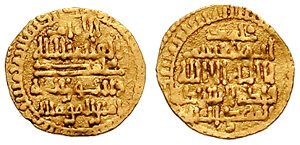
Al-Qa'im Bi-Amrillah
Al-Qa'im Bi-Amrillah was a second Fatimid caliph from 934 to 946. Born 893, in Salamiyah. Died 946, in Mahdia. Positions held include Fatimid Caliph (934–946) and Ismaili imam (934–946).
Facts
13 facts · 2 confirmed by two sources · 0 cited · 11 from one source
What’s different
- Born: we show 893 (Confirmed). Wikidata also lists February 893 and March 893
- Died: we show 946 (Confirmed). Wikidata also lists May 18, 946
Where this comes from
Papalocal keeps its own record. It started from these sources; what each one said is kept here as it was copied, so a change on their side never changes this page by itself. Tap one to read its version.
What Wikidata says · copied November 16, 2026 · revision 2553831590
- Described as
- second Fatimid caliph from 934 to 946
- Other names
- Muhammad al-Qa'im Bi-Amrillah
- Born
- 893 · 1 reference; February 893; March 893
- Died
- May 18, 946 · 1 reference; 946 · 1 reference
- Born in
- Salamiyah
- Died in
- Mahdia
- Citizen of
- Fatimid Caliphate
- Occupation
- politician; imam; caliph
- Positions held
- Fatimid Caliph (934–946); Ismaili imam (934–946)
- Children
- Al-Mansur Billah
- Father
- Abdullah al-Mahdi Billah
- Religion
- Islam
- Wikipedias with a page
- 31
Wikidata item Q293549 (wikidata.org/wiki/Q293549), public domain (CC0). Copied November 16, 2026.
What Wikipedia says · copied November 16, 2026 · revision 1385797955
Abū al-Qāsim Muḥammad ibn ʿAbd Allāh (Arabic: أبو القاسم محمد ابن عبد الله; March/April 893 – 17 May 946), better known by his regnal name al-Qāʾim (القائم) or al-Qāʾim bi-Amr Allāh (Arabic: القائم بأمر الله, lit. 'He who carries out God's orders'), was the twelfth Isma'ili Imam and second caliph of the Fatimid dynasty, ruling in Ifriqiya from 934 to 946, succeeding his father Abd Allah al-Mahdi Billah (r. 909–934).
Born in March or April 893 in the Syrian town of Salamiyah, where his father, under the guise of a wealthy merchant, was leading the clandestine Isma'ili missionary network. Al-Qa'im and his father had to flee Salamiyah in 903 to avoid Abbasid persecution under the impact of a pro-Isma'ili revolt in Syria. Aided by sympathizers, the small group found refuge in to Ramla in Palestine and Fustat in Egypt, before turning west and making for the remote oasis town of Sijilmasa in what is now Morocco. While there, the Isma'ili missionary (da'i) Abu Abdallah al-Shi'i, who had converted the Kutama Berbers, overthrew the Aghlabid dynasty ruling in Ifriqiya and established the Fatimid Caliphate on behalf of al-Mahdi. After al-Mahdi's accession, al-Qa'im was officially made the designated successor and played a significant role during his father's reign as a military commander. He suppressed a Kutama revolt that broke out after the murder of Abu Abdallah al-Shi'i, captured Barqa, and led two invasions of Egypt, in 914–915 and 919–921. The Fatimids were able to capture Alexandria and threaten the capital, Fustat, but ultimately failed due to strong Abbasid resistance, logistical challenges, and the indiscipline of their troops. In 927, al-Qa'im led a campaign to suppress the Zenata Berbers in what is now central Algeria. He secured Fatimid control of Tahert, received the submission of the Sanhaja Berbers, and founded the city of al-Muhammadiya (modern Msila) as a stronghold to control the region.
After al-Mahdi's death in March 934, al-Qa'im succeeded without opposition, and mostly kept his father's ministers in place. A Fatimid naval raid sacked Genoa in northern Italy in the same summer, but the Fatimid position in the central Mediterranean was challenged by an anti-Fatimid revolt broke out in Sicily in 937 that was not suppressed until 940. In the west, the defection of the Berber commander Musa ibn Abi'l-Afiya upended Fatimid control over Morocco, and al-Qa'im's generals campaigned in the area without achieving lasting success. Another attempt to invade Egypt was launched in 935, but it was quickly defeated by the new local strongman, Muhammad ibn Tughj al-Ikhshid. The main event of al-Qa'im's reign was the great revolt led by the Kharijite preacher Abu Yazid, who mobilized Berber tribes as well as Arab townsmen against Fatimid rule, made unpopular by its strict taxation, unpopular Isma'ili doctrine, and the exactions of the unruly Kutama soldiery. The rebellion began in February 944 and rapidly gained momentum, resulting in the surrender of Kairouan and the siege of the Fatimid capital, al-Mahdiya. Al-Qa'im died on 17 May 946 in al-Mahdiya, with the rebellion still ongoing. His son, Isma'il, succeeded him as al-Mansur Billah and eventually quelled the uprising.
- Born, in its opening lines
- April 893
- Died, in its opening lines
- May 17, 946
From the Wikipedia article “Al-Qa'im (Fatimid caliph)” (en.wikipedia.org/wiki/Al-Qa'im_(Fatimid_caliph)), by its contributors, under CC BY-SA 4.0 (creativecommons.org/licenses/by-sa/4.0/). Copied November 16, 2026; not changed.
Confirmed Two sources agree. Cited One source, and it names where it got it. One source One source, without a reference of its own. Sources disagree The sources disagree. We show the best-supported value and keep theirs below.
