
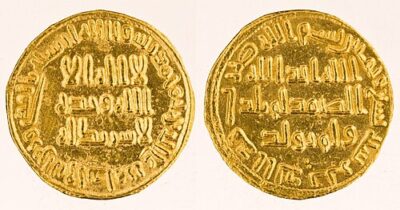
Al-Walid I
Al-Walid I was an Umayyad caliph. Born 668, in Medina. Died February 23, 715, in Ghouta. Positions held include Umayyad Caliph (705–715).
Facts
30 facts · 1 confirmed by two sources · 1 cited · 27 from one source · 1 where the sources disagree
What’s different
- Born: we show 668 (Sources disagree). Wikipedia says c. 674
Where this comes from
Papalocal keeps its own record. It started from these sources; what each one said is kept here as it was copied, so a change on their side never changes this page by itself. Tap one to read its version.
What Wikidata says · copied November 16, 2026 · revision 2567316897
- Described as
- Umayyad caliph
- Other names
- Al-Walid ibn Abd al-Malik
- Born
- 668
- Died
- February 23, 715
- Born in
- Medina
- Died in
- Ghouta
- Buried in
- Bab al-Saghir Cemetery
- Citizen of
- Umayyad Caliphate
- Occupation
- politician; governor; caliph · 1 reference
- Positions held
- Umayyad Caliph (705–715)
- Spouse
- Umm al-Banin bint Abdul Aziz
- Children
- Ibrahim ibn al-Walid; Al-Abbas ibn al-Walid; Yazid III; Abd al-Aziz ibn al-Walid; Masrur ibn al-Walid; Bishr ibn al-Walid; Umar ibn al-Walid
- Father
- Abd al-Malik ibn Marwan
- Mother
- Wallada bint al-Abbas ibn al-Jaz
- Siblings
- Hisham ibn Abd al-Malik; Sulayman ibn Abd al-Malik; Yazid II; Maslamah ibn Abd al-Malik; Muhammad ibn Abd al-Malik ibn Marwan; Sa'id ibn Abd al-Malik; Marwan ibn Abd al-Malik; Fatima bint Abd al-Malik; Bakkar ibn Abd al-Malik
- Religion
- Islam
- Wikipedias with a page
- 53
Wikidata item Q284003 (wikidata.org/wiki/Q284003), public domain (CC0). Copied November 16, 2026.
What Wikipedia says · copied November 16, 2026 · revision 1382328737
Al-Walid ibn Abd al-Malik ibn Marwan (c. 674 – 23 February 715), commonly known as al-Walid I, was the sixth Umayyad caliph, ruling from October 705 until his death in 715. He was the eldest son of his predecessor, Caliph Abd al-Malik (r. 685–705). As a prince, he led annual raids against the Byzantines from 695 to 698 and built or restored fortifications along the Syrian Desert route to Mecca. He became heir apparent in c. 705, after the death of the designated successor, Abd al-Malik's brother Abd al-Aziz ibn Marwan.
Under al-Walid, his father's efforts to centralize government, impose a more Arabic and Islamic character on the state, and expand its borders were continued. He heavily depended on al-Hajjaj ibn Yusuf, his father's powerful viceroy over the eastern half of the caliphate. During his reign, armies commissioned by al-Hajjaj conquered Sind and Transoxiana in the east, while the troops of Musa ibn Nusayr, the governor of Ifriqiya, conquered the Maghreb and Hispania in the west, bringing the caliphate to its largest territorial extent. War spoils from the conquests enabled al-Walid to finance impressive public works, including his greatest architectural achievement, the Great Mosque of Damascus, as well as the al-Aqsa Mosque in Jerusalem, the Prophet's Mosque in Medina, and the building of the historical city of Anjar. He was the first caliph to institute programs for social welfare, aiding the poor and handicapped among the Muslim Arabs of Syria, who held him in high esteem.
His reign was marked by domestic peace and prosperity and likely represented the peak of Umayyad power, though it is difficult to ascertain his direct role in its affairs. The balance al-Walid maintained among the elites, including the Qays and Yaman army factions, may have been his key personal achievement. On the other hand, the massive military expenditures of his rule, as well as his extravagant grants to the Umayyad princes, became a financial burden on his successors.
- Born, in its opening lines
- c. 674
- Died, in its opening lines
- February 23, 715
From the Wikipedia article “Al-Walid I” (en.wikipedia.org/wiki/Al-Walid_I), by its contributors, under CC BY-SA 4.0 (creativecommons.org/licenses/by-sa/4.0/). Copied November 16, 2026; not changed.
Confirmed Two sources agree. Cited One source, and it names where it got it. One source One source, without a reference of its own. Sources disagree The sources disagree. We show the best-supported value and keep theirs below.
