
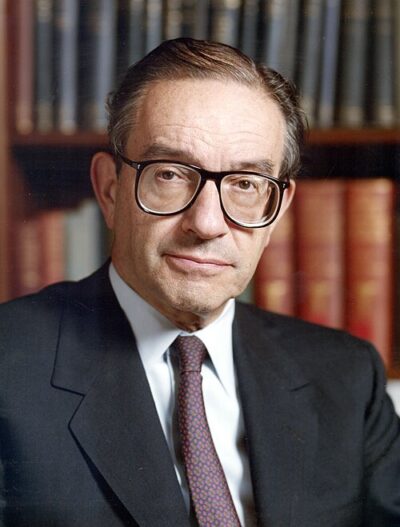
Alan Greenspan
Alan Greenspan was an American economist and financial advisor. Born March 6, 1926, in New York City. Died June 22, 2026, in Washington, D.C.. Positions held include Chair of the Federal Reserve (1987–2006) and Chair of the Council of Economic Advisers (1974–1977). Educated at Columbia University and Stern School of Business. Awards include Honorary Knight Commander of the Order of the British Empire, Presidential Medal of Freedom and Commander of the Legion of Honour.
Facts
41 facts · 2 confirmed by two sources · 19 cited · 20 from one source
Where this comes from
Papalocal keeps its own record. It started from these sources; what each one said is kept here as it was copied, so a change on their side never changes this page by itself. Tap one to read its version.
What Wikidata says · copied November 13, 2026 · revision 2568550326
- Described as
- American economist and financial advisor (1926–2026)
- Born
- March 6, 1926 · 7 references
- Died
- June 22, 2026 · 3 references
- Born in
- New York City · 3 references
- Died in
- Washington, D.C. · 3 references
- Cause of death
- Parkinson's disease
- Citizen of
- United States
- Occupation
- economist · 1 reference; banker · 1 reference; politician · 1 reference; entrepreneur; jazz musician; consultant · 1 reference; author; writer · 1 reference
- Positions held
- Chair of the Federal Reserve (1987–2006); Chair of the Council of Economic Advisers (1974–1977) · 1 reference
- Political party
- Republican Party
- Education
- Columbia University; Stern School of Business (–1977); Juilliard School · 1 reference; George Washington Educational Campus · 1 reference
- Member of
- American Philosophical Society · 1 reference; Group of Thirty; Objectivist movement · 1 reference
- Instrument
- clarinet
- Awards
- Honorary Knight Commander of the Order of the British Empire (2002) · 1 reference; Presidential Medal of Freedom (2005) · 1 reference; Commander of the Legion of Honour; Francis Boyer Award (1996) · 1 reference; Fellow of the American Statistical Association (1989) · 1 reference; Paul A. Volcker Lifetime Achievement Award for Economic Policy (2019) · 2 references; honorary doctor of the Hofstra University; honorary doctor of the Katholieke Universiteit Leuven; Financial Times Person of the Year (1998) · 1 reference
- Field
- economics; economics of banking · 1 reference; central banking · 1 reference; central bank · 1 reference
- Spouse
- Andrea Mitchell (1997–2026) · 1 reference; Joan Mitchell Blumenthal (1952–1953) · 1 reference
- Religion
- atheism
- Wikipedias with a page
- 67
Wikidata item Q193635 (wikidata.org/wiki/Q193635), public domain (CC0). Copied November 13, 2026.
What Wikipedia says · copied November 13, 2026 · revision 1384665292
Alan Greenspan (March 6, 1926 – June 22, 2026) was an American economist who served as the 13th chair of the Federal Reserve from 1987 to 2006. He worked as a private adviser and provided consulting for firms through his company, Greenspan Associates LLC.
First nominated to the Federal Reserve by President Ronald Reagan in August 1987, Greenspan was reappointed at successive four-year intervals until retiring in January 2006, after the second-longest tenure in the position, behind only William McChesney Martin. President George W. Bush appointed Ben Bernanke as his successor. Greenspan came to the Federal Reserve Board from a consulting career. Although he was subdued in his public appearances, favorable media coverage raised his profile to a point that several observers likened him to a "rock star". Democratic leaders of Congress criticized him for politicizing his office because of his support for social security privatization and tax cuts.
Many have argued that the "easy-money" policies of the Fed during Greenspan's tenure, including the practice known as the "Greenspan put", were a leading cause of the dot-com bubble and subprime mortgage crisis (the latter occurring within a year of his leaving the Fed), which, said The Wall Street Journal, "tarnished his reputation". Yale economist Robert Shiller argues that "once stocks fell, real estate became the primary outlet for the speculative frenzy that the stock market had unleashed". Greenspan argued that the housing bubble was not a result of low-interest short-term rates but rather a worldwide phenomenon caused by the progressive decline in long-term interest rates – a direct consequence of the relationship between high savings rates in the developing world and its inverse in the developed world.
- Born, in its opening lines
- March 6, 1926
- Died, in its opening lines
- June 22, 2026
From the Wikipedia article “Alan Greenspan” (en.wikipedia.org/wiki/Alan_Greenspan), by its contributors, under CC BY-SA 4.0 (creativecommons.org/licenses/by-sa/4.0/). Copied November 13, 2026; not changed.
Confirmed Two sources agree. Cited One source, and it names where it got it. One source One source, without a reference of its own. Sources disagree The sources disagree. We show the best-supported value and keep theirs below.
