
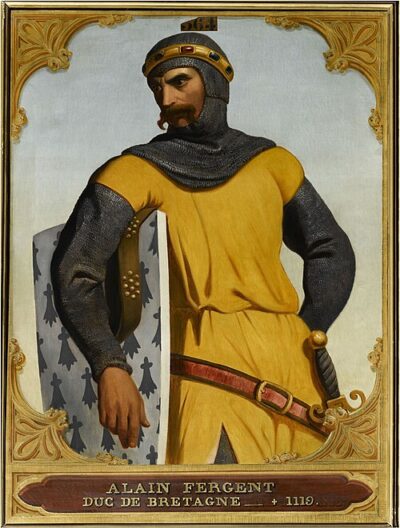
Alan IV
Alan IV was a Duke of Brittany. Born 1060, in Châteaulin. Died October 13, 1119, in Redon.
Facts
15 facts · 1 confirmed by two sources · 2 cited · 11 from one source · 1 where the sources disagree
What’s different
- Born: we show 1060 (Sources disagree). Wikipedia says c. 1063
Where this comes from
Papalocal keeps its own record. It started from these sources; what each one said is kept here as it was copied, so a change on their side never changes this page by itself. Tap one to read its version.
What Wikidata says · copied November 17, 2026 · revision 2553926368
- Described as
- Duke of Brittany (1060-1119)
- Other names
- Alain IV de Bretagne
- Born
- 1060
- Died
- October 13, 1119 · 1 reference
- Born in
- Châteaulin
- Died in
- Redon
- Buried in
- Redon Abbey
- Spouse
- Constance of Normandy (1086–) · 1 reference; Ermengarde of Anjou (1093–1112) · 1 reference
- Children
- Conan III, Duke of Brittany; Hawise of Brittany · 1 reference; Brian Fitz Count; Geoffroy de Bretagne · 1 reference
- Father
- Hoel II, Duke of Brittany
- Mother
- Hawise, Duchess of Brittany
- Siblings
- Mathias II de Bretagne
- Religion
- Christianity
- Wikipedias with a page
- 25
Wikidata item Q453613 (wikidata.org/wiki/Q453613), public domain (CC0). Copied November 17, 2026.
What Wikipedia says · copied November 17, 2026 · revision 1383780258
Alan IV (c. 1063 – 13 October 1119) was Duke of Brittany from 1072 until his abdication in 1112. He was also Count of Nantes (from c. 1103) and Count of Rennes. His parents were Duchess Hawise and Duke Hoel II. He is also known as Alan Fergant. Through his father, he was of the Breton House of Cornouaille dynasty (Breton: Kerne dynasty). He was the last Breton-speaking Duke of Brittany.
- Born, in its opening lines
- c. 1063
- Died, in its opening lines
- October 13, 1119
From the Wikipedia article “Alan IV of Brittany” (en.wikipedia.org/wiki/Alan_IV_of_Brittany), by its contributors, under CC BY-SA 4.0 (creativecommons.org/licenses/by-sa/4.0/). Copied November 17, 2026; not changed.
Confirmed Two sources agree. Cited One source, and it names where it got it. One source One source, without a reference of its own. Sources disagree The sources disagree. We show the best-supported value and keep theirs below.
