
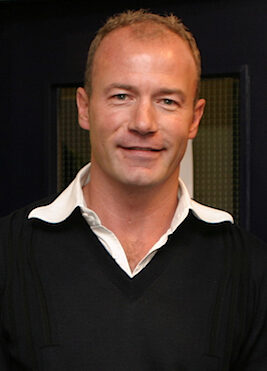
Alan Shearer
Alan Shearer is an English footballer. Born August 13, 1970, in Newcastle upon Tyne. Teams include Blackburn Rovers F.C. (1992–1996), Newcastle United F.C. (1996–2006) and Southampton F.C. (1988–1992). Educated at Gosforth Academy. Awards include Officer of the Order of the British Empire, Commander of the Order of the British Empire and Premier League Hall of Fame.
Facts
18 facts · 1 confirmed by two sources · 2 cited · 15 from one source
Where this comes from
Papalocal keeps its own record. It started from these sources; what each one said is kept here as it was copied, so a change on their side never changes this page by itself. Tap one to read its version.
What Wikidata says · copied November 16, 2026 · revision 2557621553
- Described as
- English footballer
- Other names
- Shearer
- Born
- August 13, 1970 · 5 references
- Born in
- Newcastle upon Tyne
- Citizen of
- United Kingdom
- Occupation
- association football player; association football coach · 1 reference; sports commentator
- Education
- Gosforth Academy
- Teams
- Blackburn Rovers F.C. (1992–1996); Newcastle United F.C. (1996–2006); Southampton F.C. (1988–1992); England national under-21 association football team (1990–1992); England national association football B team (1992); England men's national association football team (1992–2000)
- Sport
- association football
- Awards
- Officer of the Order of the British Empire (2001); Commander of the Order of the British Empire (2016); Premier League Hall of Fame (2021) · 1 reference
- Height
- 1.83 m (6 ft 0 in)
- Wikipedias with a page
- 75
Wikidata item Q483583 (wikidata.org/wiki/Q483583), public domain (CC0). Copied November 16, 2026.
What Wikipedia says · copied November 16, 2026 · revision 1383919469
Alan Shearer (born 13 August 1970) is an English football pundit and former professional player who played as a striker. With 260 goals, Shearer is the Premier League's all-time record goalscorer. He was named Football Writers' Association Player of the Year in 1994 and won the PFA Player of the Year award in 1995. In 1996, he came third in both Ballon d'Or and FIFA World Player of the Year awards. In 2004, he was named by Pelé in the FIFA 100 list of the world's greatest living players. Shearer was one of the first two players inducted into the Premier League Hall of Fame in 2021.
Shearer played his entire career in the top level of English football. He started his career at Southampton in 1988 before moving in 1992 to Blackburn Rovers, where he established himself as among the most prolific goalscorers in Europe and won the 1994–95 Premier League. In the summer of 1996, he joined his hometown club Newcastle United for a then world record £15 million, and in his first season won his third consecutive Premier League Golden Boot. He played in the 1998 FA Cup and 1999 FA Cup finals, captaining the team in the latter, and eventually became the club's all-time top scorer. He retired at the end of the 2005–06 season.
For the England national team, Shearer appeared 63 times and scored 30 goals. UEFA Euro 1996 was his biggest success at international football; England reached the semi-finals and Shearer was awarded the UEFA Euro Golden Boot and was named in the UEFA Euro Team of the Tournament. He went on to captain England at 1998 FIFA World Cup and UEFA Euro 2000, then retired from international football.
Since retiring as a player in 2006, Shearer has worked as a television pundit for the BBC. He is one of the hosts of the podcast The Rest Is Football. In 2009, he briefly left his BBC role to become Newcastle United's manager in the last eight games of their 2008–09 season, in an unsuccessful attempt to save them from relegation. Shearer is a Commander of the Order of the British Empire (CBE), a Deputy Lieutenant of Northumberland, a Freeman of Newcastle upon Tyne and an honorary Doctor of Civil Law of Northumbria and Newcastle Universities.
- Born, in its opening lines
- August 13, 1970
From the Wikipedia article “Alan Shearer” (en.wikipedia.org/wiki/Alan_Shearer), by its contributors, under CC BY-SA 4.0 (creativecommons.org/licenses/by-sa/4.0/). Copied November 16, 2026; not changed.
Confirmed Two sources agree. Cited One source, and it names where it got it. One source One source, without a reference of its own. Sources disagree The sources disagree. We show the best-supported value and keep theirs below.
