
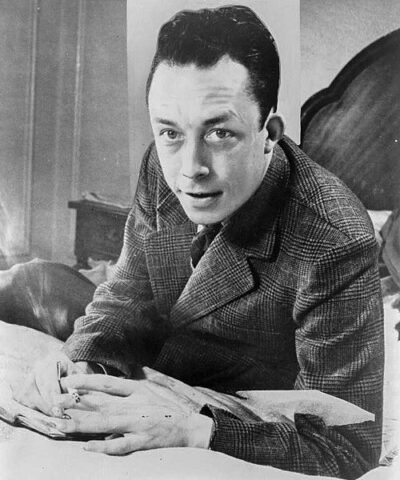
Albert Camus
Albert Camus was a French philosopher, author, and journalist. Born November 7, 1913, in Dréan. Died January 4, 1960, in Villeblevin. Known for L'homme révolté, A Happy Death and The Fall. Educated at University of Algiers 1. Awards include Nobel Prize in Literature.
Facts
47 facts · 2 confirmed by two sources · 24 cited · 21 from one source
Where this comes from
Papalocal keeps its own record. It started from these sources; what each one said is kept here as it was copied, so a change on their side never changes this page by itself. Tap one to read its version.
What Wikidata says · copied November 16, 2026 · revision 2568385951
- Described as
- French philosopher, author, and journalist (1913–1960)
- Other names
- Camus
- Born
- November 7, 1913 · 14 references
- Died
- January 4, 1960 · 20 references
- Born in
- Dréan · 2 references
- Died in
- Villeblevin · 4 references
- Buried in
- Cemetery in Lourmarin
- Cause of death
- single-vehicle accident · 1 reference
- Citizen of
- France · 3 references
- Occupation
- writer · 6 references; philosopher · 5 references; novelist · 2 references; journalist · 4 references; essayist; playwright · 3 references; French resistance fighter · 1 reference; poet · 1 reference
- Worked for
- L'Express (1955–1956); Alger républicain (1938–1939); Combat (1943–1947); Paris-Soir (1940–1941); Le Soir républicain (1939–1940)
- Education
- University of Algiers 1 (1935–1936) · 1 reference
- Member of
- American Academy of Arts and Sciences; comité de lecture des éditions Gallimard (1943–1959)
- Sport
- association football
- Known for
- L'homme révolté · 1 reference; A Happy Death; The Fall; The Myth of Sisyphus; The Stranger · 1 reference; The Plague · 1 reference; Albert Camus, María Casares. Correspondence (1944-1959); Caligula · 1 reference; Neither Victims Nor Executioners
- Awards
- Nobel Prize in Literature (1957) · 2 references
- Field
- philosophy · 1 reference; literature · 1 reference; journalism · 1 reference; ethics · 1 reference; existence · 1 reference; political philosophy · 1 reference
- Spouse
- Simone Hié (1934–1940) · 3 references; Francine Faure (1940–1960) · 3 references
- Children
- Catherine Camus · 1 reference; Jean Camus · 1 reference
- Father
- Lucien Auguste Camus
- Religion
- atheism
- Lived in
- France · 1 reference
- Wikipedias with a page
- 205
Wikidata item Q34670 (wikidata.org/wiki/Q34670), public domain (CC0). Copied November 16, 2026.
What Wikipedia says · copied November 16, 2026 · revision 1384113961
Albert Camus ( kam-OO; French: [albɛʁ kamy] ; 7 November 1913 – 4 January 1960) was a French philosopher, writer, and political activist. He was the recipient of the 1957 Nobel Prize in Literature at the age of 44, the second-youngest recipient in history, and the first laureate in literature born in Africa. His works include The Stranger, The Plague, The Myth of Sisyphus, The Fall and The Rebel.
Camus was born in French Algeria to pied-noir parents. He spent his childhood in a poor neighbourhood and later studied philosophy at the University of Algiers. He was in Paris when the Germans invaded France during World War II in 1940. Camus tried to flee but finally joined the French Resistance where he served as editor-in-chief at Combat, an outlawed newspaper. After the war, he was a celebrity figure and gave many lectures around the world.
He married twice but had many extramarital affairs. Camus was politically active; he was part of the left that opposed Joseph Stalin and the Soviet Union because of their totalitarianism. Camus was a moralist and leaned towards anarcho-syndicalism. He was part of many organisations seeking European integration. During the Algerian War (1954–1962), he kept a neutral stance, advocating a multicultural and pluralistic Algeria, a position that was rejected by most parties.
Philosophically, Camus's views contributed to the rise of the philosophy known as absurdism. Some consider Camus's work to show him to be an existentialist, even though he himself firmly rejected the term throughout his lifetime.
- Born, in its opening lines
- November 7, 1913
- Died, in its opening lines
- January 4, 1960
From the Wikipedia article “Albert Camus” (en.wikipedia.org/wiki/Albert_Camus), by its contributors, under CC BY-SA 4.0 (creativecommons.org/licenses/by-sa/4.0/). Copied November 16, 2026; not changed.
Confirmed Two sources agree. Cited One source, and it names where it got it. One source One source, without a reference of its own. Sources disagree The sources disagree. We show the best-supported value and keep theirs below.
