
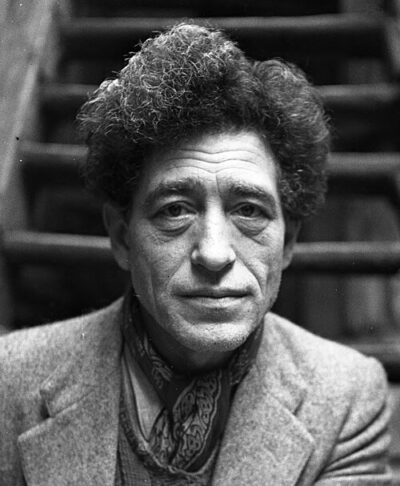
Alberto Giacometti
Alberto Giacometti was a Swiss sculptor and painter. Born October 10, 1901, in Borgonovo. Died January 11, 1966, in Chur. Known for Grande Femme II, Grande tête mince and L'Homme qui marche I. Educated at Académie de la Grande Chaumière.
Facts
35 facts · 2 confirmed by two sources · 22 cited · 11 from one source
Where this comes from
Papalocal keeps its own record. It started from these sources; what each one said is kept here as it was copied, so a change on their side never changes this page by itself. Tap one to read its version.
What Wikidata says · copied November 16, 2026 · revision 2568458158
- Described as
- Swiss sculptor and painter (1901–1966)
- Born
- October 10, 1901 · 22 references
- Died
- January 11, 1966 · 13 references
- Born in
- Borgonovo · 3 references
- Died in
- Chur · 6 references
- Buried in
- Borgonovo
- Cause of death
- chronic obstructive pulmonary disease
- Citizen of
- Switzerland · 3 references; France · 1 reference
- Occupation
- sculptor · 2 references; painter · 1 reference; writer · 1 reference; jewelry designer · 2 references; lithographer · 1 reference; draftsperson · 2 references; illustrator · 1 reference; designer · 1 reference
- Education
- Académie de la Grande Chaumière
- Genre
- abstract art · 2 references; figure · 1 reference; animal painting · 1 reference; genre painting · 1 reference; landscape painting · 1 reference; portrait · 1 reference
- Known for
- Grande Femme II; Grande tête mince; L'Homme qui marche I; The Nose
- Field
- art of sculpture · 1 reference
- Spouse
- Annette Giacometti (1949–)
- Father
- Giovanni Giacometti · 1 reference
- Mother
- Annetta Giacometti
- Siblings
- Diego Giacometti · 1 reference; Bruno Giacometti · 1 reference; Ottilia Giacometti
- Religion
- reformed · 1 reference
- Wikipedias with a page
- 61
Wikidata item Q157194 (wikidata.org/wiki/Q157194), public domain (CC0). Copied November 16, 2026.
What Wikipedia says · copied November 16, 2026 · revision 1374895416
Alberto Giacometti (, US also , Italian: [alˈbɛrto dʒakoˈmetti]; 10 October 1901 – 11 January 1966) was a Swiss sculptor, painter, draftsman and printmaker, who was one of the most important sculptors of the 20th century. His work was particularly influenced by artistic styles such as Cubism and Surrealism. Philosophical questions about the human condition, as well as existential and phenomenological debates played a significant role in his work.
Beginning in 1922, he lived and worked mainly in Paris but regularly visited his hometown Borgonovo to see his family and work on his art. Around 1935, he gave up on his surrealist influences to pursue a more in-depth analysis of figurative compositions.
Giacometti wrote texts for periodicals and exhibition catalogues and recorded his thoughts and memories in notebooks and diaries. His critical nature led to self-doubt about his own work and his self-perceived inability to do justice to his own artistic vision. His insecurities nevertheless remained a powerful motivating artistic force throughout his entire life.
Between 1938 and 1944, Giacometti's sculptures had a maximum height of seven centimetres (2.75 inches). Their small size reflected the actual distance between the artist's position and his model. In this context, he self-critically stated: "But wanting to create from memory what I had seen, to my terror the sculptures became smaller and smaller".
After World War II, Giacometti created his most famous sculptures: his extremely tall and slender figurines. These sculptures were subject to his individual viewing experience—between an imaginary yet real, a tangible yet inaccessible space.
In Giacometti's whole body of work, his painting constitutes only a small part. After 1957, however, his figurative paintings were equally as present as his sculptures. The almost monochrome paintings of his late work do not refer to any other artistic styles of modernity.
- Born, in its opening lines
- October 10, 1901
- Died, in its opening lines
- January 11, 1966
From the Wikipedia article “Alberto Giacometti” (en.wikipedia.org/wiki/Alberto_Giacometti), by its contributors, under CC BY-SA 4.0 (creativecommons.org/licenses/by-sa/4.0/). Copied November 16, 2026; not changed.
Confirmed Two sources agree. Cited One source, and it names where it got it. One source One source, without a reference of its own. Sources disagree The sources disagree. We show the best-supported value and keep theirs below.
